Tuesday, September 21, 2010

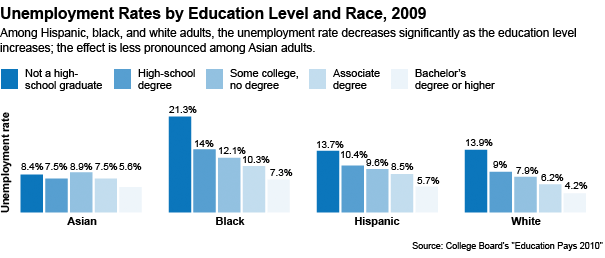
The Unemployment Rate For Asian High School Dropouts Is 40 To 60 Percent Lower Than Other Racial Groups


The above chart is from the College Board via The Chronicle of Higher Education.

Notice how much lower the unemployment rate for Asian high school dropouts is than for any other racial group. For Asians, the unemployment rate in 2009 for high school dropouts is 8.4%. For the other racial groups, the high school dropout unemployment rate ranges from 13.7% to 21.3%.

In addition to promoting increased education levels of US workers, a study should be undertaken to see what can be learned from Asians' low unemployment rate for high school dropouts, and whether there is useful information that can be applied to the other racial groups to lower their high school dropout unemployment rate.

Maybe some of the employment benefits obtained from education can be applied to high school dropouts without increasing their education levels.

Recession Over But Employment Depression Continues

There is a maxim that when your neighbors lose their jobs, it is a recession. When you lose your job, it is a depression.

Despite NBER's declaration that the recession ended June 2009, the job market has not recovered. Unemployment still hovers around the 9.5 percent mark and the number of employed is still millions below the peak of the pre-recession levels with millions of long-term unemployed.

US Illegal Immigrants Are 4% Of US Population But Have 8% of Newborns

From Pew Research, "8% - U.S.-Born Children of Unauthorized Immigrants:"


...while a little more than 4% of the U.S. adult population is composed of unauthorized immigrants, their children make up 8% of newborn population. Additionally, 7% of the overall child population (those younger than age 18) in the U.S. are the children of unauthorized immigrants.
The entire article, "Unauthorized Immigrants and Their U.S.-Born Children" by Jeffrey S. Passel, Senior Demographer, and Paul Taylor, Director, Pew Hispanic Center is available here.

Misunderstood Finance Ranked Top 50th Economics Blog By PostRank

This blog, Misunderstood Finance, is ranked in the top 50 in economics blogs by PostRank.

Sinai Calls For US Capital Gains Tax Cut To Boost Economy

From The Wall Street Journal opinion piece, "Cap Gains Taxation: Less Means More: A new study suggests a zero cap gains rate could create millions of jobs at a fraction of the cost of the spending stimulus" by Allen Sinai:
Capital gains taxation is one area in which lawmakers can help jump-start the economy. Capital gains tax rates for taxpayers in the top four income brackets are set to move higher in a few months. My [Allen Sinai] new study, "Capital Gains Taxes and the Economy," published this week by the American Council for Capital Formation, shows that the net effect of lower capital gains taxation is a significant plus for U.S. macroeconomic performance.
Allen Sinai is chief global economist, strategist and president of Decision Economics Inc.

Wall Street Journal online subscribers can read Sinai's complete opinion piece here.

Monday, September 20, 2010

Much Of Income Inequality Disappears With Adjustments For Different Inflation Rates For Upper And Lower Income Groups

A research paper, "The Welfare Implications of Rising Price Dispersion" by Christian Broda, University of Chicago, GSB and John Romalis, University of Chicago, GSB, finds that US income inequality measures are distorted by different inflation rates for upper and lower income groups. Upper income groups face higher inflation rates and therefore when accurate adjustments are made to real dollars, a substantial part, if not all, of income inequality between the upper and lower income groups disappears.
From the Broda and Romalis' paper:
Using scanner data on household consumption of non-durable goods between 1994 and 2005, we document that the relative prices of low-quality products that are consumed disproportionately by low-income households were falling over this period. This implies that non-durable inflation for the 10th percentile of the income distribution has only been 4.3 percent between 1994 and 2005 (0.4 percent per annum), while the non-durable inflation for the 90th percentile has been 11.9 percent (1.0 percent annually), and 13.4 percent (1.2 percent annually) for the richest 5 percent of households in the sample. Over the period 1994 – 2005, the conventionally measured ratio between real household income at the 90th and 10th percentile rose by 5.7 percent (0.5 percent per annum) and the 95th/10th ratio rose by 7.5 percent (0.7 percent per annum). This suggests that the inflation differential in non-durable goods (around 30 percent of total consumption) is enough to offset almost 40 percent of the rise in both of these inequality ratios over this period. In the case of other common inequality measures, the 80/20th and 95/20th income ratios, the non-durable inflation differential is enough to offset over 80 percent and 50 percent, respectively, of the rise in these indicators. Moreover, we provide evidence that suggests that the increase in price dispersion is not limited to the products in our sample nor to our time period. If differences in income-group specific inflation rates in our sample are representative of the broader economy, then real income growth in the US has been much more substantial and equal than suggested by standard measures. In that case, “real” inequality may have actually fallen between 1994 and 2005.
Read the entire research paper here.

Is The Answer To Global Warming The Growing And Storage Of Green Plant Matter?

From "Could the garbage heap help save us from global warming?" by Hugh Price, Washington Post, September 18, 2010:
With an overabundance of carbon dioxide in the atmosphere, it is reasonable to ask, "Where are the plants?" Why hasn't the Earth's vegetation grown larger and faster to absorb the additional CO2? The answer is that it probably has. Some of the 20th century's improvement in crop yields may be due to higher concentrations of CO2 in the atmosphere. Nevertheless, eventually those plants die or are eaten, returning their carbon to the atmosphere. To remove CO2 from the atmosphere, the plant material has to be prevented from decomposing.
***
In 2009, the combined U.S. production of corn, wheat and soybeans was 487 million metric tons. That production measures the usable part of the plants. It is reasonable to believe that there is at least as much material in unused stalks and leaves. If just this material were stored rather than burned or plowed under, it could compensate for almost a quarter of the U.S. carbon footprint. The Mountaineer Power Plant could match the captured carbon of its high-tech approach by piling up the plant waste from 12,000 acres of farmland, at a tiny fraction of the cost.
***
The biggest problem with this approach may be that it's so low-tech. No green-technology subsidies are required, so there may not be a natural constituency for it. On the other hand, environmentalists should love it. What could be greener than growing plants? And for those concerned about the economy, this approach provides a low-cost method of reducing the country's carbon footprint without increasing the cost of energy. It is also reversible. If current concerns about CO2 concentrations turn out to be unwarranted, the stockpiled material will be readily available for use. What could be simpler?
Read the complete Washington Post article here.

Saturday, September 18, 2010

Traffic Lights That Act Locally Improve Traffic Globally

Traffic lights that act locally can improve traffic globally, new research suggests. By minimizing congestion, the approach could save money, reduce emissions and perhaps even quash the road rage of frustrated drivers.

The new approach makes traffic lights go with the flow, rather than enslaving drivers to the tyranny of timed signals. By measuring vehicle inflow and outflow through each intersection as it occurs and coordinating lights with only their nearest neighbors, a systemwide smoothness emerges, scientists report in a September Santa Fe Institute working paper.
From ScienceNews "To tame traffic, go with the flow: Lights should respond to cars, a study concludes, not the other way around" by Rachel Ehrenberg, Web edition, Friday, September 17th, 2010.

Friday, September 17, 2010

Reduce Poverty: Remove Work Disincentives From Government Entitlement And Transfer Programs

A response I wrote to a Wall Street Journal opinion, "Wealth and Poverty: How's that inequality thing working out?" published on September 17, 2010:
The article actually explains a lot about why inequality and poverty exists in the US in mentioning that the Census data overstates poverty because it excludes noncash government payments like housing subsidies, food stamps, the earned income tax credit or entitlements like Medicaid.

The strategy of the US response to poverty, at least since the end of WWII, is to transfer payments to the poor and needy through subsidies and entitlements. Transfer payments and entitlement programs do not promote the principles for success in the US.

Success in the US requires hard work, education, motivation, skills and good work habits. Transfer payments promote dependency, reduce motivation and interfere with skill development. Transfer and entitlement payments have income eligibility cutoffs, which act as a large marginal tax increase and motivate people to avoid generating income to lose the government income. All government entitlement and transfer programs have some eligibility requirement or unintended consequence that works against successful achievement. It can be the previous single parent requirement for government benefits for a child, which broke up families and removed fathers from homes, or income eligibility requirements for lunch programs and food stamps, which forces families close to the cutoff income level to choose between earning more money and feeding their children nutritionally.

Similarly, the minimum wage laws prevent many unskilled workers below the poverty level from developing good work habits and needed job skills because they remain unemployed. It is too costly for employers to hire and train these unskilled workers at minimum wage levels. At the same time, all across the US, middle and upper income kids can learn valuable job skills as interns without pay because it is educational, but training an unskilled employee requires minimum wage.

The best way to reduce poverty in the US is to review and eliminate all the disincentives to full time work skill development our transfer and entitlement programs have in them. Some programs need to be eliminated and others need to be modified. For example, unemployment insurance acts both as a needed safety net in time of unemployment and as a disincentive to finding work while there are remaining benefits. Modify the unemployment program to act as an incentive to find work by allowing the benefits to be continued (at a reduced level) after one finds a new job so one is better off working with unemployment benefits than either not working or working without benefits.

Some of our poverty and lack of workforce skill training (which increases poverty) is the result of the unintended disincentives in place in many transfer and entitlement programs.

Many of the governments new programs to help families during this recession, such as the recent housing foreclosure prevention programs, contain requirements that act as disincentives to working or making more money above eligibility levels.

Remove from all transfer and entitlement the disincentives for work and skill training and the economy will grow, poverty will decline and household income will increase.
Read the complete Wall Street Journal opinion piece here.
If the full Wall Street Journal opinion is unavailable at the previous links, try this link. It may help.

Supersymmetric Particle Price Higher Than Higgs Boson On Intrade

The current price on Intrade for the observation of supersymmetry particle before December 31, 2013 is now higher than the Intrade price for the observation of a Higgs Boson particle.

The supersymmetric particle observation price is 21.2. The Higgs Boson particle observation price is 15.

Someone obviously believes there is a 41 percent greater chance of finding a supersymmetry particle before December 31, 2013 than there is in finding a Higgs Boson.

Fed Economists Refute Lewis' Book: The Big Short

Paul Willen, research economist and policy adviser at the Boston Fed, with Boston Fed economist Christopher Foote and Atlanta Fed economist Kris Gerardi, refute the claims made in the best selling book, "The Big Short" by Michael Lewis:
In this post, we focus on the logic of the "sure thing" claim, which is that the subprime bears were exploiting the ignorance of the subprime bulls. The idea that subprime bulls were ignorant is central to the thesis of the book, because it explains both why investors made such huge errors and why it was possible for the subprime bears to exploit, with little risk, the collapse of the mortgage market.

Lewis argues that the ignorance of the subprime bulls resulted from a combination of laziness and obfuscation by issuers of the securities they were buying. We argue, however, that the evidence, including some in the book itself, shows this claim to be patently incorrect. Issuers provided staggering amounts of information about mortgage securities and there was a whole industry of analysts on Wall Street who pored over that data and published literally thousands of reports.
Read "A closer look at Michael Lewis's 'The Big Short' ", the complete Federal Reserve Bank of Atlanta article here.

CBO Elmendorf: Presentation to Macroeconomic Advisers: Fiscal Policy Choices in Uncertain Times

From CBO Director Doug Elmendorf's presentation to Macroeconomic Advisers, "Fiscal Policy Choices in Uncertain Times" on September 16, 2010:
  • The economic recovery will probably proceed at a modest pace—leaving total output well below its sustainable level, and the unemployment rate well above its sustainable level, for a number of years.

  • In CBO’s judgment, the available monetary and fiscal tools, if applied at sufficient scale, would improve economic conditions during the next few years—though with costs and risks in the medium and long term. Policymakers need to address those trade-offs.

  • To avoid worsening the medium-term and long-term imbalance between federal spending and revenue, any policies that widened budget deficits in the near term would need to be accompanied by specific polices to reduce spending or increase revenue over time.
Read the CBO director's complete presentation here or below.
Elmendorf Fiscal Policy Choices in Uncertain Times

Elmendorf Fiscal Policy Choices in Uncertain Times


Thursday, September 16, 2010

Lifestyle Comment To TIME Post On Increasing Poverty

A comment I posted on the Curious Capitalist blog on Time.com, "Why Are a Record Number of Americans Living in Poverty?" by Stephen Gandel:
Income inequality has nothing to do with the point of your article about the increase in poverty. According to same GINI census data, http://www.census.gov/newsroom/releases/pdf/09-16-10_slides.pdf,
(see pdf page 15, or document page 13), the 1967 GINI was also .37. So over 43 years, inequality as measured by GINI increased by 22 percent, as poverty has generally declined in the US.

Until this recent recession, poverty in the US has been declining. As you correctly point out, the extended amount of unemployment and the lack of jobs are causing the increase in poverty.

The increase in the GINI index since the early 1980s is directly related to the changing nature of the household and the decrease in the average number of people per household.

The census GINI numbers are measured per household. With the increase in divorce, out of wedlock births by adults and the resulting increase in single parent households, naturally household GINI inequality measures will increase. A substantial part of the increase in household GINI is a cultural phenomenon having nothing to do with the increasing income of the upper ten percent.

The increase in single wage earner households, and single working mothers due to divorce and out of wedlock births has led to an increase in GINI and stagnation in household and per capita income.

It easy for the press to blame and insinuate that the increase in income inequality is due to the increasing income and income share of the wealthier US households. If there were fewer single parent households and fewer divorces, the income of the middle and lower tier of households would also have increased and GINI would have decreased.

Divorced women and single parent mothers are most likely poor as are their children. It has always been the case, and there increasing numbers, increases childhood poverty rates and the overall poverty rates. The poverty rate for a female householder without a husband present is close to 40 percent, according to the US Census Bureau.

Our lifestyle explains more about our overall poverty rates then does any GINI index that measures income inequality between the upper 10 percent and the lower 10 percent.

Almost Half The US Receives Entitlement Benefits

From The Wall Street Journal article, "Obstacle to Deficit Cutting: A Nation on Entitlements" by Sara Murray:
As recently as the early 1980s, about 30% of Americans lived in households in which an individual was receiving Social Security, subsidized housing, jobless benefits or other government-provided benefits. By the third quarter of 2008, 44% were, according to the most recent Census Bureau data.


That number has undoubtedly gone up, as the recession has hammered incomes. Some 41.3 million people were on food stamps as of June 2010, for instance, up 45% from June 2008. With unemployment high and federal jobless benefits now available for up to 99 weeks, 9.7 million unemployed workers were receiving checks in late August 2010, more than twice as many as the 4.2 million in August 2008.
Still more Americans—19 million by 2019, according to the Congressional Budget Office—will get federal aid to buy health insurance when legislation passed this year is implemented.

Wednesday, September 15, 2010

History Shows Cutting Spending And Taxes Spurs Economic Growth

From The Wall Street Journal article, "Tax Cuts vs. 'Stimulus': The Evidence Is In: A review of over 200 fiscal adjustments in 21 countries shows that spending discipline and tax cuts are the best ways to spur economic growth." by Harvard Economics Professor Alberto Alesina:
Politicians argue for increased stimulus spending, as opposed to spending cuts, on the grounds that it would speed up economic recovery. This argument might have it exactly backward. Indeed, history shows that cutting spending in order to reduce deficits may be the key to promoting economic recovery.
***
Economic history shows that even large adjustments in fiscal policy, if based on well-targeted spending cuts, have often led to expansions, not recessions. Fiscal adjustments based on higher taxes, on the other hand, have generally been recessionary.
***
The evidence from the last 40 years suggests that spending increases meant to stimulate the economy and tax increases meant to reduce deficits are unlikely to achieve their goals. The opposite combination might.
Read the complete article here. If the entire article is not available, try this link.

Tuesday, September 14, 2010

Friday, September 10, 2010

Goolsbee, Supply-Side, Income And Wealth Effects

A comment I posted on Rortybomb, "Goolsbee on Supply-Side and Subprime" by Mike Konczal:
The rise in executive and high-income compensation mentioned in 2 and 3 is in large part due to the sharp rise in the stock market as pay shifted from salary to stock incentives and stock options, starting around 1980 as more income was generated from stock investments than salaries. An effect of a tax law change itself.

To make statements about effects of marginal tax cuts on high-income earners, studies have to separate the effects of taxes on stock compensation (options, etc.) and wages.

They studies do not. For example, the timing switch mentioned in three is in part a decision about when to recognize the wealth gain in stock option compensation. The proper question is not when an executive converts the investment and pays taxes on it. Of course, a rational executive will pick a lower tax year. The studies fail to recognize that the wealth, the appreciation in the stock price, has already occurred and exists independent of its conversion into a taxable event.

The more relevant questions is to what extent did tax policy aid or hinder that stock’s appreciation and do corporations adjust their incentive compensation policies to offset expected tax effects. If corporations adjust future realized compensation for expected tax changes, then of course, corporate income also changes in an opposite direction to gross income to keep after tax income level.

Over the period from Kennedy to Bush, the tax laws increased relating to exceeding a maximum executive compensation level. The consequence was that the amount of executive compensation paid as stock options, etc. increased tremendously.

To make a positive, negative or neutral statement about marginal tax rates on high-income taxpayers, the studies have to distinguish tax effects on wages versus wealth creation (which can occur without recognized taxable income) versus stock market effects.

High wealth and high-income effects are not synonymous and different taxes have different effects on these two components.

There is still a lot of research needed to answer the questions about the effect of marginal tax rates. Yes, a lower marginal tax rate speeds up income recognition. The more relevant, important and difficult question is did the decrease in marginal tax rates contribute to the increased wealth that was recognized in the earlier period?

A paper than definitively answered positively or negatively the supply side effect of marginal tax cuts would have to look both at income and wealth increases (decreases) due to marginal tax cuts.

Looking at either wealth or income creation separately cannot answer the question about marginal tax effects. Both components need to be considered at the same time.

Manufacturers That Ship Further Domestic Distances Export More

From the research paper, "EXPORTS, BORDERS, DISTANCE, AND PLANT SIZE" by Thomas J. Holmes, University of Minnesota, Federal Reserve Bank of Minneapolis, and NBER and John J. Stevens, Board of Governors of the Federal Reserve System:
The fact that large manufacturing plants export relatively more than small plants has been at the foundation of much work in the international trade literature. We examine this fact using Census micro data on plant shipments from the Commodity Flow Survey. We show the fact is not entirely an international trade phenomenon; part of it can be accounted for by the effect of distance, distinct from any border effect. Export destinations tend to be further than domestic destinations, and large plants tend to ship further distances even to domestic locations, as compared with small plants. We develop an extension of the Melitz (2003) model and use it to set up an analysis with model interpretations of ratios between large plant and small plant shipments that can be calculated with the data. We obtain a decomposition of the overall ratio into a term that varies with distance, holding fixed the border, and a term that varies with the border, holding fixed the distance. The distance term accounts for more than half of the overall difference.
Free download of the Holmes and Stevens paper is available here.

Goolsbee, New Chairman Of The CEA, Stand Up Comedy Routine


Austan Goolsbee, the new chairman of the Council of Economic Advisers, doing a stand up comedy routine at the IMPROV comedy club in Washington, DC about a year ago.

NJ Gov Christie Explains: Teacher Union Caused Teacher Layoffs


Governor Chris Christie response to a teacher about teacher layoffs at a town hall meeting in Raritan Township, September 8, 2010.

Wednesday, September 8, 2010

Gender Wage Studies Show Salary Differences When None Exist

A comment I posted on Carpe Diem, "There's New Evidence That Employers Do NOT Discriminate Against Single, Childless Women. But Do They Then Discriminate Against Mothers?" by Mark Perry:
Women represent about half of the 130-135 million workers in the US. Given the large size of the US workforce, for there to be any measurable wage discrimination in average salaries, there has to be millions of women who are underpaid and who have the legal right to file discrimination charges against their employers. Where are the numerous lawsuits and Department of Labor complaints? Who are the employers who are discriminating against women?

Gender wage discrimination is only found when male and female employees are grouped by criteria across different employers, such as in the AAUW study cited by Heather Boushey.

How does one control, if one can at all, for different aspects of jobs across different employers? Different employers provide varying amounts of vacation and sick days, carryovers and buyouts for vacation and sick days as for teachers, employee costs of medical benefits, business travel time -- days on the road away from home, risk of injury, reimbursement of employee expenses, frequency of deadlines and need to work late and on weekends, etc.

Gender discrimination wage studies do not find salary discrimination in individual employers. Within companies, employees in a job category are homogenous. They get the same value of benefits and risks. They get the same medical benefits, the same number of sick and vacation days, the same travel obligations, the same frequency of deadlines and need to work late, the same job injury risk, etc.

These gender wage studies just show that male and female employees put values on the differing aspects of jobs in different industries and at different employers. The wage discrepancies in the studies are reflections of the studies' inabilities to quantify all the relevant value aspects of a job.

Within employers, when male-female workers are homogeneous and have similar skills and employee traits, there is no wage discrimination. Only across employers and industries, when male female workers place different priorities on different job characteristics, do any of these studies find a wage difference.

The AAUW study states:

"Women are more likely than men to work in the nonprofit and local government sectors, where wages are typically lower than those in the for-profit and federal government sectors."

The study does not adjust for any benefit differences between private sector and public or non-profit jobs. For example, public sector jobs have pensions and other benefits that are more generous and valuable than private sector jobs, that one can be fired only for cause from the public sector, or that deadlines and travel are rare in public sector and non-profit jobs, etc. The AAUW does not adjust pay for any of these and other job characteristics.

If there is truly gender wage discrimination in the US, the organizations should name the employers responsible.

US Obesity Increases From 1987 to 2007 Raised Medical Costs By 3 Percent: Obesity Effect On Federal Budget Uncertain

The twenty year increase in US obesity from 1987 to 2007 accounted for a 3 percent increase in health care spending.

From the Congressional Budget Office summary report, "HOW DOES OBESITY IN ADULTS AFFECT SPENDING ON HEALTH CARE?":
A relatively simple set of calculations using survey data indicates that if the distribution of adults by weight between 1987 and 2007 had changed only to reflect demographic changes, such as the aging of the population, then health care spending per adult in 2007 would have been roughly 3 percent below the actual 2007 amount.
The overall effect of lowering obesity rates on total healthcare expenses and on the federal budget is not clear because of the added medical expenses and social security expenses due to the increased life expectancy.

CBO states:
How reducing obesity would affect both total (rather than per capita) spending for health care and the federal budget over time is less clear. To the extent that people, on average, lived longer because fewer individuals were obese, savings from lower per capita spending would be at least partially offset by additional expenditures for health care during those added years of life. Moreover, the impact on the federal budget would include not only changes in federal spending on health care but also changes in tax revenues and in spending for retirement programs such as Social Security, for which costs are directly tied to longevity. As a result, the net impact of reductions in obesity rates on national health care expenditures and on federal budget deficits would depend on the magnitude of those various effects.
Read CBO's summary report here.
CBO's full 12-page report is available here.

2.4 Percent Of Healthcare Costs Due To Malpractice

From "Malpractice Adds Less than 3 Percent to Healthcare Tab" by Peggy Peck, Executive Editor, MedPage Today, September 07, 2010:
Costs associated with medical malpractice added about $55.6 billion to the nation's total healthcare costs in 2008 -- roughly 2.4% of a more than $2.3-trillion tab -- and most of that money went to pay for tests, procedures, and treatments associated with defensive medicine, according to an analysis by Harvard researchers.

Icecap Melting At Half Of IPCC Estimated Rate

From "New study slashes estimate of icecap loss" AFP - Wednesday, September 8:
Estimates of the rate of ice loss from Greenland and West Antarctica, one of the most worrying questions in the global warming debate, should be halved, according to Dutch and US scientists.
***
When the glaciers started to retreat around 20,000 years ago, the crust started to rebound, and is still doing so.

This movement, though, is not just a single vertical motion, lead researcher Bert Vermeersen of Delft Technical University, in the Netherlands, said in phone interview with AFP.

"A good analogy is that it's like a mattress after someone has been sleeping on it all night," he said.

The weight of the sleeper creates a hollow as the material compress downwards and outwards. When the person gets up, the mattress starts to recover. This movement, seen in close-up, is both upwards and downwards and also sideways, too, as the decompressed material expands outwards and pulls on adjacent stuffing.

Often ignored or considered a minor factor in previous research, post-glacial rebound turns out to be important, says the paper.
***
"The corrections for deformations of the Earth's crust have a considerable effect on the amount of ice that is estimated to be melting each year," said Vermeersen, whose team worked with NASA's Jet Propulsation Laboratory and the Netherlands Institute for Space Research.

"We have concluded that the Greenland and West Antarctica ice caps are melting at approximately half the speed originally predicted."
Read the complete article here.

Tuesday, September 7, 2010

Should Unemployed Women Have Babies Instead Of Job Searching

From "Forget the Job Hunt. Have a Baby Instead." by Penelope Trunk:
Hey, girls! Here’s an idea for what to do if you’re unemployed: Have a baby. Your first reaction is probably that this is a throwback to the 1950s. But it’s not. This is the most up-to-date career advice you’re going to get for dealing with a down-in-the-dumps job market.
***
Men and women are not identical. So they need to manage kids differently, and MBAs differently and unemployment differently. So here’s to a productive (and fertile) economic slump for all!
Read Trunk's complete article and her reasoning for unemployed women to use unemployment time to have a child as a sound career move here.

Substantial And Sustainable Is The Right Infrastructure Investment: McKinsey Quarterly

From the McKinsey Quarterly article, "The right way to invest in infrastructure" by Michael Lind:
But to support such an infrastructure modernization in the United States and to strengthen its infrastructure industries enough that they might ultimately generate revenue beyond its borders, funding needs to be not only substantial but also sustainable. According to the American Society of Civil Engineers, the United States needs to spend at least $2.2 trillion over five years for deferred maintenance of existing infrastructure and investment in new infrastructure. Infrastructure is the kind of public capital asset—with high up-front costs and long-term, continuing benefits—that justifies public borrowing within the limits of a capital budget distinct from ordinary appropriations. For this reason, Congress’s short-term investment proposals deflate the important role infrastructure could play in a long-term recovery. The more effective solution would be to establish a national infrastructure bank, modeled on the European Investment Bank and some state-level economic-development banks.
Read the complete article here.

Our Public Schools And Teachers Are Not Using Proven Teaching Methods

From The New York Times article, "Forget What You Know About Good Study Habits" by Benedict Carey:
Such [study and learning] theories have developed in part because of sketchy education research that doesn’t offer clear guidance. Student traits and teaching styles surely interact; so do personalities and at-home rules. The trouble is, no one can predict how.

Yet there are effective approaches to learning, at least for those who are motivated. In recent years, cognitive scientists have shown that a few simple techniques can reliably improve what matters most: how much a student learns from studying.

The findings can help anyone, from a fourth grader doing long division to a retiree taking on a new language. But they directly contradict much of the common wisdom about good study habits, and they have not caught on.
Unfortunately, public schools and teachers employ and perpetuate the falsehood of the common wisdom for studying and learning instead of using techniques and teaching methods that have been scientifically proven to improve student learning.

No wonder our students are dropping out of school at alarming rates and do poorly on reading and mathematics evaluation tests.

Read the complete NY Times article here.

Bernanke's Assessment Of the Causes Of The Recent Financial Crisis

From Federal Reserve Chairman Ben Bernanke's testimony, "Causes of the Recent Financial and Economic Crisis" before the Financial Crisis Inquiry Commission, September 2, 2010:
In discussing the causes of the crisis, it is essential to distinguish between triggers (the particular events or factors that touched off the crisis) and vulnerabilities (the structural weaknesses in the financial system and in regulation and supervision that propagated and amplified the initial shocks).
Read his entire prepared testimony as a PDF here.

Monday, September 6, 2010

The SEC Needs To Fix Its Structural Problems Before It Gets More Funds

The SEC has structural, cultural and incentive problems, which lead the commission and its staff to focus on the wrong aspects of the securities and investment industry. These problems also make the SEC look understaffed and insufficiently funded. In medicine, the best medical care is preventive care, which stops an illness from starting. At the SEC, prevention is secondary to the number of enforcement actions and the amount of fines and penalties imposed on wrongdoers. Actions and fines against wrongdoers is the primary measure of the SEC's success. The SEC does not have any incentive to look at its fraud cases and develop any efficient algorithmic type of analysis that would prevent future fraud.

Congress rewards the SEC for the quantity of frauds it finds in a year, but not for preventive measures that deter the occurrence of fraud. Bernie Madoff is a good example of the structural problems at the commission that prevent the most effective use of SEC's resources to prevent fraud.

Madoff was an affinity fraud. An affinity investment fraud occurs when the duped investors are part of a cohesive group, such as members of a particular church, a local religious group, a charity, a social club, an immigrant group, a union local, a specific country or golf club, etc., and another member of the group refers them to the fraudster.

The referral by other members of the group to a specific investment adviser or investment vehicle allows the fraud to grow because new investors trust the referring members' judgment and that trust overcomes any incredulity, inhibitions and qualms that may exist.

Affinity fraud did not begin with Madoff and it will continue as a common fraud problem for the SEC. The SEC has prosecuted, fined and ended affinity frauds years before Madoff came along.

In all the years of affinity frauds prior to Madoff, the SEC did not implement procedures as part of its examinations of investment firms and advisers to detect affinity fraud. Simple questions could act as warning flags for affinity fraud, such as how do you get new clients? Do you rely on referrals? Where do most of referrals come from? Making these questions and verifying the answers as part of an SEC examination would deter numerous cases of affinity fraud because swindlers would understand that affinity group referral would create a warning sign to the SEC of potential fraud and open that adviser up to intensive scrutiny.

Similarly, in any year, about 80 percent of professional investors do not beat their investment vehicle benchmark index, such as S&P 500, etc. The odds of a professional investor beating the relevant investment index in multiple consecutive years are even lower. A string of several years of better than comparison returns should indicate to the SEC that things are too good to be true and that the SEC needs to conduct an in depth examination of that investment adviser. Advisers showing unbelievable returns would trigger intensive SEC scrutiny. Yet, the SEC does not compare the historical adviser's returns with a comparable index or even ask the adviser to report the comparison.

The SEC as currently structured will always need more resources and there will always be undetected large investment frauds because the SEC has little if any incentive to prevent fraud or to become efficient in its methods to detect fraud.

I also posted the above as a comment on Econlog, "Technocratic Fundamentalism" by Arnold Kling.
Friday, September 3, 2010

Non-Financial Firms Were Affected More By Uncertainty Than Credit Contraction During The Recent Financial Crisis

Non-financial firms were affected more by uncertainty and lack of growth opportunities during the financial crisis than by credit contraction, according to a study by Kathleen M. Kahle and Renee Stulz.
From "Financial Policies and the Financial Crisis: How Important Was the Systemic Credit Contraction for Industrial Corporations?" by Kathleen M. Kahle, University of Arizona - Department of Finance and Rene M. Stulz, Ohio State University (OSU) - Department of Finance:
Although firm financial policies were affected by a credit contraction during the recent financial crisis, the impact of increased uncertainty and decreased growth opportunities was stronger than that of the credit contraction per se. From the start of the financial crisis (third quarter of 2007) to its peak (first quarter of 2009), both large and investment-grade non-financial firms show no evidence of suffering from an exceptional systemic credit contraction.
Ungated version of their paper is available here.

Updated Atlanta Fed Assessment Of BP Oil Spill Regional Economic Impact

From the Atlanta Fed podcast about the BP oil spill economic impact:
I think it's also important to note that the economic footprint of the affected area is relatively small compared to the overall size of the U.S. economy. So I think it's important that since we haven't seen disruptions in energy and transportation and because of the limited size of the affected area, we do not see the Gulf oil spill as having significant impact on the national economy. And, in fact, to that end, we haven't altered our outlook for the U.S. economy because of the oil spill.
***
As far as tourism goes, the amount of cancellations that hotels and rental properties have received over the past couple of months has really accelerated because, well, people had genuine fear that there was going to be oil on the beaches of places they intended to vacation to. So there were a lot of cancellations over the past couple of months, really start[ing] in June and into July and also into August. Even though the oil didn't affect very much of the Gulf Coast, we did see cancellations going all the way down to Southwest Florida.

That said, when we take a step back and think about—again, turning back to your original question about what are the national implications—we saw an increase in tourism activity and bookings and visits to other areas in the Southeast that weren't affected by the spill, especially along the eastern coast of Florida. Even reports from Tennessee and the mountain vacation areas saw an increase in activity. And, anecdotally, they told us that a number of their guests had said that they had planned to go to the Gulf Coast but decided to go elsewhere. So, the overall national effect on tourism, I think, was partially offset by the fact that people simply chose to take vacations elsewhere.
***
Another point that the scientist I was speaking with this morning brought up was that the natural system is very resilient. He gives 80 percent of the credit to the natural system and not necessarily the actions that have been taken.
***
Census Bureau data tell us that there's roughly an estimated 8,000 people employed in this industry along the affected coastal communities. In addition, the National Marine Fisheries Service reports that roughly the same amount of people—8,000—are employed in fish-processing plants along the states bordering the Gulf. So, it's a small industry when you look at some of the larger national numbers but still very important to some local communities.

The fact that two-thirds of the Gulf remains open to fishing, I think, is a positive sign. Basically, that means that not all of those jobs have been immediately affected. Some waters off the coast of Louisiana have been reopened recently, and some recreational fishing areas previously closed have opened up as well. I think the primary risk factor going forward is the potential destruction or contamination of fish, shrimp, oyster stocks, and the possibility that operations can be limited for several years. And our contacts in the scientific community tell us that this is probably going to be the case, that we're going to see a couple of years until there is full rehabilitation of the stocks that were affected.

Our contacts inform us that the overall impact of a reduced Gulf seafood supply will be felt mainly in restaurants, but not so much in grocery stores, more broadly, as really only about 1 percent or so of the seafood sold nationally through these outlets comes from the Gulf of Mexico.
Michael Chriszt, assistant vice president in the Atlanta Fed's research department responsible for the Regional Economic Information Network, along with Susan Remy, a Regional Economic Information Network analyst from the Federal Reserve Bank of Atlanta's Birmingham Branch, discuss (13 minutes) the BP oil spill in the Gulf of Mexico and its impact on regional economies.

Read a partial transcript of the podcast interview here.

Click here to listen to the 13 minute podcast about the economic impact of the BP oil spill on the Gulf Coast region.

The previous June 2010, Atlanta Fed podcast about the economic impact of BP Deepwater oil spill is available here.

Wednesday, September 1, 2010

Why The NY Fed Allowed Lehman To Fail

From the testimony of Thomas C. Baxter Jr., Executive Vice President and General Counsel of the Federal Reserve Bank of New York, on September 1, 2010, before the Financial Crisis Inquiry Commission, Washington, DC:
"Why did you allow Lehman to fail?" It is an understandable question, but one that nevertheless contains a false premise. The Federal Reserve did not "allow" Lehman Brothers to die, bankruptcy being the equivalent of death to a financial company. Instead, the Federal Reserve, the United States Treasury Department, the Securities and Exchange Commission (SEC), and others tried hard to save it—not for its own sake, of course, but for the sake of all the families and businesses who would be harmed by the devastating effects of a Lehman bankruptcy. We did not succeed, but the effort made was serious and determined. We came very close.
Read Baxter's complete testimony on why the NY Fed could not and did not save Lehman Brothers from bankruptcy here.


Germany's Economic Growth Without Stimulus Is 6 Times Greater Than US With Stimulus

From The Beacon Blog, "Macroeconomic Policy, European-Style" by Randall Holcombe:
Figures announced this week show that in the second quarter the US economy grew at a 1.6% annual rate. Economic growth in the 16-nation euro zone was 3.9%. That includes Greece, Spain, and Portugal, who are part of that 16-nation group. Germany, by itself, grew at a 9% annual rate.
Is the Obama stimulus package working? One way to judge is to compare US economic growth with economic growth in Germany, where Chancellor Merkel has rejected deficit spending for stimulus as fiscally irresponsible.
Read the complete Beacon blog post here.

Tuesday, August 31, 2010

For Tennis Fans: Oudin's 2010 Courage Sneakers Are Available From Adidas

As a favor to tennis fans everywhere, Melanie Oudin's sneakers are made by Adidas and are available for purchase from the company's website.

I am not employed or compensated in anyway by Adidas. Also, I do not know anyone who is employed by Adidas. I remember when my daughter was influenced by fashion trends and fads started by celebrities, sports players, recording artists and movie stars. Clothing trends and fads are a cause of much parental stress in children clothing shopping.

Oudin's 2009 Adidas Believe tennis shoes, which do not appear to be available anymore.

This Time It Is Not The Economy Stupid: It Is Health Care

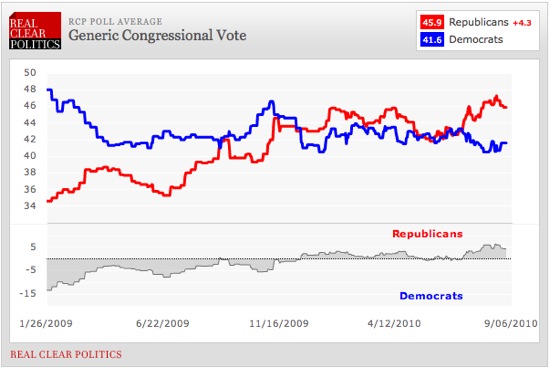
First of all, the fact that the health care bill is no longer the topic du jore does not mean it is no longer an issue. The real questions are whether the health care bill moved voters away from the Democrats, and whether those voters have since moved back now that the debate is over. The answers are yes - the debate moved voters away from the Democrats; and no - the voters have not come back.
This time it is not the economy stupid. The above chart and quotation from RealClearPolitics blog shows that the Democrats will lose control of the House of Representatives in the November 2010 election because of health care. Read the complete RealClearPolitics blog, "Health Care Reform Has Endangered the Democratic Majority" by Jay Cost.

Sunday, August 29, 2010

Barro Blames Obama's Policies For Weak Recovery And High Unemployment

From The Wall Street Journal Opinion piece, "The Folly of Subsidizing Unemployment" by Robert Barro, economics professor at Harvard University and a senior fellow at Stanford University's Hoover Institution:
The economic "recovery" has been disappointing, to put it mildly, and it has become increasingly clear that the blame lies with the policies of the Obama administration, not with those of its predecessor.
In general, the current administration has been too focused on expanding government, redistributing more from rich to poor, and stimulating aggregate demand. I have previously criticized the stimulus package as cost-ineffective. In particular, whatever tax reductions were in the package did not involve the cuts in marginal income tax rates that encourage investment, work effort and productivity growth.
***
...suppose that the expansion of unemployment-insurance coverage to 99 weeks had not occurred and—I assume—the share of long-term unemployment had equaled the peak value of 24.5% observed in July 1983. Then, if the number of unemployed 26 weeks or less in June 2010 had still equaled the observed value of 7.9 million, the total number of unemployed would have been 10.4 million rather than 14.6 million. If the labor force still equaled the observed value (153.7 million), the unemployment rate would have been 6.8% rather than 9.5%.
Read Barro's complete Wall Street Journal opinion piece here.