Showing posts with label health care. Show all posts

Wednesday, January 5, 2011

Neither Obamacare Nor Its Repeal Fixes The Healthcare Pricing System: The Only Long Term Solution To Healthcare Costs And Medicare Is To Repair And Restore The Pricing Mechanism At The User Level

About 20 months ago, in a post on this blog, "Health Care Is A Pricing Mechanism Problem Not An Insurance Problem," I wrote that the breakdown of the pricing mechanism in healthcare, and not health insurance, is the source of the problem of the high cost of US medical services. The fix of the pricing system requires users, the consumers, to have to budget part of their own income for medical costs.

Next week, the US House Republicans will vote on and likely pass a bill to repeal Obama's landmark healthcare legislation, The Patient Protection and Affordable Care Act, colloquially and disparagingly known as Obamacare. It is extremely unlikely the US Senate will undo the new healthcare law and even if by some odd fluke, the Senate passes a repeal, President Obama will certainly veto the bill.

Unfortunately, neither the new healthcare law, nor a repeal of that law, fixes the consumer pricing mechanism for healthcare services. One strong step towards fixing medical services' pricing in the US would be complete repeal of the employer tax deduction for medical insurance as an employee benefit.

As I wrote in my earlier post:
Most users only have to consider their want of healthcare and do not have to budget and allocate their resources to get it. Without consumers allocating their income for healthcare, the economy's pricing mechanism for allocating investment resources is broken and dysfunctional. It is over allocating investment and resources to the medical industry that otherwise would go to other industries with a better return. Consumers are also using more medical services than they would with a functioning price mechanism.

Any government program must be funded, but to most people their actual expected cost of medical services is higher than they want to or can afford to pay. If people were willing to pay for medical services out of pocket, they would only need insurance for catastrophic illnesses with extraordinarily high expenses.

Most government solutions attempt in part to keep the cost borne by the average user low by subsidizing and shifting some of the unpaid cost to a few others who pay more through higher taxes. This resolution does nothing to restore the pricing mechanism, and usage and cost will continue to grow. When costs are shifted and not borne by the end-user, the government is forced to delay, ration, deny and otherwise restrict services to contain growth in costs and use. The experience of most countries with a government health care system is rationing, delays and denials of services.

The true long-term solution to our healthcare problems is to repair and restore the pricing mechanism for consumer use of health services.
Read the complete earlier post here.

Thursday, December 9, 2010

Health Care Costs And Worker Opportunity Costs

A comment I posted to "What's Cost Got to Do with It?" by Joseph T. Salerno on the Mises Daily blog:
Two points.

1. Health care costs, direct and insurance, were and continue to be a big issue, but they follow the same pricing principles mentioned. All the economic articles and research I have seen on the topic discuss, analyze, and provide solutions on the cost side of medical services and health insurance especially that costs are higher in the US than other countries and the US spends more per capita for medical services. They ignore the value to the consumer.

Like all other products and services, the price paid is determined by the value to the consumer. The US has very high GDP per capita and very high productivity rates. These factors would make a worker's opportunity costs, on average, high in comparison to other countries.

With a high opportunity cost, one would expect US medical prices would be higher than other countries as long as the higher price lowers the opportunity costs of medical services to the consumer. Delays caused by waiting for doctor appointments, specialist appointments, medical tests scheduling (such as MRIs, etc.), use of less efficient older technologies, use of older less efficient drugs that require re-treatment, lost productivity from the medical condition, etc. have a high opportunity costs for American workers (who often also have to take off work time to care for an ill child, parent, or spouse). Using new, efficient (in the sense of diagnosis time and treatment) technologies and decreasing the total time (and opportunity cost including lost productivity) to the consumer from the first phone call for an appointment to final result is expensive and will result in higher US medical costs. Most looks at other country medical services find the US had shorter wait times, newer technology to speed diagnosis and treatment, newer, more effective (and more expensive) drugs, and fewer doctor visits per year and per medical condition. This is not to say anything about end results, which are often used as a measure of comparative health care. It is about the speed of reaching that end result, the opportunity costs, beginning from a consumer's awareness of the condition (not first doctor appointment, but the wait for the first appointment) to final recovery.

To me, medical costs in the US are high because these services have a high value and lower opportunity cost to Americans. All attempts to directly control medical costs will fail because the value of the service to the consumer will remain high. American consumers will find ways to spend more, under any medical cost regime, to reduce their opportunity costs while receiving medical services.

Medical costs in the US will rise until they are equal to the consumers' opportunity costs and value.

If the value of the medical services were lower to US consumers, the medical establishment would find ways to reduce costs.

2. To all the comments that say costs are factored into price before production are ignoring that many businesses fail, despite adequate business plans, because consumers are not buying the goods in sufficient numbers for the business to remain viable. At a lower price, the business will sell more, but at a loss. Lack of demand kills many businesses.

Businesses I know consider demand as much as production costs and some will even regularly sell items at or below cost, such as loss leaders, in hopes of increasing overall demand and hopefully increase sales of their other goods. If costs were the main or only consideration, then profit margins would be much higher than they are at most businesses. Demand is determined by value and it sets an upper limit on price and profit.
Also see my earlier post, "The Marginal Value Of US Medical Service Is High So Medical Prices Are High" relating to this topic.

Friday, October 22, 2010

ObamaCare Will Decrease Workforce Labor And Increase Healthcare Spending On Previously Uninsured Says CBO

From CBO Director Doug Elmendorf's October 22, 2010, presentation, "Economic Effects of the March Health Legislation" at the Schaeffer Center of the University of Southern California:
  • The legislation will reduce the amount of labor used in the economy by roughly half a percent, primarily by reducing the amount of labor that workers choose to supply.

  • The legislation will increase spending on health care for people who would have been uninsured in the absence of the legislation.

  • The legislation will decrease spending on health care for people who would be insured with or without the legislation. The magnitude of that decrease, and the extent to which it will be achieved through greater efficiencies in the delivery of care or through reductions in access to care or quality of care, are unclear.
See the complete slide presentation here, on Scribd or embedded below.

CBO Economic Effects of New Healthcare

Thursday, October 7, 2010

Veterans' Health Care Inflation Adjusted Costs To Rise By 45 To 75 Percent by 2020

From the CBO summary on the cost of veterans' health care:
The Congressional Budget Office (CBO) projects that the future costs for VA to treat enrolled veterans will be substantially higher (in inflation-adjusted dollars) than recent appropriations for that purpose, partly because more veterans are likely to seek care in the VA system but mostly because health care costs per enrolled veteran are projected to increase faster than the overall price level. Under two scenarios that CBO examined, the total real resources (in 2010 dollars) necessary to provide health care services to all veterans who seek treatment at VA would range from $69 billion to $85 billion in 2020, representing cumulative increases of roughly 45 percent to 75 percent since 2010.
Read the full 50 page CBO report, "Potential Costs of Veterans’ Health Care" here, on Scribd or embedded below.
Costs of Veterans' Health Care

Thursday, September 23, 2010

Women Stand To Lose The Most Care Under Obamacare

Since comparative medical effectiveness studies (see excerpts from NY Times article below) show that mammograms are not a useful preventive care medical diagnosis tool, is there any doubt that if ObamaCare would not pay for a woman's mammogram, the law would not pass today, unless it had an exception to allow for the payment of mammograms.

If you will have to put a special provision in the law to pay for mammograms, what other commonly accepted treatments and diagnosis tools will be eliminated.

Women as a group are the biggest users of medical care in the US. The treatment that they are used to receiving and expect to continue to receive under ObamaCare is the medical care most threatened by the new law. Many common procedures from mammograms to Papp smears to regular gynecological visits will be subject to more and more medical effectiveness studies. More and more of what a women considers basic medical care will be at risk and many commonly expected procedures will be found comparatively unnecessary as the new law is phased in.

From The New York Times article, "Mammograms’ Value in Cancer Fight at Issue" by Gina Kolata:
A new study suggests that increased awareness and improved treatments rather than mammograms are the main force in reducing the breast cancer death rate.
***
Nonetheless, the new study is “very credible,” said Dr. Barnett Kramer, associate director for disease prevention at the National Institutes of Health.

"This is the first time researchers used real populations to compare the effects of treatment and mammography in the modern era of treatment," Dr. Kramer said. "It shows the relative impacts of screening versus therapy in an era in which therapy has been improving."
***
That means, Dr. H. Gilbert Welch of Dartmouth wrote in an additional analysis in an accompanying editorial, that mammography could have reduced the breast cancer death rate by as little as 2 percent, an amount so small that it is not really different from zero.

Two percent is an estimate, Dr. Welch said. But, he said, whatever the effect of mammograms is, "all the signals here are that it is much smaller than we believed."

Dr. Laura Esserman, a professor of surgery and radiology at the University of California in San Francisco, said it tells her that "if you get the same treatment and the outcome is the same if you find it earlier or later, then you don’t make a difference when you find it early."

And screening has a cost, Dr. Welch said. Screening 2,500 50-year-olds for a decade would identify 1,000 women with at least one suspicious mammogram resulting in follow-up tests. Five hundred would have biopsies. And 5 to 15 of those women would be treated for cancers that, if left alone, would have grown so slowly they would never have been noticed.

When the study was planned, the scientists expected that screening would be even more effective than it was in studies from decades ago. After all, mammography had improved and, in Norway, each mammogram was independently read by two radiologists, which should make it less likely that cancers would be missed. The researchers expected mammograms to reduce the breast cancer death rate by a third.

Wednesday, September 8, 2010

US Obesity Increases From 1987 to 2007 Raised Medical Costs By 3 Percent: Obesity Effect On Federal Budget Uncertain

The twenty year increase in US obesity from 1987 to 2007 accounted for a 3 percent increase in health care spending.

From the Congressional Budget Office summary report, "HOW DOES OBESITY IN ADULTS AFFECT SPENDING ON HEALTH CARE?":
A relatively simple set of calculations using survey data indicates that if the distribution of adults by weight between 1987 and 2007 had changed only to reflect demographic changes, such as the aging of the population, then health care spending per adult in 2007 would have been roughly 3 percent below the actual 2007 amount.
The overall effect of lowering obesity rates on total healthcare expenses and on the federal budget is not clear because of the added medical expenses and social security expenses due to the increased life expectancy.

CBO states:
How reducing obesity would affect both total (rather than per capita) spending for health care and the federal budget over time is less clear. To the extent that people, on average, lived longer because fewer individuals were obese, savings from lower per capita spending would be at least partially offset by additional expenditures for health care during those added years of life. Moreover, the impact on the federal budget would include not only changes in federal spending on health care but also changes in tax revenues and in spending for retirement programs such as Social Security, for which costs are directly tied to longevity. As a result, the net impact of reductions in obesity rates on national health care expenditures and on federal budget deficits would depend on the magnitude of those various effects.
Read CBO's summary report here.
CBO's full 12-page report is available here.

2.4 Percent Of Healthcare Costs Due To Malpractice

From "Malpractice Adds Less than 3 Percent to Healthcare Tab" by Peggy Peck, Executive Editor, MedPage Today, September 07, 2010:
Costs associated with medical malpractice added about $55.6 billion to the nation's total healthcare costs in 2008 -- roughly 2.4% of a more than $2.3-trillion tab -- and most of that money went to pay for tests, procedures, and treatments associated with defensive medicine, according to an analysis by Harvard researchers.

Tuesday, August 31, 2010

This Time It Is Not The Economy Stupid: It Is Health Care

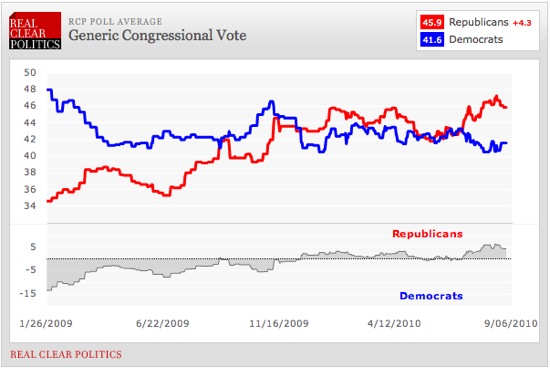
First of all, the fact that the health care bill is no longer the topic du jore does not mean it is no longer an issue. The real questions are whether the health care bill moved voters away from the Democrats, and whether those voters have since moved back now that the debate is over. The answers are yes - the debate moved voters away from the Democrats; and no - the voters have not come back.
This time it is not the economy stupid. The above chart and quotation from RealClearPolitics blog shows that the Democrats will lose control of the House of Representatives in the November 2010 election because of health care. Read the complete RealClearPolitics blog, "Health Care Reform Has Endangered the Democratic Majority" by Jay Cost.

Wednesday, August 25, 2010

Was CBO Pressured During The Health Care Debate To Hide Important Information From Congress?

[UPDATE: On September 14, 2010, Keith Hennessey retracted his post that CBO was pressured. See Hennessey's retraction "Retracting one of my CBO health care posts".]

Keith Hennessey thinks that the Congressional Budget Office was pressured to hide important information during the health care bill debate. CBO's recent data (PDF page 24, document page 6) shows that the new health care law will increase federal entitlement spending by $401 billion over the next decade, and will increase taxes by $525 billion over that same time period. Hennessey writes in his blog:
Based on CBO’s normal scoring practices and the intense scrutiny of both CBO and this legislation, this cannot possibly have been an oversight. I would bet heavily that CBO was pressured not to show this information.

If I’m right, CBO should have resisted this pressure and provided a picture that was both more complete and consistent with how they usually score legislation.

Deficits matter. So do spending and revenues. If they remain in place, these laws will make government spending $401 B larger this decade. By reducing the budget deficit through tax increases, these bills will shift some of the fiscal burden from the future to the present. By increasing government spending, these bills will increase the cost of government on the private sector that pays for it. That latter point is an important piece of information that Congress should have had when they voted.

I am generally a fan of CBO, and please don’t group me with the bashers who say they did everything wrong. This, however, was a failure.
Keith Hennessey served as Deputy Assistant to the President for Economic Policy and Deputy Director of the National Economic Council at the White House from August 2002 through the end of 2007. In 2008 and the first three weeks of 2009, he was Assistant to the President for Economic Policy and Director of the National Economic Council, a position now held by Dr. Larry Summers for President Obama.

Thursday, August 12, 2010

1 Out Of 6 Medicare Recipients Is 18-64 Years Old

From "Nonelderly Medicare Beneficiaries: Access And Costs More Problematic" by Chris Fleming, August 12th, 2010, on HealthAffairs Blog:
A new study released today by Health Affairs [HTML version] focuses on an often-neglected segment of Medicare enrollees: people ages 18–64 with permanent disabilities, a group that currently numbers eight million, or roughly one-sixth of the total number of Americans on Medicare.
The study is available as a PDF here.

Thursday, August 27, 2009

Is Government Mandated Health Insurance Constitutional?

In an August 22, 2009, Washington Post article, "Illegal Health Reform," David B. Rivkin Jr. and Lee A. Casey argue that Congress cannot mandate the purchase of healthcare insurance.

President Obama's proposal to reform the medical system requires every individual to obtain medical insurance.

Rivkin and Casey write:
But can Congress require every American to buy health insurance?

In short, no. The Constitution assigns only limited, enumerated powers to Congress and none, including the power to regulate interstate commerce or to impose taxes, would support a federal mandate requiring anyone who is otherwise without health insurance to buy it.
Read the complete Washington Post article by Rivkin and Casey here.

Tuesday, August 25, 2009

Hidden Costs Of Free Government Health Care: The French Example

City Journal has an article about the true cost of having free government health care in France. Read "Paying for Le Treatment" by Guy Sorman, City Journal, 24 August 2009.

Sorman writes:
France’s costly national health insurance is mostly financed by taxes on labor. A Frenchman making a monthly salary of 3,000 euros will pay approximately 350 of them (deducted by his employer) for health insurance. Then the employer will add approximately 1,200 euros, making the total monthly cost to the employer of this individual’s services not 3,000 euros but 4,200. High labor costs in France affect not only consumer prices but also unemployment rates, since employers are reluctant to pay so much for low-skill workers. Economists agree that unemployment rates and the cost of national health insurance are directly related everywhere, which partly explains why even in periods of economic growth, the average French unemployment rate hovers around 10 percent.

High as they are, taxes on wages are not enough to cover the constant deficits that national health insurance runs. France imposes an additional levy to try to close the insurance deficit—the CSG (contribution sociale généralisée)—which applies to all income, including dividends, and which Parliament increases every year.
The French system negatively affects employment in France and increases the cost of drugs in the US for Americans.

Read the entire article here.