Showing posts with label Employment. Show all posts

Wednesday, September 22, 2010

Public Sector Unions Have Excessive Powers

From the excellent and comprehensive National Affairs article, "The Trouble with Public Sector Unions" by Daniel Disalvo:
When it comes to advancing their interests, public-sector unions have significant advantages over traditional unions. For one thing, using the political process, they can exert far greater influence over their members' employers — that is, government — than private-sector unions can. Through their extensive political activity, these government-workers' unions help elect the very politicians who will act as "management" in their contract negotiations — in effect handpicking those who will sit across the bargaining table from them, in a way that workers in a private corporation (like, say, American Airlines or the Washington Post Company) cannot. Such power led Victor Gotbaum, the leader of District Council 37 of the AFSCME in New York City, to brag in 1975: "We have the ability, in a sense, to elect our own boss."
***
By contrast, as economist Richard Freeman has written, "public sector unions can be viewed as using their political power to raise demand for public services, as well as using their bargaining power to fight for higher wages." The millions spent by public-employee unions on ballot measures in states like California and Oregon, for instance, almost always support the options that would lead to higher taxes and more government spending. The California Teachers Association, for example, spent $57 million in 2005 to defeat referenda that would have reduced union power and checked government growth. And the political influence of such massive spending is of course only amplified by the get-out-the-vote efforts of the unions and their members. This power of government-workers' unions to increase (and then sustain) levels of employment through the political process helps explain why, for instance, the city of Buffalo, New York, had the same number of public workers in 2006 as it did in 1950 — despite having lost half of its population (and thus a significant amount of the demand for public services).
Read the complete National Affairs article here.

Clearly, there is a need to reform and restrict the bargaining powers of public sector unions and their influence on the political process.

Tuesday, September 21, 2010

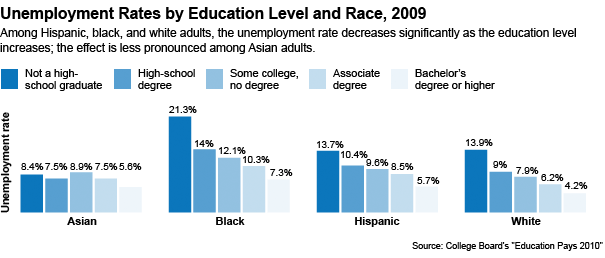
The Unemployment Rate For Asian High School Dropouts Is 40 To 60 Percent Lower Than Other Racial Groups


The above chart is from the College Board via The Chronicle of Higher Education.

Notice how much lower the unemployment rate for Asian high school dropouts is than for any other racial group. For Asians, the unemployment rate in 2009 for high school dropouts is 8.4%. For the other racial groups, the high school dropout unemployment rate ranges from 13.7% to 21.3%.

In addition to promoting increased education levels of US workers, a study should be undertaken to see what can be learned from Asians' low unemployment rate for high school dropouts, and whether there is useful information that can be applied to the other racial groups to lower their high school dropout unemployment rate.

Maybe some of the employment benefits obtained from education can be applied to high school dropouts without increasing their education levels.

Friday, September 17, 2010

Reduce Poverty: Remove Work Disincentives From Government Entitlement And Transfer Programs

A response I wrote to a Wall Street Journal opinion, "Wealth and Poverty: How's that inequality thing working out?" published on September 17, 2010:
The article actually explains a lot about why inequality and poverty exists in the US in mentioning that the Census data overstates poverty because it excludes noncash government payments like housing subsidies, food stamps, the earned income tax credit or entitlements like Medicaid.

The strategy of the US response to poverty, at least since the end of WWII, is to transfer payments to the poor and needy through subsidies and entitlements. Transfer payments and entitlement programs do not promote the principles for success in the US.

Success in the US requires hard work, education, motivation, skills and good work habits. Transfer payments promote dependency, reduce motivation and interfere with skill development. Transfer and entitlement payments have income eligibility cutoffs, which act as a large marginal tax increase and motivate people to avoid generating income to lose the government income. All government entitlement and transfer programs have some eligibility requirement or unintended consequence that works against successful achievement. It can be the previous single parent requirement for government benefits for a child, which broke up families and removed fathers from homes, or income eligibility requirements for lunch programs and food stamps, which forces families close to the cutoff income level to choose between earning more money and feeding their children nutritionally.

Similarly, the minimum wage laws prevent many unskilled workers below the poverty level from developing good work habits and needed job skills because they remain unemployed. It is too costly for employers to hire and train these unskilled workers at minimum wage levels. At the same time, all across the US, middle and upper income kids can learn valuable job skills as interns without pay because it is educational, but training an unskilled employee requires minimum wage.

The best way to reduce poverty in the US is to review and eliminate all the disincentives to full time work skill development our transfer and entitlement programs have in them. Some programs need to be eliminated and others need to be modified. For example, unemployment insurance acts both as a needed safety net in time of unemployment and as a disincentive to finding work while there are remaining benefits. Modify the unemployment program to act as an incentive to find work by allowing the benefits to be continued (at a reduced level) after one finds a new job so one is better off working with unemployment benefits than either not working or working without benefits.

Some of our poverty and lack of workforce skill training (which increases poverty) is the result of the unintended disincentives in place in many transfer and entitlement programs.

Many of the governments new programs to help families during this recession, such as the recent housing foreclosure prevention programs, contain requirements that act as disincentives to working or making more money above eligibility levels.

Remove from all transfer and entitlement the disincentives for work and skill training and the economy will grow, poverty will decline and household income will increase.
Read the complete Wall Street Journal opinion piece here.
If the full Wall Street Journal opinion is unavailable at the previous links, try this link. It may help.

Wednesday, September 8, 2010

Gender Wage Studies Show Salary Differences When None Exist

A comment I posted on Carpe Diem, "There's New Evidence That Employers Do NOT Discriminate Against Single, Childless Women. But Do They Then Discriminate Against Mothers?" by Mark Perry:
Women represent about half of the 130-135 million workers in the US. Given the large size of the US workforce, for there to be any measurable wage discrimination in average salaries, there has to be millions of women who are underpaid and who have the legal right to file discrimination charges against their employers. Where are the numerous lawsuits and Department of Labor complaints? Who are the employers who are discriminating against women?

Gender wage discrimination is only found when male and female employees are grouped by criteria across different employers, such as in the AAUW study cited by Heather Boushey.

How does one control, if one can at all, for different aspects of jobs across different employers? Different employers provide varying amounts of vacation and sick days, carryovers and buyouts for vacation and sick days as for teachers, employee costs of medical benefits, business travel time -- days on the road away from home, risk of injury, reimbursement of employee expenses, frequency of deadlines and need to work late and on weekends, etc.

Gender discrimination wage studies do not find salary discrimination in individual employers. Within companies, employees in a job category are homogenous. They get the same value of benefits and risks. They get the same medical benefits, the same number of sick and vacation days, the same travel obligations, the same frequency of deadlines and need to work late, the same job injury risk, etc.

These gender wage studies just show that male and female employees put values on the differing aspects of jobs in different industries and at different employers. The wage discrepancies in the studies are reflections of the studies' inabilities to quantify all the relevant value aspects of a job.

Within employers, when male-female workers are homogeneous and have similar skills and employee traits, there is no wage discrimination. Only across employers and industries, when male female workers place different priorities on different job characteristics, do any of these studies find a wage difference.

The AAUW study states:

"Women are more likely than men to work in the nonprofit and local government sectors, where wages are typically lower than those in the for-profit and federal government sectors."

The study does not adjust for any benefit differences between private sector and public or non-profit jobs. For example, public sector jobs have pensions and other benefits that are more generous and valuable than private sector jobs, that one can be fired only for cause from the public sector, or that deadlines and travel are rare in public sector and non-profit jobs, etc. The AAUW does not adjust pay for any of these and other job characteristics.

If there is truly gender wage discrimination in the US, the organizations should name the employers responsible.

Friday, August 6, 2010

New Jobs Have Left And Gone Away

Where have you gone, jobs I used to do
A nation turns it's lonely eyes to you (Woo, woo, woo)
What's that you say, economic bloggers
New jobs have left and gone away
(Hey, hey, hey...hey, hey, hey)
Sung to the tune of Mrs. Robinson, written by Paul Simon and sung by Simon and Garfunkel.

The employment report came out to day.
Enhanced by Zemanta

Thursday, July 29, 2010

Do Teachers Have The Voting Power To Give Themselves Raises?

Teachers are the largest professional group in the US workforce today. There are more elementary and secondary teachers than doctors, lawyers, and engineers, etc.

"During the 1999–2000 school year, a total of about 3,450,000 teachers worked in public and private elementary and secondary schools across the country—representing about 2.7 percent of the overall U.S. workforce that year. Elementary and secondary school teachers constituted a greater percentage of the workforce than physicians (0.5 percent), legal professionals (0.8 percent), postsecondary faculty (0.9 percent), engineers (1.0 percent), firemen and law enforcement workers (1.0 percent), registered nurses (1.5 percent), or any other professional group that year. Elementary and secondary school teachers constituted about the same percentage of the workforce as all secretaries and administrative assistants (2.7 percent) and slightly less than retail workers (2.8 percent) (U.S. Department of Labor 2002)." From National Center For Education Statistics, Special Analysis 2005.

Many teachers also live in communities where there is school budget voting. I suspect teachers are more likely to go to the polls to vote to approve larger school budgets and teacher salary increases..

When you add together the budget votes of spouses and close relatives of teachers, it is not surprising that salaries of teachers are rising.

They have the voting power to give themselves and other teachers raises, under the guise of improving children education.

The above was also posted on The Beacon, "Why More Spending Doesn’t Produce Better Schools."