Showing posts with label High school. Show all posts

Friday, October 8, 2010

15% Of High Schools Produce Half The High School Dropouts: 2/3 of Hispanic, 3/4 of African-American, 4/5 of Native American Dropouts

From "If Schools Were Like 'American Idol' . . . Unless we measure success by how children perform, we'll have higher standards for pop stars than public schools." by Robert Murdoch:
...the United States is home to more than 2,000 dysfunctional high schools. They represent less than 15% of American high schools yet account for about half of our dropouts. When you break this down, you find that these institutions produce 81% of all Native American dropouts, 73% of all African-American dropouts, and 66% of all Hispanic dropouts.

At our grade schools, two-thirds of all eighth-graders score below proficient in math and reading. The average African-American or Latino 9-year-old is three grades behind in these subjects. Behind the grim statistics is the real story: lost opportunities, crushed dreams, and shattered lives. In plain English, we trap the children who need an education most in failure factories.
Read the complete Wall Street Journal article here.

Sunday, September 26, 2010

High School Dropout Signaling Model

A comment I posted on EconLog, "Educational Signaling and Statistical Discrimination" by Bryan Caplan:
Any signaling model of education has to explain the very low comparative unemployment rate for Asian high school dropouts.

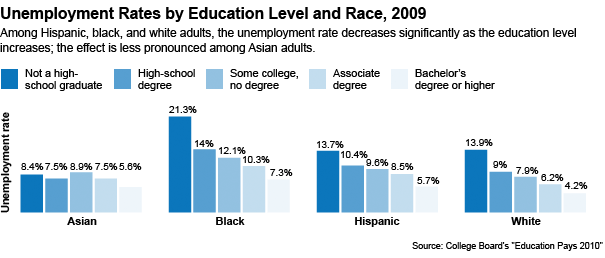
Blacks, Hispanics and Whites all show downward sloping unemployment rates as education levels increase. Asians show a relatively flat, low unemployment rate for all educational levels.

Asian high school dropouts have an unemployment rate that is 40 percent of Blacks and 60 percent of Hispanics and Whites' high school dropout unemployment rates.

See unemployment chart towards end of article on the Chronicle of Education, "Education Pays, but How Much?" by Beckie Supiano at the following web link:

http://chronicle.com/article/Education-Pays-But-How/124552/
Furthermore, there are two types of high school dropouts. Those that upon entering high school are expected to graduate and those that upon entering are expected to dropout.

The expected to dropout group obviously have predictive negative characteristics of a high school dropout, alcohol and drug abuse and/or behavioral problems, which make them potentially and likely poor workers.

The expected to graduate group dropouts for non-predictive reasons, such as an unexpected loss of emotional or economic parental support, would make good, cheap workers. One would think the employment market would find a way to identify this subgroup. Whether Asians are the market response to signaling, I do not know since I have not seen data on Asian high school dropout characteristics. Asians generally have the lowest dropout rate of the ethnic groups.

Also, although I cannot find a link, European dropouts who come to the US do very well finding jobs that pay well. The reason often stated for the success of European high school dropouts is that in Europe they do not dropout due to drug use, alcohol abuse, teen pregnancy or behavioral problems as is common in the US for high school dropouts.
Also see my earlier post, "The Unemployment Rate For Asian High School Dropouts Is 40 To 60 Percent Lower Than Other Racial Groups."

Tuesday, September 21, 2010

We Do Not Know How to Improve Student Education Levels And High School Graduation Rates

A comment I posted to the Wall Street Journal opinion piece, "A Teacher Quality Manifesto" by Deborah Kenny:
In k-12 education, just about every variable, class size, teacher subject matter education level, dollars spent per pupil, availability of classroom technology, years of teacher experience, etc., unbiased controlled studies find either no effect or a minimal effect on student educational performance in the major subject matters tested, reading and arithmetic and dropout rates.

Even things like parent participation in the schools do not matter. For example, Asians on average outperform in school yet have low levels of parent school participation.

Everybody has a fix for the high US high school dropout rate and the low student performance on standardized math and reading tests. One year it is a nutritional breakfast, another year, it is increased parent involvement in schools. There is always some idea that seems to generate a lot of buzz as the solution to our education problems. Currently, it is charter schools.

Just about everything has been tried and while there are always isolated examples of where 'something' seems to work, that 'something' does not work when applied broadly to a large number of schools with a diverse student population.

There are many things that different parent groups do not like about the education system, such as unions, tenure, teacher pay (too high, too low), too bureaucratic, teacher skill level, length of school day, etc., but in many ways these things are like a surgeon's bedside manner. We may or may not like things about our teachers and our school systems, but like a great surgeon's bad bedside manner, it does not mean anything about results.

The fact of the matter is that despite years of throwing billions of dollars at schools, teachers and studies of student performance, we are clueless as to what will significantly increase the learning and graduation rates of our students. Most studies or education experiments produce small, if any, improvements. The magic cure to fix our educational system is undiscovered.

There are obviously broad differences in test results, high graduation rates and college attendance rates among different school systems in the US. We know from experience that whatever we do at the teacher, school and school system levels will not make poorly performing schools perform substantially better, as measured by graduation rates, or standardized test results.

If any method used in the US were a clear-cut success, a large number of our nation's schools would adopt it with very visible positive student results. It does not exist. Given how much money we spent on schools and education research, the magic fix probably does not exist.

Yes, it would be nice to increase the high school graduation rates and increase the levels of student performance on standardized tests. The problem we face is that we truly do not know how.

The Unemployment Rate For Asian High School Dropouts Is 40 To 60 Percent Lower Than Other Racial Groups


The above chart is from the College Board via The Chronicle of Higher Education.

Notice how much lower the unemployment rate for Asian high school dropouts is than for any other racial group. For Asians, the unemployment rate in 2009 for high school dropouts is 8.4%. For the other racial groups, the high school dropout unemployment rate ranges from 13.7% to 21.3%.

In addition to promoting increased education levels of US workers, a study should be undertaken to see what can be learned from Asians' low unemployment rate for high school dropouts, and whether there is useful information that can be applied to the other racial groups to lower their high school dropout unemployment rate.

Maybe some of the employment benefits obtained from education can be applied to high school dropouts without increasing their education levels.

Friday, July 30, 2010

Erica Goldson's Inspiring Valedictorian Speech

From Erica Goldson's excellent 2010 valedictorian speech at Coxsackie-Athens High School:
We are not enlivened by an educational system that clandestinely sets us up for jobs that could be automated, for work that need not be done, for enslavement without fervency for meaningful achievement. We have no choices in life when money is our motivational force. Our motivational force ought to be passion, but this is lost from the moment we step into a system that trains us, rather than inspires us.
Read Erica's complete valedictorian speech here.


Enhanced by Zemanta