Animation updates every second.
Source: Calculated Risk
Monday, August 12, 2013
Animation Of Shifts In US Population Distribution, 1900 To 2060
From Calculated Risk, "U.S. Population Distribution by Age, 1900 through 2060" by Bill McBride:


Saturday, August 10, 2013
Top Five Democratic Candidates With Best OddsTo Get Presidential Primary Nomination
On the betting site, PaddyPower, the top five candidates with the best betting odds for winning the Democratic Primary Presidential nomination out of a field of 35 are:
- Hillary Clinton - 15 to 8 odds;
- Martin O'Malley - 10 to 1 odds;
- Joe Biden - 12 to 1 odds;
- Andrew Cuomo - 12 to 1 odds;
- Kirsten Gillibrand - 16 to 1 odds.
Top Five Republican Candidates With Best OddsTo Get Presidential Primary Nomination
On the betting site, PaddyPower, the top five candidates with the best betting odds for winning the Republican Primary Presidential nomination out of a field of 24 are:
- Marco Rubio - 6 to 1 odds;
- Jeb Bush - 7 to 1 odds;
- Chris Christie - 8 to 1 odds;
- Bob Portman - 8 to 1 odds;
- Paul Ryan - 8 to 1 odds.
Competitive Pressures And Not Issuer Shopping For Favorable Credit Ratings Led Credit Rating Agencies To Assign Lower Default Ratings To CDOs
According to the following study, competiton by credit rating companies for rating business and not issuer rate shopping led to credit ratings of lower default risk for collateralized debt securities (mortgage backed secutities).
From The Review of Financial Studies (gated unfortunately), "Rating Shopping or Catering? An Examination of the Response to Competitive Pressure for CDO Credit Ratings" by
From The Review of Financial Studies (gated unfortunately), "Rating Shopping or Catering? An Examination of the Response to Competitive Pressure for CDO Credit Ratings" by
Although investors paid a premium for dual ratings, AAA CDO tranches rated by both Moody's and S&P defaulted more frequently than tranches rated by only one of them, which is inconsistent with pure rating shopping. Rating agencies made upward adjustments beyond their model when their competitor had more lenient assumptions.
Lowest-Wage Sectors Produce 40 Percent To 50 Percent Of Job Gains In Recoveries Since 1970s
From the Federal Reserve Bank of Atlanta, Macroblog, "Myth and Reality: The Low-Wage Job Machine" by Dave Altig:
The following chart shows the percentages of job gains sorted by low-wage, middle-wage, and high-wage sectors for each of the U.S. expansion periods dating back to 1970:
Source: Federal Reserve Bank of Atlanta
I've dated the current recovery from March 2010: the month that employment gains turned positive. It should also be noted that the cross-recovery comparisons are not quite apples-to-apples given changes in the way sectoral employment is reported by the U.S. Bureau of Labor Statistics. (There are only 11 sectors, for example, in the recovery periods prior to 1991.)
But I don't think this materially alters the basic picture: The lowest-wage sectors have consistently produced 40 percent to 50 percent of the job gains in recent recoveries. Though the percentage was slightly higher in July, it was not materially so. And this recovery does not look at all unusual when taken as a whole.

Friday, August 9, 2013
Real World Data, As Opposed To Laboratory Setting, Finds Talking On Cellphones While Driving Does Not Lead To More Accidents: Legislation Banning Talking On Cellphone Is Not Reducing Accidents
From "Research shows cellphone use may not cause more car crashes" on ScienceBlog:
Published in the American Economic Journal: Economic Policy, the study uses data from a major cellphone provider and accident reports to contradict previous findings that connected cellphone use to increased crash risk. Such findings include the influential 1997 paper in the New England Journal of Medicine, which concluded that cellphone use by drivers increased crash risk by a factor of 4.3 — effectively equating its danger to that of illicit levels of alcohol. The findings also raise doubts about the traditional cost-benefit analyses used by states that have, or are, implementing cellphone-driving bans as a way to promote safety.
"Using a cellphone while driving may be distracting, but it does not lead to higher crash risk in the setting we examined," said Saurabh Bhargava, assistant professor of social and decision sciences in CMU’s Dietrich College of Humanities and Social Sciences. "While our findings may strike many as counterintuitive, our results are precise enough to statistically call into question the effects typically found in the academic literature. Our study differs from most prior work in that it leverages a naturally occurring experiment in a real-world context."
For the study, Bhargava and the London School of Economics and Political Science’s Vikram S. Pathania examined calling and crash data from 2002 to 2005, a period when most cellphone carriers offered pricing plans with free calls on weekdays after 9 p.m. Identifying drivers as those whose cellphone calls were routed through multiple cellular towers, they first showed that drivers increased call volume by more than 7 percent at 9 p.m. They then compared the relative crash rate before and after 9 p.m. using data on approximately 8 million crashes across nine states and all fatal crashes across the nation. They found that the increased cellphone use by drivers at 9 p.m. had no corresponding effect on crash rates. Additionally, the researchers analyzed the effects of legislation banning cellphone use, enacted in several states, and similarly found that the legislation had no effect on the crash rate.
Thursday, August 8, 2013
Mortgagor Unemployment Best Predictor (Not Negative Equity) Of Default: Policies To Promote Employment Much More Effective Than Mortgage Modification Programs To Stem Defaults
From Federal Reserve Bank of Atlanta, "Unemployment, Negative Equity, and Strategic Default" by Kristopher Gerardi, Kyle F. Herkenhoff, Lee E. Ohanian, and Paul S. Willen, Working Paper 2013-4, August 2013, [Abstract weblink] [Research paper weblink]:
Abstract:Using new household-level data, we quantitatively assess the roles that job loss, negative equity, and wealth (including unsecured debt, liquid assets, and illiquid assets) play in default decisions. In sharp contrast to prior studies that proxy for individual unemployment status using regional unemployment rates, we find that individual unemployment is the strongest predictor of default. We find that individual unemployment increases the probability of default by 5–13 percentage points, ceteris paribus, compared with the sample average default rate of 3.9 percent. We also find that only 13.9 percent of defaulters have both negative equity and enough liquid or illiquid assets to make one month's mortgage payment. This finding suggests that "ruthless" or "strategic" default during the 2007–09 recession was relatively rare and that policies designed to promote employment, such as payroll tax cuts, are most likely to stem defaults in the long run rather than policies that temporarily modify mortgages. [Emphasis added.]Link to 50 page research paper.
US Federal Court Rules Bitcoins Are Currency And Subject To American Law
From arstechnica, "Federal judge: Bitcoin, 'a currency,' can be regulated under American law: Bitcoin Savings and Trust's founder has been accused of running a Ponzi scheme." by Cyrus Farivar:
In the case of a Texas man accused of massive Bitcoin-based fraud, a federal judge has ruled that bitcoins are “a currency or form of money," and are therefore subject to relevant US laws.
The case revolves around Bitcoin Savings and Trust (BTCST), a virtual Bitcoin-based hedge fund that many suspected of being a scam. BTCST shut down in August 2012, and the Securities and Exchange Commission (SEC) last month formally charged founder Trendon Shavers with running a Ponzi scheme.
Wednesday, August 7, 2013
Quality And Productivity Gains Are Exceptions To "Broken Window Fallacy"
From The Federal Reserve Bank of New York, "Could Superstorm Sandy Stimulate the Region's Economy?" by Jaison R. Abel, Jason Bram, Richard Deitz, James Orr, Kaivan K. Sattar, and Eric Stern:
However, it’s important not to fall prey to what economists call the “broken window fallacy.” It argues that the activity associated with fixing a broken window—or replacing a refrigerator—does little to raise economic well-being and, at best, simply brings the window, and the economy, back to where it was before the window was broken—even if this money comes from an outside source. Much of the economic activity generated by Sandy will be used to restore what was lost from the storm’s damage. As we discuss in a previous post, the region’s economic costs from the storm are substantial, difficult to measure, and need to be weighed against any benefits of an increase in activity. So while economic activity may have been boosted from such spending, the region’s net wealth hasn’t changed.
The Potential for Productivity Gains
Of course, some of the spending that will occur is for more than just replacing things like broken windows. In fact, even when a new window replaces an old one, it’s likely to be one that’s better—for example, one that’s more energy-efficient. Thus, in the case of replacing things damaged from the storm, there’s some potential for improvements to the region’s productivity. Along these lines, much of the spending will be used to rebuild and upgrade the region’s critical public infrastructure, making it more productive. For example, Sandy destroyed sizable electrical and signal infrastructure of New York’s Metropolitan Transportation Authority (MTA) that was old and in need of repair. Given the MTA’s budget constraints, it’s not clear whether the agency would have upgraded the electrical and signal equipment without the $3.8 billion in Sandy relief funds. Notably, studies indicate that such investments in public infrastructure can increase the attractiveness of an area and raise its productivity for many years. So any investments that upgrade and reduce the risk to the region’s critical public infrastructure could provide a form of longer-term economic stimulus. While these longer-term benefits of disaster aid are easy to conceive, they’re hard to measure.
Tuesday, August 6, 2013
US Household Income 8 Percent Below Peak
From The Wall Street Journal, Real Time Economics, "Vital Signs Chart: Incomes Still 8% Below 2002 Peak" by Neil Shah:
At $52,098, median income is above this year’s low point of $51,422 in February, yet 8% below its post-dot-com peak of $56,648 in February 2002.
 |
| Source: The Wall Street Journal |
Make Breakfast The Biggest Meal Of The Day And Lose Weight
From "Eating a Big Breakfast Fights Obesity and Disease" on ScienceBlog:
[T]he time of day we eat can have a big impact on the way our bodies process food, says Prof. Daniela Jakubowicz of TAU’s Sackler Faculty of Medicine and the Diabetes Unit at Wolfson Medical Center. In a recent study, she discovered that those who eat their largest daily meal at breakfast are far more likely to lose weight and waist line circumference than those who eat a large dinner. And the benefits went far beyond pounds and inches. Participants who ate a larger breakfast — which included a dessert item such as a piece of chocolate cake or a cookie — also had significantly lower levels of insulin, glucose, and triglycerides throughout the day, translating into a lower risk of cardiovascular disease, diabetes, hypertension, and high cholesterol. These results, published recently in the journal Obesity, indicate that proper meal timing can make an important contribution towards managing obesity and promoting an overall healthy lifestyle.*** By the end of the study, participants in the “big breakfast” group had lost an average of 17.8 pounds each and three inches off their waist line, compared to a 7.3 pound and 1.4 inch loss for participants in the “big dinner” group. According to Prof. Jakubowicz, those in the big breakfast group were found to have significantly lower levels of the hunger-regulating hormone ghrelin, an indication that they were more satiated and had less desire for snacking later in the day than their counterparts in the big dinner group.
IKEA Uses Augmented Reality To Enable Viewing Virtual Furniture In Your Home
The 2014 IKEA catalogue gives you the ability to place virtual furniture in your own home with the help of augmented reality.
Place IKEA furniture in your home with augmented reality:
Place IKEA furniture in your home with augmented reality:
Monday, August 5, 2013
States And Local Governments Owe $7 Trillion: About $22,000 Per Person: Legal Loopholes And Misleading Government Accounting Hide Borrowing From Citizenry: Unfunded Public Sector Retirement Benefits Account For Half Of The Debt
From City Journal, "The Indebted States of America: States and localities owe far, far more than their citizens know." by Steven Malanga:
***
Just a few years ago, most experts estimated that state and local governments owed about $2.5 trillion, mostly in the form of municipal bonds and other debt securities. But late last year, the States Project, a joint venture of Harvard’s Institute of Politics and the University of Pennsylvania’s Fels Institute of Government, projected that if you also count promises made to retired government workers and money borrowed without taxpayer approval, the figure might be higher than $7 trillion.
Most states have restrictions on debt and prohibitions against running deficits. But these rules have been no match for state and local governments, which have exploited loopholes and employed deceptive accounting standards in order to keep running up debt.*** Today, states and localities engineer most of their borrowing through what [Columbia Law School’s Richard] Briffault calls “non-debt debt,” a term for bonds designed to avoid legal restrictions on borrowing.*** Briffault estimates that such evasions are responsible for three-quarters of state debt and two-thirds of municipal obligations incurred through bond offerings. The growth of this kind of borrowing helps explain why state and local debt outstanding from municipal securities has blasted from $2 trillion (in today’s dollars) in 2000 to nearly $3 trillion today—real growth of 50 percent in little over a decade.*** If you define municipal debt simply as what states and localities have borrowed, the total nationwide comes to about $3 trillion. Nevertheless, these governments actually owe more than twice that much, according to estimates from groups like the States Project. The reason for the discrepancy is that states and localities carry another kind of debt—promises of retirement benefits to public-sector workers—and they have radically underfunded the systems that must pay for it. As Boston University Law School professor Jack Michael Beermann wrote recently in the Washington and Lee Law Review, the situation is a “double whammy” for future taxpayers, who not only will have to pay for “the consumption of prior generations” but also will receive “reduced government services” as increased spending on retirement debt crowds out other programs.
 |
| Source: City Journal |
Estimates of state and municipal debt have been growing for another reason: more and more independent experts are exposing local governments’ faulty accounting standards. The Chicago-based Institute for Truth in Accounting observes that governments are balancing their budgets using “antiquated budgeting rules and accounting standards,” adding that “hundreds of billions of dollars of unfunded retirement systems’ liabilities are not reported on the face of states’ balance sheets.”
Saturday, August 3, 2013
Our All-Volunteer Military Is More Educated, From A Higher Income Community, Not From A Disadvantaged Background And Not Overrepresented By Minorities
From The Heritage Foundation, "Who Serves in the U.S. Military? The Demographics of Enlisted Troops and Officers" by Shanea Watkins, Ph.D. and James Sherk:
Who serves in the active-duty ranks of the U.S. all-volunteer military? Conventional wisdom holds that military service disproportionately attracts minorities and men and women from disadvantaged backgrounds. Many believe that troops enlist because they have few options, not because they want to serve their country. Others believe that the war in Iraq has forced the military to lower its recruiting standards.[HT: Al Roth, Market Design]***
- U.S. military service disproportionately attracts enlisted personnel and officers who do not come from disadvantaged backgrounds....
- Members of the all-volunteer military are significantly more likely to come from high-income neighborhoods than from low-income neighborhoods....
- American soldiers are more educated than their peers....
- Contrary to conventional wisdom, minorities are not overrepresented in military service....
Half As Many Of Today's Teens Get A Driver's License Compared To The 1990s
From the New York Post, "Teens lack ‘driving’ passion, fewer get licenses" by Dana Sauchelli And Rebecca Harshbarger:
Only 44 percent of teens are now getting a driver’s license within a year of being eligible — nearly half of the number of high-school seniors who had a license in the 1990s, according to the AAA study released yesterday.
US Marijuana Use Peaked Around 1985: Use Among Young Adults Declining Since Mid-80s: Only 7 Percent Of Americans Currently Use Marijuana
From Gallup, "In U.S., 38% Have Tried Marijuana, Little Changed Since '80s: Fewer young adults have tried it today compared with in the 1970s and 1980s" by Lydia Saad:
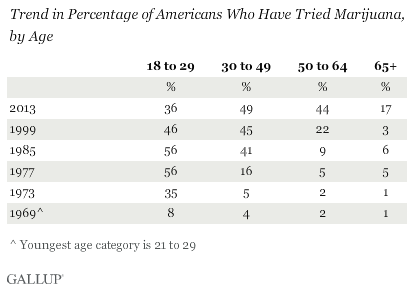
Even as Americans' support for legalizing marijuana has doubled, and more than 20 states have loosened marijuana restrictions in various ways, Gallup finds relatively little increase throughout the past three decades in the percentage of U.S. adults who say they have tried marijuana.*** Gallup's trend by age reveals that widespread experimentation with marijuana first occurred among adults aged 18 to 29 between 1969 and 1973, rising from 8% to 35%. It then continued to mount, reaching 56% by 1977, and remained at that level in 1985. Since then, however, marijuana use among young adults has progressively declined. At the same time, as the bulge of young adults who tried marijuana in the 1970s ages and replaces older Americans who never tried it, the rate of all Americans who have ever tried the drug has increased slightly.
Source: Gallup
Although more than one-third of American adults have tried marijuana, a much smaller percentage admit to currently using it. Seven percent of U.S. adults in the July 10-14 survey -- a separate half-sample from the one asked if they have ever tried it -- say they smoke marijuana.
CBO Presentation On Using Data For US Budget Projections
Several things to note about the following CBO presentation on budget projections:
- CBO uses a 10-year window for analysis. Politicians can manipulate the projected budgetary outcome of legislation by front-loading the revenue part of the legislation (new or higher taxes, fees, etc.) and delaying major expenses of the legislation, so some or all of the costs are past the 10-year window. If Congress enacts legislation that will raise $100 per year for the first 10 years then cost a million dollars in year eleven, the legislation will be projected by CBO to reduce the deficit by $1000 (10 x $100). CBO will ingore the million dollar expense in year eleven as part of its 10 year projections.
- CBO assumes the current law remains the same in projecting out ten years. If a law will end in a couple of years, CBO assumes it will end then, even if history shows Congress will repeatedly extend the law. Likewise, CBO assumes all provisions of a proposed law will be in force and not waived or overridden after the law is passed.
- CBO measures the revenue from tax increases in a static economic environment. Taxes are modeled as if tax increases and decreases do not affect economic output, investment or labor. A 10 percent increase in the tax rate is projected to increase tax revenues by 10 percent and likewise a 10 percent decrease in tax rates is projected to decrease tax revenues by 10 percent. In reality, the economy's output, investment and labor are affected by tax rates, but not on a one to one basis. This effect is not modeled by CBO as part of its projections.
Friday, August 2, 2013
Innovation Is A Game Of Attrition
From LinkedIn, "Why the Most Innovative Companies Aren't" by Jeff DeGraff, Professor at University of Michigan:
Consider the 2010 BusinessWeek innovation survey of thousands of senior leaders in dozens of countries. It identified the following as the greatest challenges to making innovation happen in their companies:
Ironically, during the worst recession in nearly a century, money wasn’t among the top barriers. Similarly, strategy, technology and competencies, the usual excuses for why innovation isn’t happening, were not among the main concerns of these executives. Instead, the primary challenges are essentially leadership issues of coordinating and integrating innovation throughout the enterprise and beyond.
- Lengthy development times
- Lack of coordination
- Risk adverse culture
- Limited customer insight
*** Remember innovation is a game of attrition. Every venture capitalist knows that you take multiple shots on goal because you never know what project is going to score and what isn’t until you take the shot. So hedge first and optimize later. Forget the 80/20 rule. That’s for efficiency wonks. It has nothing to do with making things amazingly new. Use the 20/80 rule instead. That is, it’s easier to change 20% of your company 80% than it is to change 80% of your company 20%. View your company’s performance on a bell curve and start at the tails where crisis or outstanding performance prevails. These are the places outside the norm where the risk of innovating and the reward of keeping things the same are reversed. Momentum is the key when connecting the dots of innovation. Find existing projects with lawyers, guns and money and hide your revolutionaries inside these Trojan Horses. They already have political capital and the means for propulsion. Use them to keep moving forward. Work out of sight and prototype your project until it starts to look like something that might actually succeed. Show, don’t tell.
Thursday, August 1, 2013
Only A Third Of The Potential 4 Million Homeowners Benefited From Obama's HAMP Mortgage Renegotiation Program Due To Bad Organizational Design of The Program
75 percent of the mortgage loans potentially eligible for renegotiation under the HAMP program were in the hands of servicers who had neither the experience, expertise or staff to handle mortgage renegotiations. The lack of adequate planning by the President and Congress as to the ability of exisitng servicers to handle the increased volume of mortgage renegotiations led to the program's failure to meet the needs of most of its potential benficiaries.
Additionally, those homeowners who benefited from the HAMP program and who lowered their monthly mortgage payments did not use their newly available funds to stimulate the economy and make consumer purchases. The funds were used mostly to pay down other household debt.
From Columbia Ideas at Work, "Why Did the Home Affordable Modification Program Underperform?" by Tomasz Piskorski, Edward S. Gordon Associate Professor of Real Estate, Columbia Busienss School:
Yet four years later, only about one third of the 4 million homeowners estimated to potentially benefit from HAMP during its initial lifespan (through December 2012) have received modifications through the program.*** Servicers with lower renegotiation activity had existing organizational designs that were much less conducive to mortgage modification. These organizations had smaller, less trained, and overloaded servicing staff, and servicing call-centers that were unable to efficiently handle a large number of calls. One of the most important differences among servicers is their ability to deal with distressed loans: some servicers have expertise in dealing with non-performing mortgages, while others only specialize in efficient processing of checks from borrowers.
These differences across servicers are economically important. Piskorski and his co-authors find that about 75 percent of loans are in the hands of servicers with organizational designs that were less conducive to renegotiations. This makes some sense because during “normal” times, it may have been efficient to just specialize in the mass processing of checks from borrowers.*** However, their results also suggest that such programs targeted at distressed borrowers may not necessarily result in a sizeable increase in non-durable or durable consumption, at least in the near term.
Why is that the case? It appears that distressed borrowers use additional resources from debt reduction to pay down their other debt in lieu of spending on new consumer goods. These findings are consistent with arguments that the large accumulation of household debt prior to the crisis is an important factor limiting household consumption.
The analysis offers a lesson for policy makers and servicers: any policy intervention in response to foreclosure or other crises may face similar organizational hurdles and should be accounted for in its design. In the case of HAMP, for instance, modification rates might have been higher if the program had allowed servicing for modifications to be shifted to servicers that were better prepared to review, negotiate, and process modifications.
Golf Revenue Exceeds Combined Revenue of Baseball, Basketball, Football And Hockey
from Bloomberg, "The Real Economic Impact of Golf" by Nikhil Hutheesing:
Some 26 million U.S. golfers helped the industry generate $69 billion in revenue in 2011, according to the latest data from market researcher SRI International. While that's down from $76 billion in a 2005 SRI study, it tops revenue from such professional spectator sports as baseball, basketball, football and hockey combined, according to the Census Bureau. Add in the spillover effect on industries such as tourism, and the golf economy expands to $177 billion.
Treasury Expects To Hold First Floating Rate Note Auction In January 2014
From U.S. Department of the Treasury, "Mark Your Calendars: Treasury Expects To Hold First Floating Rate Note Auction In January 2014" by Matthew Rutherford:
Treasury announced today that it will hold the inaugural Floating Rate Notes (FRNs) auction in January 2014, making FRNs the first new Treasury security since we introduced Treasury Inflation-Protected Securities (TIPS) more than 15 years ago.Treasury Announces First Floating Rate Note Auction press release, January 23, 2014.
Surge In Gun Permits in Newtown After Sandy Hook Shooting
From The Wall Street Journal, "In Newtown, Gun Permits Surge After Shooting: Residents Cite Desire for Protection, a Rush to Buy Before Tighter Rules Kicked In" by Joseph De Avila and Alison Fox:
NEWTOWN, Conn.—The number of people seeking permits to buy guns has surged in this town [Newtown, Ct.] following the December massacre of schoolchildren by a local man, even as the parents of some victims had urged stricter weapons laws nationwide.
Through July 24, more than 200 people in Newtown have received new local pistol permits, according to a review of local records, surpassing the 171 new permits issued for all of last year.*** "I think people realize that you can't call the police all the time and expect them to save you," said Newtown resident Bill Stevens, 48 years old, an avid hunter who owns more than a dozen firearms. "It's sinking in to some folks that 'I need to take responsibility for keeping my family safe.' "
Obama's Tax Increases Have Slowed Post Recession Economic Growth
From The Wall Street Journal, "Data of Prosperity Past: The latest GDP revisions underscore how subpar the current recovery is:"
 |
| Source: The Wall Street Journal |
The tragic difference is how poorly the economy has emerged from this last recession. In the 1980s, growth averaged about 5% in the first four years of expansion compared with 2.2% since the current recovery began in mid-2009. If this had been a normal post-World War II expansion, the economy would be $1.3 trillion larger now.
The Commerce [Department] calculators found that the beginning stages of the Obama recovery were stronger than first estimated, but growth dipped to 1.8% in 2011, rising to 2.8% in the election year, only to decelerate again in the last nine months to average about 1%.
The question is why the setbacks?*** The data suggest that a major cause of the recent slowdown has been the Obama tax increase. The uncertainty about whether and how much taxes would rise caused business to seize up in 2012's fourth quarter, and the arrival of the increase in January has slammed business investment. Residential investment has rebounded with the housing recovery, but real nonresidential fixed investment fell by 4.6% in the first quarter and rose a modest 4.6% in the second, for a net of zero in the first half.
Without business investment, wages and incomes won't rise. The tax hike raised rates on capital gains, dividends and small-business income—that is, on the returns from investment—at a time when nurturing more private investment and risk-taking should be a priority. In other words, the growth gap on President Obama's watch is best explained by policy blunders that have added risk, uncertainty and new tax and regulatory burdens on investment, hiring and risk-taking.
Wednesday, July 31, 2013
Quarterly And Yearly GDP Growth Rates Do Not Accurately Predict Following Year's GDP Growth Rate: S&P Index Is A Bettter Economic Forecaster Than Past GDP Growth Number
From The Wall Street Journal, "The Stock Market Beats GDP as an Economic Bellwether: The initial quarterly numbers are usually wrong—and they're poor predictors of future economic growth." by Edward Lazear:
The government's initial estimate of the previous quarter's GDP, the "advance" estimate, is followed by revisions in the two subsequent months, called the "preliminary" and "final" estimate. The "final" estimate is often revised again in subsequent months and years to yield the actual GDP number. It is quite common for there to be significant differences between the actual GDP number and the initial estimate.
The average quarter between 1996 and 2012 experienced growth at an annualized rate of 2.4%. In 26 of the 67 quarters that I analyzed, the advance estimate the BEA missed the actual rate of growth (reported much later) by at least 1.2 percentage points—half the actual average growth rate. In nine of those quarters, the initial GDP estimate was off by more than the average growth rate itself, e.g., off by more than 2.4 percentage points.*** In fact, there is no clear statistical relation of a given quarter's GDP growth to the growth rate during the following year. A good leading indicator should at least predict whether the future will be better or worse than average. But knowing where the current quarter's GDP growth rate is relative to its historic average predicts correctly where next year's GDP growth rate will be relative to its historic average only 61% of the time. This is not much better than a coin toss. The longer run view is no better. Last year's growth rate does not predict with any statistical reliability next year's growth rate.
Market indexes are better predictors of GDP growth. My analysis of 1996-2012 shows that the performance of the S&P 500 relative to its average predicts the performance of the economy in the next year relative to its average a full three-fourths of the time.
Indeed, knowing the current quarter's GDP growth rate adds almost nothing to the predictive power of the quarterly change in S&P 500. For the purposes of predicting next year's GDP growth, we are better off ignoring the current quarter's growth rate altogether.
For every additional 80-point quarterly change in the S&P 500—which is the average quarterly change (up or down) during the period I studied—the market predicts about one-half percentage point of additional GDP growth during the subsequent year with statistical reliability. (Here, statistical reliability means that the correlation between future GDP and the S&P 500 could have arisen from pure luck with a probability of less than 3-in-100.)
In Countries With Greater Income Inequality, People At All Income Levels Are Happier
From Columbia Ideas at Work, "Does Inequality Make You Happier? New research shows that the relationship between income inequality and life satisfaction is not as simple as it seems" by Paul Ingram, Kravis Professor of Business at Columbia Business School:
The assumption is widespread in Western countries: income equality is bad. Policymakers from across the political spectrum often base their arguments on this idea, and in recent years it has become embedded in our cultural consciousness. But the relationship between income inequality and happiness turns out to be complicated, and often surprising. As new research by Professor Paul Ingram and Columbia Business School doctoral candidate Ivana Katic shows, people at all income levels are happier, on average, in countries with greater income inequality.
Slow Long-Term Growth US Economy Means Longer Working Years And Many Fewer Future Retirees
From Bloomberg, "Don't Grade the Economy on a Curve" by Megan McArdle:
To take just one example, think about retirement savings. If the economy is going to grow at 3 percent a year, then you can pour a relatively modest 15 percent of your income into savings and probably retire in comfort. But if it is going to grow at 0 percent, then stocks won’t deliver much in the way of aggregate returns, so you need to save more like 40 percent of your income, if you want to enjoy a retirement that’s now often almost as long as your working life.From Bureau of Economic Analysis, "GROSS DOMESTIC PRODUCT: SECOND QUARTER 2013 (ADVANCE ESTIMATE):"
People do not realize that that when they put a fairly small percentage of their income into a retirement account, they’re banking on a pretty steady growth rate. It just doesn’t occur to them, because economic growth has been going on for so long that it feels like a law of nature, not something that’s highly contingent.
Real gross domestic product -- the output of goods and services produced by labor and property located in the United States -- increased at an annual rate of 1.7 percent in the second quarter of 2013 (that is, from the first quarter to the second quarter), according to the "advance" estimate released by the Bureau of Economic Analysis. In the first quarter, real GDP increased 1.1 percent (revised [downward]).
New York State Facing $2 Billion Plus Budget Gaps For Next Several Years Warns State Comptroller DiNapoli: Full Report
From The Journal News, lohud.com, "DiNapoli warns of growing state budget gaps" by Joseph Spector, Albany Bureau Chief:
New York could face rising budget gaps if the economy doesn't improve and the state lets some taxes expire as planned, Comptroller Thomas DiNapoli said in a report Tuesday.NYS Comptroller's report is available as a PDF and embedded below.
The state's five-year fiscal outlook expects budget gaps of $2 billion next fiscal year and $2.9 billion in the two subsequent years. DiNapoli warned that the budget gaps could be as high as $6 billion if the state's revenue and spending projections aren't met.
"The use of non-recurring or temporary resources to meet recurring expenses exacerbates the structural deficit, making future budgeting more difficult," the report said.
Monday, July 29, 2013
Many Early Detected "Cancers" Are Not Fatal, Not Cancerous And Not Malignant: Top Cancer Scientists Call For Restricting "Cancer" Use As A Diagnostic Term
From The New York Times, "Scientists Seek to Rein In Diagnoses of Cancer" by Tara Parker-Pope:
A group of experts advising the nation’s premier cancer research institution has recommended sweeping changes in the approach to cancer detection and treatment, including changes in the very definition of cancer and eliminating the word entirely from some common diagnoses.
The recommendations, from a working group of the National Cancer Institute, were published on Monday in the Journal of the American Medical Association. They say, for instance, that some premalignant conditions, like one that affects the breast called ductal carcinoma in situ, which many doctors agree is not cancer, should be renamed to exclude the word carcinoma so that patients are less frightened and less likely to seek what may be unneeded and potentially harmful treatments that can include the surgical removal of the breast.
The group, which includes some of the top scientists in cancer research, also suggested that many lesions detected during breast, prostate, thyroid, lung and other cancer screenings should not be called cancer at all but should instead be reclassified as IDLE conditions, which stands for “indolent lesions of epithelial origin.”*** "We need a 21st-century definition of cancer instead of a 19th-century definition of cancer, which is what we’ve been using," said Dr. Otis W. Brawley, the chief medical officer for the American Cancer Society, who was not directly involved in the report.
The impetus behind the call for change is a growing concern among doctors, scientists and patient advocates that hundreds of thousands of men and women are undergoing needless and sometimes disfiguring and harmful treatments for premalignant and cancerous lesions that are so slow growing they are unlikely to ever cause harm.
The advent of highly sensitive screening technology in recent years has increased the likelihood of finding these so-called incidentalomas — the name given to incidental findings detected during medical scans that most likely would never cause a problem. However, once doctors and patients are aware a lesion exists, they typically feel compelled to biopsy, treat and remove it, often at great physical and psychological pain and risk to the patient. The issue is often referred to as overdiagnosis, and the resulting unnecessary procedures to which patients are subjected is called overtreatment.
Officials at the National Cancer Institute say overdiagnosis is a major public health concern and a priority of the agency. "We’re still having trouble convincing people that the things that get found as a consequence of mammography and P.S.A. testing and other screening devices are not always malignancies in the classical sense that will kill you,” said Dr. Harold Varmus, the Nobel Prize-winning director of the National Cancer Institute. “Just as the general public is catching up to this idea, there are scientists who are catching up, too."
Older People Are Healhty Until A Year Or Two Before Death
From "People are remaining healthier later in life" on ScienceBlog:
A new study, conducted by David Cutler, the Otto Eckstein Professor of Applied Economics, shows that, even as life expectancy has increased over the past two decades, people have become increasingly healthier later in life.
"With the exception of the year or two just before death, people are healthier than they used to be," Cutler said. "Effectively, the period of time in which we're in poor health is being compressed until just before the end of life. So where we used to see people who are very, very sick for the final six or seven years of their life, that's now far less common. People are living to older ages and we are adding healthy years, not debilitated ones."
The study results are based on data collected between 1991 and 2009 from nearly 90,000 individuals who responded to the Medicare Current Beneficiary Survey (MCBS). Cutler reported these findings in work with Mary Beth Landrum of Harvard Medical School and Kaushik Ghosh of the National Bureau of Economic Research.
Thursday, July 25, 2013
Almost All Americans Approve Of Marriage Between Blacks And Whites
From Gallup, "In U.S., 87% Approve of Black-White Marriage, vs. 4% in 1958: Ninety-six percent of blacks, 84% of whites approve" by Frank Newport:
87% of Americans now favor marriage between blacks and whites, up from 4% in 1958.
 |
| Source: Gallup |
Internet Has Increased Domestic Music Listening Over Foreign Music
From The Economist, Free exchange, "Face the music" by C W:
From the 1960s to the 1980s, the proportion of domestic music fell sharply: Italians were listening to relatively less Italian music and relatively more American music. By 1985, consumers spent as much time listening to foreign bands as they did domestic groups. But from the low point of the mid-1980s the picture changed. We have now reached a level of domestic consumption not seen for 50 years, with 70% of listening time devoted to domestic tunes. People increasingly seem to prefer domestic repertoire to foreign fare.
Why is this? Improved communication networks make a big—and counterintuitive—difference. People might assume that the internet would make consumers’ music choices more global. But the spread of the internet has actually enabled the dissemination of local music within countries more than it has increased the availability and consumption of foreign music.
Copy Of USDOJ Insider Trading Criminal Indictment Against SAC Capital Advisors
Copy of US criminal indictment and grand jury charges against SAC Capital Advisors for insider trading embedded below. The indictment is also available on USDOJ website. Also, SEC civil charges against Steven Cohen are here.
USDOJ Criminal Indictment Against SAC For Insider Trading by Milton Recht
American Companies' Share Of US Workers Declining: Hiring More Workers Abroad
From The New York Times, Economix, "The Multinational Equation on Jobs" by Catherine Rampell:
As for American multinational companies (like Ford, which Mr. Obama cited), their employment in the United States actually stayed flat from 2009 to 2011 while they hired in large numbers abroad. From 2009 to 2011, domestic employment at these American companies was 22.9 million, while the number of employees abroad rose to 11.7 million from 10.8 million.
As a result, the share of employment at these American companies that is based at home has been shrinking, to 66.3 percent in 2011 from 79 percent in 1989:
Source: Source: Bureau of Economic Analysis.
Soutce: The New York Times

US Median Real (Inflation Adjusted) Household Income Is 5% Lower Than In June 2009
From The Wall Street journal, "The Inequality President: The rich have done fine under Obamanomics, not so the middle class:"
Each month the consultants at Sentier Research crunch the numbers from the Census Bureau's Current Population Survey and estimate the trend in median annual household income adjusted for inflation. In its May 2013 report, Sentier put the figure at $51,500, essentially unchanged from $51,671 a year earlier.
Source: The Wall Street Journal
And that's the good news. The bad news is that median real household income is $2,718, or 5%, lower than the $54,218 median in June 2009 when the recession officially ended. Median incomes typically fall during recessions. But the striking fact of the Obama economy is that median real household income has fallen even during the recovery.
While the declines have stabilized over the last two years, incomes are still far below the previous peak located by Sentier of $56,280 in January 2008.

Wednesday, July 24, 2013
NYC Owes $88 Billion For Retiree Health Care: 15 Times As Much As Detroit Owes
From City Journal, "What New York Should Learn from Detroit: The Motor City’s bankruptcy proves that even big cities are not too big to fail." by Nicole Gelinas:
New York, after all, is doing well compared with many other cities. The time to act is now. But act New York must: the city’s obligations dwarf even Detroit’s. Consider the $5.7 billion Detroit owes for retiree health care. New York owes $88.2 billion—or $20 billion more than Detroit when adjusted for population—and the city has no money squirreled away for this purpose. Or consider pensions: New York owed pensioners $69.9 billion more than it set aside as of last year’s annual report. Adjusted for population, that’s $28 billion more than Detroit owes. New York’s bondholder debt stands at $77.3 billion, about $34 billion less than Detroit when adjusted for the population difference. That means there’s still time, but bondholders should remember that Detroit kept borrowing until it was too late to maintain the illusion that the city could afford its retirement benefits. Now both creditors and pensioners will suffer.
New York should heed another stark indicator. Detroit can’t balance its annual budget because it must spend one-third of its revenues on health, retirement benefits, and debt. New York’s budget has run an operating deficit six of the past seven years (with the shortfalls covered by pre-2008 surpluses). These deficits exist because New York also spent a third of the budget on health, retirement benefits, and debt.
Tuesday, July 23, 2013
NYS Fracking Moratorium Five Years Old: Despite Safe Fracking Across Its Border In PA And Despite DOE And EPA Studies Finding Fracking Safe
New York State, particularly Governor Andrew Cuomo, continues to allow its upstate residents and economy to suffer by bowing to NYC metro area liberal and environmental political groups who oppose fracking, despite all the studies and real world evidence that it can occur safely.
From The Journal News, "Five years later, fracking pause still in place" by Jon Campbell:
From The Journal News, "Five years later, fracking pause still in place" by Jon Campbell:
Tuesday marks the five-year anniversary of the state’s official move to put large-scale hydrofracking permit applications on hold, a period of time opponents of the technique say speaks to their strength and advocates say points to a display of political indecision.
The Joint Landowners Coalition of New York, a statewide group of pro-drilling landowners, is hosting a news conference in Binghamton to mark the anniversary. A five-year delay is “ridiculous” and landowners are “fed up,” the group wrote in a memo to local organizations.
Many environmental and anti-fracking groups, citing the potential for damage to water supplies and community character, have called on the state to either ban shale-gas drilling or implement a lengthier moratorium.
Then Gov. David Paterson officially put high-volume fracking on pause in New York on July 23, 2008, when he ordered the Department of Environmental Conservation to conduct an in-depth environmental review of the technique and craft permitting guidelines.
Monday, July 22, 2013
Fiscal And Monetary Policy Uncertainty Increased Unemployment By 1.3 Percent, From 6.5 To 7.8 Percent At End Of 2012: Fed Reserve Bank Of San Francisco
From Federal Reserve Bank of San Francisco Economic Letter, "Uncertainty and the Slow Labor Market Recovery" by Sylvain Leduc and Zheng Liu:
The U.S. labor market has recovered more slowly following the Great Recession than after previous recessions. Historically, the unemployment rate tends to fall as job openings increase, a relationship represented graphically by the Beveridge curve. However, even though the number of job openings in the economy has been rising during the recovery, the unemployment rate has remained stubbornly high. As a result, as Figure 1 shows, the Beveridge curve has shifted away from its historical pattern. There are now more jobless workers for a given number of job openings than in the decade before the downturn.
Sources: Job Openings and Labor Turnover Survey (JOLTS), Daly et al. (2012),and authors’ calculations. Federal Reserve Bank of San Francisco *** We present evidence that heightened uncertainty about economic policy during the recovery made businesses more reluctant to hire workers. When uncertainty rises, businesses become more hesitant to hire. They reduce recruiting efforts by raising hiring standards, increasing the number of interviews, or simply not filling vacancies. For instance, some businesses may interview candidates multiple times and end up deciding to postpone hiring altogether (see Rampell 2013).
Our results suggest that heightened policy uncertainty accounts for as much as two-thirds of the recent shift in the Beveridge curve. We estimate that uncertainty pushed the unemployment rate 1.3 percentage points higher by late 2012 than it would have been based on trends from the decade before the downturn. Without elevated uncertainty, unemployment would have been roughly 6.5% at the end of 2012, instead of the actual 7.8%.*** In an uncertain economic environment, businesses reduce their recruiting intensity. This means that job seekers are less likely to be successful in finding work, even though posted job vacancies increase.

Most Americans Prefer Traditonal Books To Electronic Book Devices
From Rasmussen Reports, "75% Prefer Traditional Book to Electronic Reading Device:"
Three-out-of-four Americans still prefer a traditional book over an electronic book-reading device and continue to reads books that way.
A new Rasmussen Reports national telephone survey finds that 75% of American Adults would rather read a book in a traditional print format than on an electronic book-reading device like a Kindle.
Friday, July 19, 2013
Full Text Of SEC Charges Against Steven Cohen
From the SEC press release, "SEC Charges Steven A. Cohen With Failing to Supervise Portfolio Managers and Prevent Insider Trading:"
Washington D.C., July 19, 2013 — The Securities and Exchange Commission today announced charges against hedge fund adviser Steven A. Cohen for failing to supervise two senior employees and prevent them from insider trading under his watch.Full text of SEC Administraive Proceeding Order instituting proceedings against Steven A Cohen below and on SEC site. USDOJ insider trading criminal charges against SAC are here.
The SEC’s Division of Enforcement alleges that Cohen received highly suspicious information that should have caused any reasonable hedge fund manager to investigate the basis for trades made by two portfolio managers who reported to him – Mathew Martoma and Michael Steinberg. Cohen ignored the red flags and allowed Martoma and Steinberg to execute the trades. Instead of scrutinizing their conduct, Cohen praised Steinberg for his role in the suspicious trading and rewarded Martoma with a $9 million bonus for his work. Cohen’s hedge funds earned profits and avoided losses of more than $275 million as a result of the illegal trades.
Study Finds Facebook Photos Not Useful For Judging Prospective Employees
From TIME, "Employers: Facebook Party Pics Don’t Always Reflect Employees’ Bad Judgment" by Maia Szalavitz:
While recent concerns about employers plumbing social media for information about both current and potential employees have led many users to adjust their privacy settings and posting habits, a new study found that college students who posted images of themselves [on Facebook] enjoying a drink or two, or even using drugs were just as responsible and hard-working as those who did not advertise their partying.
"People high in conscientiousness were just as likely to post about chugging beer or doing drugs as someone who was low in conscientiousness," says the study’s lead author William Stoughton, a doctoral candidate at North Carolina State University.
Those who posted drinking and drug images were also more likely to be extraverted than people who didn’t— another trait that many employers find appealing, since it involves being sociable, friendly and enthusiastic, all useful for occupations that require interacting with others.
So by screening out candidates who show drinking and drug use on social media, "You might be throwing out the very people you want," says another of the study’s co-authors Lori Foster Thompson, an associate professor of psychology at North Carolina State.
Department Of Energy Study Finds Fracking Does NOT Pollute Drinking Water
From CBS News, "Study finds fracking chemicals didn't pollute water: AP" by The Associated Press:
A landmark federal study on hydraulic fracturing, or fracking, shows no evidence that chemicals from the natural gas drilling process moved up to contaminate drinking water aquifers at a western Pennsylvania drilling site, the Department of Energy told The Associated Press.
After a year of monitoring, the researchers found that the chemical-laced fluids used to free gas trapped deep below the surface stayed thousands of feet below the shallower areas that supply drinking water, geologist Richard Hammack said.
Big Box Retailers Join Walmart In Opposing Washington DC Fair Wage Law Which Applies Only To Large Square Foot Stores And Exempts Unionized Stores
From Washington Business Journal, "Major retailers urge Gray veto of living wage bill, threaten to table expansion plans" by Michael Neibauer:
A half-dozen major retailers have signed a letter to D.C. Mayor Vincent Gray urging him to veto the large retailer living wage bill, threatening to "revisit" expansion plans if the legislation is enacted.
Top executives with The Home Depot Inc., Target Corp., AutoZone Inc., Lowe's Cos. Inc., Walgreen Co. and Macy's Inc. "respectfully" requested that Gray kill the measure, which would force all retailers with 75,000 square feet, whose parent company's grosses at least $1 billion a year, to pay their employees $12.50 an hour, net of benefits.*** The legislation, adopted last week by the D.C. Council, exempts unionized stores, including Giant and Safeway. Wal-Mart, which was planning to open six D.C. stores, is the obvious target of the bill, but this letter suggests other, major retailers are equally concerned about its effects.*** The letter from the six retailers further states, "Given the geographic location of the District market, access to District consumers is not necessarily dependent on establishing multiple storefronts within the city boundaries. The unintended consequence of this legislation will continue to drive consumers outside of the city, where they are already spending more than a billion dollars annually on retail options available in the suburbs of Maryland and Virginia."
Thursday, July 18, 2013
At Best, Artificial Intelligence Computer Programs As Smart As 4 Year Old With Learning Difficulties
From University of Illinois at Chicago, "Computer smart as a 4-year-old" by Jeanne Galatzer-Levy:
Artificial and natural knowledge researchers at the University of Illinois at Chicago have IQ-tested one of the best available artificial intelligence systems to see how intelligent it really is.
Turns out–it’s about as smart as the average 4-year-old, they will report July 17 at the U.S. Artificial Intelligence Conference in Bellevue, Wash.*** But unlike most children, the machine’s scores were very uneven across different portions of the test. “If a child had scores that varied this much, it might be a symptom that something was wrong,” said Robert Sloan, professor and head of computer science at UIC, and one of the study’s authors.
Greater Life Expectancy Increase For Blacks Since 1970 and 1930 Than For Whites
From The New York Times, "Racial Disparities in Life Spans Narrow, but Persist" by Sabrina Tavernise:
Life expectancy for blacks rose to 75 years in 2010, up from 64 years in 1970. For whites, it rose to 79 years from 72 years in the same period. In 1930, life expectancy stood at 48 for blacks and at 60 for whites.
Higher infant mortality among blacks also contributes to the gap, but less than it used to. The infant mortality rate for blacks fell by 16 percent from 2005 to 2011, compared with a 12 percent drop for whites, said Kenneth M. Johnson, a demographer at the University of New Hampshire.
Heart disease was the single biggest drag on black life expectancy, accounting for a full year of the 3.8-year difference between whites and blacks. The second-biggest factor was cancer, accounting for about eight months of the difference.
Wednesday, July 17, 2013
McKinsey Projects Investment In Shale Gas And Oil Production (Fracturing) Could Add The Most To GDP By 2020: $690 Billion Per Year To GDP And 1.7 Million Jobs: More Than Investment In Trade, Technology, Infrastrucuture Or Education: Mr. President, Stop Keeping America Unemployed: Approve Keystone Pipeline And Open More Federal Lands to Fracking
McKinsey finds that invesment in shale oil and gas will add more to US GDP by 2020 than investment in trade, technology, infrastrucuture or education.
From McKinsey & Company, "Game changers: Five opportunities for US growth and renewal" by Susan Lund, James Manyika, Scott Nyquist, Lenny Mendonca, and Sreenivas Ramaswamy, July 2013:
From McKinsey & Company, "Game changers: Five opportunities for US growth and renewal" by Susan Lund, James Manyika, Scott Nyquist, Lenny Mendonca, and Sreenivas Ramaswamy, July 2013:
The US economy is struggling to find a new formula for vigorous growth. But all growth opportunities are not created equal. New McKinsey research pinpoints five catalysts—in energy, trade, technology, infrastructure, and talent development—that can quickly create jobs and deliver a substantial boost to GDP by 2020.***
Source: McKinsey & Co *** Shale-gas and -oil production. Powered by advances in horizontal drilling and hydraulic fracturing, the production of domestic shale gas and oil has grown more than 50 percent annually since 2007. The shale boom could add as much as $690 billion a year to GDP and create up to 1.7 million jobs across the economy by 2020. The impact will extend to energy-intensive manufacturing industries and beyond. The United States now has the potential to reduce net energy imports to zero—but only if it can successfully address the associated environmental risks.

US Ranked 94th Among Country Tax Systems
From Tax Foundation, "U.S. Tax System Ranks 94th in the World" by Andrew Lundeen:
The U.S. tax system ranks 94th out of 100 countries considered in a recently released study of international "tax attractiveness."*** In an increasingly globalized world, the attractiveness of a countries tax climate continues to become more important, as people, companies, and money find it easier to locate in the most attractive places.
Unfortunately, this study only adds to the increasing pile of evidence that suggests the U.S. is not one of those places.
Natural Human Immune Response Damages DNA And Is Cancer Causing: Over Two-Thirds Of DNA Damage In Some Cancers (Bladder, Cervical, Breast, Head and Neck, and Lung) Caused By Natural Immune Response
From The National Institutes of Health, "NIH scientists find that proteins involved in immunity potentially cause cancer:"
A set of proteins involved in the body’s natural defenses produces a large number of mutations in human DNA, according to a study led by researchers at the National Institutes of Health. The findings suggest that these naturally produced mutations are just as powerful as known cancer-causing agents in producing tumors.
The proteins are part of a group called apolipoprotein B mRNA-editing enzyme catalytic polypeptide-like (APOBEC) cytidine deaminases. The investigators found that APOBEC mutations can outnumber all other mutations in some cancers, accounting for over two-thirds in some bladder, cervical, breast, head and neck, and lung tumors.
Tuesday, July 16, 2013
90 Percent Of Black Murder Victims Are Killed By Other Blacks: An Epidemic That Needs The Focus Of The Mass Media, Black Leaders, President Obama, Attorney General Holder: Crimes Against And Murder Of Blacks By Whites Is Not A Major Problem In Today's US That Needs Either Media Or Government Special Attention
From The Wall Street Journal, "Jason Riley: Race, Politics and the Zimmerman Trial: The left wants to blame black criminality on racial animus and 'the system,' but blacks have long been part of running that system." by Jason L Riley:
The homicide rate claiming black victims today is seven times that of whites, and the George Zimmermans of the world are not the reason. Some 90% of black murder victims are killed by other blacks.
So let's have our discussions, even if the only one that really needs to occur is within the black community. Civil-rights leaders today choose to keep the focus on white racism instead of personal responsibility, but their predecessors knew better.
"Do you know that Negroes are 10 percent of the population of St. Louis and are responsible for 58% of its crimes? We've got to face that. And we've got to do something about our moral standards," Dr. Martin Luther King Jr. told a congregation in 1961. "We know that there are many things wrong in the white world, but there are many things wrong in the black world, too. We can't keep on blaming the white man. There are things we must do for ourselves."
What Do The Zimmerman Verdict Protesters Know That The Jury Did Not Know?
From Samizdata, "So what do these people know that the jury did not know?" by Perry de Havilland:
So my question is… so what do these people [protesting the Zimmerman acquittal] know that the jury did not know? Why exactly are they protesting the verdict? I have not read any coherent arguments as to why the jury in this case got it wrong.
Monday, July 15, 2013
Largest Decline In Restaurant Spending Since Beginning Of 2008
From The Wall Street Journal, Real Time Economics, "Check Please? Restaurant Spending Plummets in June" by Eric Morath:
Sales at U.S. restaurants and bars took the largest one-month tumble since the recession, a possible source of concern for an industry that has been a jobs engine.
Food-service sales fell 1.2% in June, the largest decline since February 2008, the Commerce Department said Monday. Restaurant sales fell in May as well.
Why The US Bureau Of Labor Statistics Makes Revisions To Its Employment Numbers In The Two Months Following Release
From The Bureau of Labor Statistics, Beyond the Numbers, "Why are there revisions to the jobs numbers?" by Thomas Nardone, Kenneth Robertson, and Julie Hatch Maxfield:
At the beginning of each month, the Bureau of Labor Statistics (BLS) reports the change in payroll employment for the previous month.
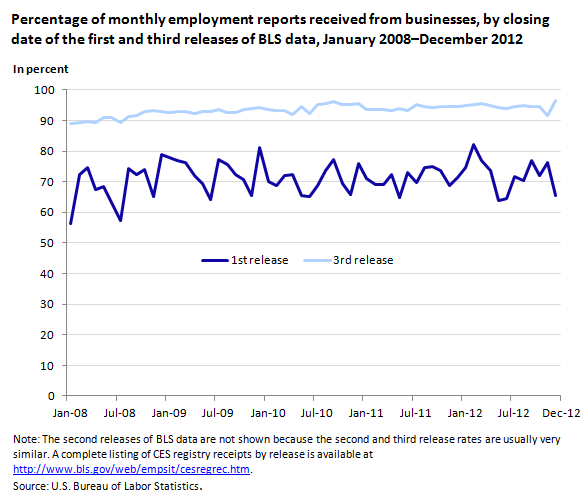
*** The estimate of employment change is based on a monthly survey of about 560,000 worksites, selected to represent the millions of businesses throughout the country. (For simplicity, we will refer to worksites as businesses even though many individual businesses provide data for multiple worksites.) In the survey sample, businesses report the total number of people who worked or received pay during the pay period that includes the 12th of the month. Although BLS uses a variety of methods to gather these reports as quickly as possible, many businesses do not have their payroll data ready to report by the scheduled date that BLS initially releases the data. In 2012, for example, the average collection rate at the time of the initial release was 73.1 percent.
The initial estimate of job change for a month is based on the growth or loss of jobs at the businesses that have reported their data. Generally, BLS assumes that the employment situation at businesses that had reported is representative of the situation at those that had not yet reported. BLS continues to collect outstanding reports from the businesses in the sample as it prepares a second and then a third estimate for the month. With each subsequent estimate, more businesses have provided their information. In 2012, the average collection rate at the time of the third estimate for a month was 94.6 percent. (See chart 1.)
 |
| Source: Bureau of Labor Statistics |
Saturday, July 13, 2013
DC School Voucher Program Reduces High School Dropout Rate From 45 Percent To 3 Percent: President Defunds Program In 2014 Budget Proposal To Protect Teachers Unions
From The Wall Street Journal, "The D.C. Voucher Example: Mr. President, how about that 97% graduation rate?"
Washington D.C.'s Opportunity Scholarship Program has released its latest data on student progress in that landmark voucher program. A remarkable 97% of its students graduated from high school in the 2011-2012 school year—a 4% increase from the two previous years. This compares to a D.C. public schools graduation rate of 55%. More than 90% of parents say they are happy with their voucher child's academic progress, and applications exceed slots for the coming school year by nearly 3 to 1.
Despite this success, Democrats killed D.C. vouchers in 2009 at the behest of teachers unions. It was left to Speaker John Boehner and former Connecticut Senator Joe Lieberman to rescue the education lifeline. The President's 2014 budget proposal again zeroes out funding, but it will survive thanks to House Republicans.
US Household Formation Is At 40 Percent Of Pre-Recession Level: Negative Effect On GDP, Home Values, Household Wealth, Demand For Appliances And Furnishings
From Federal Reserve Bank of Atlanta, Perspectives on Real Estate Speaker Series, "Difficult Job Market Suppresses Household Formations, Fed Expert Says" June 24, 2013:
during and after the 2007–09 recession, the number of households established in America plummeted by about 800,000 a year from the previous seven years.*** From 2007 through 2011, an average of roughly 550,000 households formed each year in the United States, according to the U.S. Census Bureau. This number was the lowest level since records started being kept after World War II, and was 59 percent below the annual average of 1.35 million household formations from 2000 to 2006.
The graduate in the basement may sound like a cliche. But that phenomenon appears to explain a large part of the fall in household formations, [Andrew] Paciorek [an economist at the Federal Reserve Board of Governors] indicated. He pointed out that in 2012, 45 percent of 18- to 30-year-olds lived with older family members, compared to 39 percent in 1990 and 35 percent in 1980. That increase translates to several million more young adults choosing to live with relatives rather than to form a new household.
Because of fall in formations, housing provided no spark for recovery
The decline in household formations is the main reason why the housing industry did not play its traditional role of driving the economic recovery, Paciorek explained. After previous recessions, residential investment typically accounted for 1 to 2 percent of annual economic growth, as measured by the gross domestic product (GDP). By contrast, during the first two years of the current recovery, residential investment made no contribution to GDP growth, and has only recent begun supplying a small lift, he noted.*** The household formation crash also indirectly contributed to other woes, including falling house prices, diminished household wealth tied to lower home values, and weaker demand for expensive goods such as appliances and home furnishings.
Houston Surpasses NYC As Top US Exporter
From Via Media, "Houston Unseats NYC as King of Exports:"
Houston has officially topped New York City as the greatest exporter of goods in the US—exports totaling $110.3 billion.
Friday, July 12, 2013
Decreasing Proportion Of Black Children And White Children In US: Increasing Proportion Of Asian Children, Hispanic Children And Children Of Two Or More Races
From National Institute of Health, "Federal report shows drop in proportion of children in US population: Annual statistics compilation forecasts increasing diversity:"
The number of children living in the United States declined slightly, as did the percentage of the U.S. population who are children, .... The percentage of children living in the United States who are Asian, non-Hispanic increased, as did the percentage of children who are of two or more races, and the percentage of children who are Hispanic. The percentages of children who are white, non-Hispanic, and black, non-Hispanic declined.
By 2050, about half of the American population ages under 17 is projected to be composed of children who are Hispanic, Asian, or of two or more races, the report stated. The report projected that, among children under age 17, 36 percent will be Hispanic (up from 24 percent in 2012); 6 percent will be Asian (up from 5 percent in 2012); and 7 percent will be of two or more races (up from 4 percent in 2012).”
Almost Half Of Uninsured Workers Work For Large Companies Subject To The Health Insurance Mandate
From Forbes, "News Flash: 46% Of Working Uninsured Are In Large Firms Subject To Employer Mandate" by Chris Conover:
Progressives who champion Obamacare, such as Families USA’s Ron Pollack, have assured us that the one-year delay in the employer mandate is "much ado about fairly little" given that more than 94% of employers with 50 or more workers already offer health insurance benefits. Similarly, over at the New York Times’ Economix, Jared Bernstein offers this net assessment of the one-year delay "Hard to see it having much impact at all" since the "vast majority of employers with at least 50 full-time workers — about 95 percent — already offer coverage to the workers."
*** These claims betray a fundamental misunderstanding of the characteristics of uninsured workers in America. The truth is nearly half of the nation’s nearly 28 million uninsured workers are employed by the very firms mandated to provide health coverage. [Emphasis added.]
 |
| Source: Forbes |
Thursday, July 11, 2013
Late 19th And Early 20th Century Progressive Reforms Reduced Number Of Black Professionals
From The Beacon, "Jim Crow and the Progressives" by Carl Close:
Historians often speak glowingly about the Progressive movement of the late 19th and early 20th centuries.*** Writing in the summer issue of The Independent Review, Frostburg State University economists William L. Anderson and David Kiriazis argue that the Progressive "reforms" often enabled statutes aimed at restricting economic opportunities for African Americans. Progressivism, in other words, helped give birth to Jim Crow.*** One especially pernicious example, the economists explain, involved medical licensing. In 1910, seven medical schools were geared toward training African Americans. But after Progressive reformers pushed for standards favored by the (whites-only) American Medical Association only two remained. The school closures led to fewer black physicians available to serve their communities. And by restricting competition for medical services, the closures also boosted the incomes of white doctors.
Similar patterns and outcomes afflicted other professions.
Wednesday, July 10, 2013
Workers Clinging To Jobs: Sign Of Still Weak Job Market
From The Wall Street Journal, Real Time Economics, "Still Not Enough People Willing to Quit Jobs" by Neil Shah:
The labor market has strengthened this year, yet Americans are still scared to quit their jobs — a sign they have yet to regain their confidence in the economy.
 |
| Source: The Wall Street Journal |
Tuesday, July 9, 2013
Credit Card Delinquencies Drop To Two Decade Low
From The Wall Street Journal, Real Time Economics, "Credit-Card Delinquency Falls to Lowest Rate Since 1990" by Eric Morath:
The delinquency rate on credit cards issued by banks fell to a seasonally adjusted 2.41% at the end of the first quarter of this year from 2.47% three months earlier, according to an American Bankers Association report to be published Tuesday. That is the lowest rate since 1990 and well below the 15-year average of 3.87%, the banking group found.
 |
| Source: The Wall Street Journal |
ADHD Kids Taking Medication Show No Academic Improvement Over ADHD Kids Not Taking Medication
From The Wall Street Journal, "ADHD Drugs Don't Boost Kids' Grades Studies of Children With Attention-Deficit Hyperactivity Disorder Find Little Change" by Shirley S Wang:
However, a growing body of research finds that in the long run, achievement scores, grade-point averages or the likelihood of repeating a grade generally aren't any different in kids with ADHD who take medication compared with those who don't. (Typically, studies take into account accommodations schools provide kids with ADHD, such as more time to take tests.)
A June study looked at medication usage and educational outcomes of nearly 4,000 students in Quebec over an average of 11 years and found that boys who took ADHD drugs actually performed worse in school than those with a similar number of symptoms who didn't. Girls taking the medicine reported more emotional problems, according to a working paper published on the website of the National Bureau of Economic Research, a nonprofit economics research firm.
Sunday, July 7, 2013
Feds Seize Bitcoins In Drug Bust
From The Post and Courier, "Digital currency seized in alleged drug law violation in Charleston" by Glenn Smith:
In a case believed to be the first of its kind, federal authorities have seized a Charleston [South Carolina] man's virtual currency due to an alleged drug law violation with possible links to a shadowy online black market.
The U.S. Drug Enforcement Administration recently posted a forfeiture notice indicating that agents had seized 11.02 Bitcoins worth $814 from 31-year-old Eric Daniel Hughes for allegedly violating the federal Controlled Substances Act. No other details were provided.
Friday, July 5, 2013
More Unemployed Drop Out Of Labor Force Than Get New Job
From The New York Times, Economix, "How One Month’s Jobless Fare a Month Later" by Catherine Rampell:
 |
| Source: Bureau of Labor Statistics, via Haver Analytics. The lines show worker flows from unemployment last month into each of the following statuses in the current month: unemployment, not in labor force, employment. Source: The New York Times |
As you can see [from chart above], the most likely outcome for someone unemployed in May was to continue being unemployed in June. The second-most-likely outcome was to drop out of the labor force entirely — that is, stop looking for work. (That’s part of the reason that today’s labor force participation rate is so low, although the biggest flow into the “not in labor force” category still comes from people who are leaving jobs rather than giving up a fruitless job hunt.)
Finally, the third-most-likely outcome was to find a job. Over all, fewer than one in five people who were unemployed in May were employed in June.
Unemployed workers have been more likely to flow out of the labor force than into employment for almost the entire period beginning around December 2008 to the present.
Wednesday, July 3, 2013
Less Particulate Air Pollution Causing More Tropical Storms And Hurricanes: Is EPA Considering The Negative Effects of Storm Related Deaths And Property Damage From Cleaner Air In Its Cost Benefit Studies
From The Washington Post, "An unintended consequence of reduced pollution: More storms" by Cristy Gelling:
Unless EPA adds an amount for the cost of property damage and deaths from the increased likelihood of severe tropical storms and hurricanes from cleaner air, its studies are overstating the benefits of its regulations and rules, especially rules and regulations that target aerosol and particulate producers.
The Clean Air Act, which has benefited breathing in many American cities over the past few decades, may have worsened the weather in some places.According to the National Hurricane Center (Table 3A, Page 9), the cost of the damage from the ten costliest tropical storms and hurricanes up to 2010 was over a quarter of a trillion dollars on a non-inflation adjusted basis. With the addition of Hurricane Sandy, the damage cost is over a third of a trillion dollars. When EPA does a cost benefit analysis, it also includes a dollar amount for the loss of a human life. Adding a dollar figure for the deaths from hurricanes and tropical storms can easily bring the costs of the costliest tropical storms and hurricanes closer to a half trillion dollars.
New climate simulations suggest that reducing the level of atmospheric aerosol particles produced by human activity might have been the main cause of a recent increase in tropical storm frequency in the North Atlantic.
Aerosol levels have increased since the Industrial Revolution began, but there have been periods when emissions stalled or fell, such as the Great Depression, World War II and after clean air legislation was enacted in Europe and the United States in the 1970s and 1980s.
The climate simulations suggest that these periods of lower emissions eventually increased tropical storm frequency. “It seems the Clean Air Act in particular has led to an increased number of hurricanes over the last decade or so,” says Doug Smith of Met Office Hadley Centre in England, a co-author of the research published last week in the journal Nature Geoscience.
Unless EPA adds an amount for the cost of property damage and deaths from the increased likelihood of severe tropical storms and hurricanes from cleaner air, its studies are overstating the benefits of its regulations and rules, especially rules and regulations that target aerosol and particulate producers.
Tuesday, July 2, 2013
Huge Growth In Single Father Households
Posted by Milton Recht:
From The Wall Street Journal, Real Time Economics, "Single-Father Households Are Growing Much Faster Than Single-Mother Ones" by Khadeeja Safdar:
From The Wall Street Journal, Real Time Economics, "Single-Father Households Are Growing Much Faster Than Single-Mother Ones" by Khadeeja Safdar:
The number of American households headed by single fathers has ballooned over the last five decades, according to a new study by the Pew Research Center.
Single-father-led households in the U.S. have risen about nine-fold from less than 300,000 in 1960 to over 2.6 million in 2011, Pew says. A record 8% of households with minor children in the U.S. are headed by a single father, up from just over 1% in 1960, according to Pew, which analyzed Census data. Single-mother households have increased four-fold in the same time period.
Gretchen Livingston, the study’s author and a senior researcher at Pew, defines "single fathers" as people 15 and older who head their household and report living with their own minor children, including step-children or adopted children.
Monday, July 1, 2013
Don't Fret The Student Loan Interest Rate Doubling From 3.4 Percent To 6.8 Percent: If Congress Wants To Help Student Borrowers, It Should Increase The Length Of Time For Student Loan Repayment
Posted by Milton Recht:
Without Congressional action, the federal interest rate on student loans is set to double from 3.4 percent to 6.8 percent. However, a doubling of the interest rate on an amortizing loan, such as a student loan, does not double the monthly payment.
On a 10 year student loan, the doubling of the interest rate will increase monthly payments about 17 percent. On the average student loan of $24,803, payable over 10 years, the monthly payment will increase from $244 per month to $285 per month. An increase of $41 per month. about 17 percent.
Increase The Repayment Period
If our politicians were really concerned about the financial ability of college graduates to repay their student loans, they would offer the borrowers the option of extending the maturity of the loan. Allowing student loan borrowers to pay over fifteen or twenty years would do more to reduce the monthly payment burden then messing around with interest rates on the loans.
For example, the monthly payment on the $24,803 average student loan at 6.8 percent over 10 years is $285; over 15 years, it is $220; over 30 years, it is $189.
More Effective To Lengthen Loan Than Reduce Interest Rates
The monthly payment on a student loan with a 15 year repayment rate at the higher interest rate is lower than the monthly payment on the lower interest rate loan over ten years by 9.8 percent, $220 versus $244 per month. On the twenty year term loan, the monthly payment is 22 percent lower, $189 versus $244.
The obvious solution to the increasing amounts of student loan debt is to extend the term of the loan and allow student borrowers to pay over fifteen or twenty years instead of the current ten years, with no prepayment penalties and with ways to voluntarily increase principal repayments to pay off the student loan faster if they so desired.
Subscribe to:
Posts (Atom)