[H]ow should aid be conditioned so it doesn’t become an artificial incentive to live and build in high-risk places?
A 2016 study ["The Perverse Effects of Subsidized Weather Insurance" by Omri Ben-Shahar & Kyle D. Logue, Stanford Law Review, Volume 68, March 2016] published in the Stanford Law Review pointed out what everybody in Washington quietly knows: “We call weather-related catastrophes ‘natural disasters,’ but the losses” are often due to “questionable government policies.”
... the National Flood Insurance Program, which long ago turned into a perverse subsidy for coastal development.*** As the respected insurance consultancy AIR Worldwide put it in 2015, not climate change but “the growing number and value of coastal properties is the largest factor impacting hurricane risk today.” A whopping $17 trillion in property now exists inside the U.S. storm-surge zone.
... one could even legitimately ask how many have died over the decades as a result of artificial subsidies for Americans to locate in harm’s way.
Saturday, September 15, 2018
How Many Hurricane And Flood Deaths Are Due To US Flood Insurance Subsidies?
From The Wall Street Journal, Opinion, "The U.S. Is Rich, So Storms Are Worse: Donald Trump’s thought processes may be a mystery, but better hurricane policy isn’t." by Holman W. Jenkins, Jr:

Tuesday, September 11, 2018
Home Cooked Meals Increasing: Restaurant Meals Declining
From Bloomberg Business, "American Eating Habits Are Changing Faster than Fast Food Can Keep Up" by Leslie Patton:
Restaurants are getting dinged by the convenience of Netflix, the advent of pre-made meals, the spread of online grocery delivery, plus crushing student debt and a focus on healthy eating. Eighty-two percent of American meals are prepared at home -- more than were cooked 10 years ago, according to researcher NPD Group Inc. The latest peak in restaurant-going was in 2000, when the average American dined out 216 times a year. That figure fell to 185 for the year ended in February, NPD said.
Don’t be fooled by reports of rising U.S. restaurant sales at big chains like McDonald’s Corp. Increases have been driven by price hikes, not more customers. Traffic for the industry was down 1.1 percent in July, the 29th straight month of declines, according to MillerPulse data.
*** Dining Dip
Americans are shifting to more in-home meals versus dining out
 |
| Source: Bloomberg Business |
Saturday, September 1, 2018

Wednesday, August 29, 2018
Google And Facebook Unbiased Search Engines Until Recently Top Ranked Holocaust Deniers: Why Are Tech Companies Refusing To Admit That Their Search Results Can Be Unknowingly Biased: Higher Search Ranking Of Anti-Trump, Anti-Conservative Sites Might Also Be Unintentionally Happening
Until recent changes were made to Google and Facebook search engines, these tech companies promoted Holocaust denier websites to a high ranking in search results about the Holocaust. See for example, BBC News, "Google responds on skewed Holocaust search results" by Chris Baraniuk, Technology reporter, 20 December 2016, and Business Insider, "Facebook has been promoting Holocaust denial groups at the top of its search results, and now says it made a mistake" by Rob Price, Jul. 20, 2018.
I do not believe anyone at the senior and executive level of either company is a Holocaust denier, nor do I believe any employee intentionally manipulated the code of the search engines to promote sites denying the occurrence of the Holocaust.
Complex coding can result in unintentional outcomes. Ask any company that is trying to write autonomous automobile driving programs, any computer programmer who had to debug a computer operating system code or debug any other complex computer program.
If the Tech companies were wiser, they would admit that skewed search results do happen at times in any search and can frequently happen for certain topic searches where there are extreme points of view. Denying that results for political based searches can be one-sided and appear biased is neither productive nor true. There is nothing wrong with adjusting a search to promote some lower ranking sites to give a more balance presentation of facts as a search result even if an unadjusted search result would give a one-sided result a higher ranking.
Saturday, August 25, 2018
News Audience Fell For Every News Media Except Radio In 2017
From Pew Research Center, "5 facts about the state of the news media in 2017" by Michael Barthel:
The audience for nearly every major sector of the U.S. news media fell in 2017 – with the only exception being radio. The evening audience for both local and network TV news declined 7%, while for cable it fell 12%, according to comScore TV Essentials® and StationView Essentials® data. Meanwhile, digital-native news sites’ audiences declined by 5% in terms of monthly unique visitors in 2017, according to comScore Media Metrix Multi-platform data. And the circulation for U.S. daily newspapers, whose audience has been steadily declining for several decades, fell by 11% last year, according to an analysis of data from the Alliance for Audited Media (AAM).
 |
| Source: Pew Research Center |
Tuesday, August 21, 2018
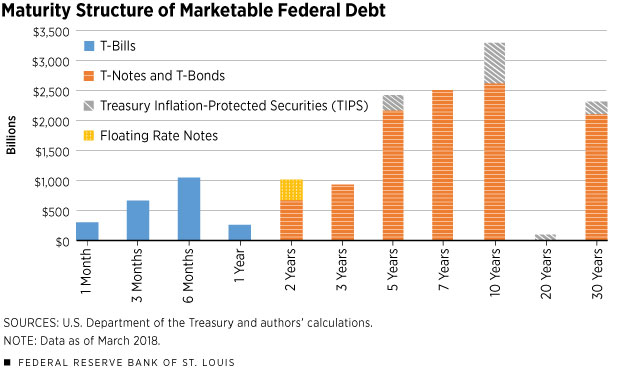
Maturity Structure Of Marketable Federal Debt
From the Federal Reserve Bank of St. Louis, Regional Economist, Third Quarter 2018, "Rising Rates Impact Borrowing Costs for the U.S. Government, Too" by Miguel Faria e Castro and Asha Bharadwaj:
Short and Long Maturities
Figure 2 presents the maturity structure of marketable federal debt as of March 2018. Each bar corresponds to the value of outstanding debt issued at the given maturity.
Source: Federal Reserve Bank of St. Louis
Figure 2 also decomposes this federal debt by the type of security. Each of these securities has different characteristics, such as a particular maturity schedule or a formula for its interest payments.
The bulk of this federal debt is financed using three main types of securities: Treasury bills, Treasury notes and Treasury bonds. These three types of securities account for almost 90 percent of all marketable federal debt outstanding as of March 2018. [Footnotes omitted.]
Thursday, August 16, 2018
Map Showing Real Value Of $100 In Each State
From Tax Foundation, "What Is the Real Value of $100 in Your State?" by Erica York:
This map shows the real value of $100 in each state. Prices for the same goods are often much cheaper in states like Missouri or Ohio than they are in states like New York or California. As a result, the same amount of cash can buy you comparatively more in a low-price state than in a high-price state.
 |
| Source: Tax Foundation |
Wednesday, August 8, 2018
Map Of State Gasoline Taxes
From Tax Foundation, "State Gasoline Tax Rates as of July 2018" by Katherine Loughead:
Today’s map shows gasoline tax rates in each state as of July 2018, using recently released data from the American Petroleum Institute.
States levy gas taxes in a variety of ways, including per-gallon excise taxes collected at the pump, excise taxes imposed on wholesalers and passed along to consumers in the form of higher prices, and sales taxes that apply to the purchase of gasoline.***
 |
| Source: Tax Foundation |
Thursday, July 26, 2018
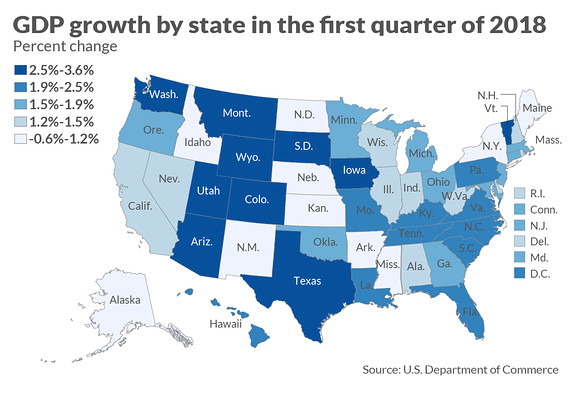
State First Quarter 2018 GDP Growth
From MarketWatch, "The West is the best: These are the fastest growing states" Published: July 26, 2018 by Jeffry Bartash:
The Far West did the best, aided by information and real estate
Source: MarketWatch
Thursday, June 28, 2018
10 Things About CBO
From Congressional Budget Office, "10 Things to Know About CBO," June 28, 2018, Presentation by Dorian Carloni, an analyst with CBO’s Tax Analysis Division, at Le Printemps de l’Évaluation at the French National Assembly:
Since 1975, CBO has produced independent analyses of budgetary and economic issues to support the Congressional budget process. Each year, the agency’s economists and budget analysts produce dozens of reports and hundreds of cost estimates for proposed legislation.
CBO is strictly nonpartisan; conducts objective, impartial analysis; and hires its employees solely on the basis of professional competence, without regard to political affiliation. The agency does not make policy recommendations, and each report and cost estimate summarizes the methodology underlying the analysis.
CBO’s work follows processes specified in the Congressional Budget and Impoundment Control Act of 1974 (which established the agency) or developed by the agency in concert with the House and Senate Budget Committees and the Congressional leadership.
Friday, June 22, 2018
Overview of CBO’s Microsimulation Tax Model
CBO uses its microsimulation tax model to simulate the effects of tax rules for a representative sample of tax filers in each year of the budget window. The model informs much of CBO’s analysis of the individual income and payroll tax system.
Thursday, June 14, 2018
Wednesday, May 23, 2018
Starbucks’s Mobile Payments System Has More Users Than Apple’s Or Google’s
From Recode, "Starbucks’s mobile payments system is so popular in the U.S., it has more users than Apple’s or Google’s: New estimates predict that it will stay that way." by Rani Molla:
By the end of this year, a quarter of U.S. smartphone users — 55 million people — over the age of 14 will make an in-store mobile payment. More than 40 percent of those people will have done so through Starbucks’s mobile payments app, according to new data from research firm eMarketer.
The Starbucks app, which launched before the other three top payments apps — Apple Pay, Google Pay and Samsung Pay — has long been the most successful payments app. It’s likely going to maintain that lead over the next few years.
***
By year’s end, Starbucks will have 23.4 million users in the U.S. who have made an in-store mobile payment in the previous six months, according to eMarketer’s estimates. That number is higher than the 14.9 million customers who are part of Starbucks’s rewards program, which only counts monthly active users; customers also don’t have to be rewards members to make purchases using the app.
Friday, May 4, 2018
Annual And 4th Quarter Real GDP Change By State
From Bureau of Economic Analysis, US Department of Commerce, "Gross Domestic Product by State: Fourth Quarter and Annual 2017: Texas Had the Fastest Growth in the Fourth Quarter:"
Real gross domestic product (GDP) increased in 47 states and the District of Columbia in the fourth quarter of 2017, according to statistics on the geographic breakout of GDP released today by the U.S. Bureau of Economic Analysis. The percent change in real GDP in the fourth quarter ranged from 5.2 percent in Texas to -1.3 percent in North Dakota (table 1 [Omitted]).
Source: BEA *** Annual GDP by state in 2017
Real GDP grew in 47 states and the District of Columbia in 2017. The percent change in real GDP ranged from 4.4 percent in Washington to -0.2 percent in Louisiana (table 4 [Omitted]).
Source: BEA


Wednesday, April 25, 2018
School Safety And School Choice: Comment To "Q&A: How an Economist Unlocked Hidden Truths About School Choice"
My comment to The Wall Street Journal, Real Time Economics, "Q&A: How an Economist Unlocked Hidden Truths About School Choice: Parag Pathak of MIT, winner of the John Bates Clark Medal for the nation’s most impressive economist under 40, says he 'fell into the topic' " by Michelle Hackman:
Prof failed to mention that many parents when given a choice will choose a new school based on its safer environment than its higher academic quality. Some studies try to hide this fact. Probably because many inner city, unionized schools are unsafe. A parent survey may ask for the parent's primary reason for leaving the old school with only a single question about academics and with multiple questions that have a student safety component, such as bullying, lack of discipline, lack of morals, safe environment, etc. The multiple questions with a safety component dilute the response rate and make it appear that safety is less important than academics to parents who want a choice. A choice, like a purchase, allows the parent to acquire a basket of benefits (safety, academics, sports, etc) that more closely matches the parent's and student's priority of benefits and more closely matches their wishes. Having a choice is always better.
Tuesday, April 24, 2018
Expensive Medicine: My Posted Comment To WSJ Opinion, "English Literature Isn’t Brain Surgery: Why is American medicine so expensive?" And An Addendum
My posted comment to The Wall Street Journal, Opinion, "English Literature Isn’t Brain Surgery: Why is American medicine so expensive? One reason is that doctors are forced to get bachelor’s degrees" by Chris Pope and Tim Rice and an addendum following the comment:
Addendum not in the published WSJ comment.
The closing of many medical schools in the early 1900s resulted in discrimination in admission to women and blacks. 5 of the 7 black medical colleges in the US were closed and blacks were denied admission to the non-black medical colleges. Women who were benefiting from the mid 19th-century expansion in women's education were becoming physicians. The early 20th century closing of medical schools shrunk the total number of acceptances to medical schools and the schools denied admission to females and accepted only males. In 1950, in the US, there were fewer female doctors than there were in 1900.
The article has cause and effect reversed. Medicine is a typical mature oligopoly, which over time has created legal, regulatory and capital investment barriers to the entry of competitors. Without competition, medicine's productivity improvements have historically lagged behind US productivity improvements allowing the cost of healthcare to grow faster than the inflation rate and allowing it to become too expensive. Instead of allowing competition and the marketplace to function, in the early 1900s, the AMA raised education standards that closed or merged half the medical schools in the US and it published a list of approved hospitals for residency training. By restricting entry, the AMA limited the supply of physicians, which continues to today with the help of antiquated state licensing laws for doctors, hospitals and other classes of medical providers. High education requirements are an anti-competitive effect of a cartel to justify higher physician earnings.
Addendum not in the published WSJ comment.
The closing of many medical schools in the early 1900s resulted in discrimination in admission to women and blacks. 5 of the 7 black medical colleges in the US were closed and blacks were denied admission to the non-black medical colleges. Women who were benefiting from the mid 19th-century expansion in women's education were becoming physicians. The early 20th century closing of medical schools shrunk the total number of acceptances to medical schools and the schools denied admission to females and accepted only males. In 1950, in the US, there were fewer female doctors than there were in 1900.
Friday, April 13, 2018
Americans Spend More On Taxes Than On Food, Clothing And Housing Combined: 30 Percent Of National Income Goes To Federal And State Taxes
From Tax Foundation, "Tax Freedom Day 2018 is April 19th" by Erica York:
What Taxes Do We Pay?
This year, Americans again will work the longest to pay federal, state, and local individual income taxes (44 days). Payroll taxes will take 26 days to pay, followed by sales and excise taxes (15 days), corporate income taxes (seven days), and property taxes (11 days). The remaining six days are spent paying estate and inheritance taxes, customs duties, and other taxes.
Source: Tax Foundation

Thursday, April 5, 2018
My WSJ comment to "Trump’s Irrelevant Tariffs: The President won the real jobs war, which wasn’t with Mexico or Germany."
My WSJ, Opinion comment to "Trump’s Irrelevant Tariffs: The President won the real jobs war, which wasn’t with Mexico or Germany" by Daniel Henninger:
When you cannot find enough workers to break rocks with a hammer, you buy a hydraulic rock crusher. For many years, until recently, US business capital investment has been declining, especially after accounting for depreciation replacement. Is there a shortage of available and future workers or a shortfall in needed catch-up investment in capital equipment that will increase productivity? When the Bracero guest worker program ended in 1964, the growers replaced labor with harvesting machines. It is competitively natural for industries to become more capital intensive as they mature. Some companies cannot afford to make the needed investment and continue to seek workers, but will not be able to be as productive and compete on price and quality. Eventually, they will go out of business. The US is undergoing a delayed Schumpeterian creative destruction transition, as profitable companies become more capital intensive.
Wednesday, April 4, 2018
My Comment To "Degree Inflation and Discrimination" in WSJ Opinion.
My posted comment to The Wall Street Journal, Opinion, "Degree Inflation and Discrimination: Could civil-rights laws and ‘disparate impact’ protect job applicants who haven’t finished college?" by Frederick M. Hess and Grant Addison:
Disparate Impact is flawed. It sets a minimum standard for ability. Hiring is a long term investment and employers want workers who can exceed the minimum, take more responsibility and be loyal. DI [Disparate Impact] concept is at its core discriminatory and statistically suspect. It assumes all ethnic, racial, cultural groups prioritize jobs equally, so that the same population percentage of equivalent skill, intellect, aptitude of each group is applying for a job. In reality, different populations do not have the same specific career goals. The most able and the least able of each group may be applying for different jobs and careers. Standardized tests aregivinggiven to large populations, but employer tests and applications are given to smaller sample populations. There is no reason to assume from percentage employed that any one company is discriminatory because its application results in different outcomes. Applicants for a specific job opening may differ in ability. Look at professional basketball.
Subscribe to:
Posts (Atom)