American adults of a normal weight with new-onset diabetes die at a higher rate than overweight/obese adults with the same disease, according to a new Northwestern Medicine study.
The study, to be published in the Aug. 7 issue of JAMA, found that normal-weight participants experienced both significantly higher total and non-cardiovascular mortality than overweight/obese participants.
Wednesday, August 8, 2012
Obese Diabetics Have A Lower Overall Death Rate Than Normal Weight Diabetics
From "Thinner Diabetics Face Higher Death Rate" on ScienceBlog:

Soon Your Name And Photo Will Appear On A Starbucks Cashier's Screen When You Enter
From The New York Times, "Starbucks and Square to Team Up" by Claire Cain Miller:
Starbucks has offered its own mobile payment app since last year and processes more than a million mobile payments a week. Customers will continue to be able to use it, but they will also be able to use Pay With Square, Square’s cellphone app, which eliminates even having to take the phone out of your pocket or sign a receipt.
At first, Starbucks customers will need to show the merchant a bar code on their phones. But when Starbucks uses Square’s full GPS technology, the customer’s phone will automatically notify the store that the customer has entered, and the customer’s name and photo will pop up on the cashier’s screen. The customer will give the merchant his or her name, Starbucks will match the photo and the payment will be complete. [Emphasis added.]
Tuesday, August 7, 2012
Economic Analysis Of Romney Tax Plan Shows 6.8 Million Additional Jobs Created And Higher GDP Growth
From "The Economic Effects Of The Romney Tax Plan" by John W. Diamond, Ph.D., Edward A. and Hermena Hancock Kelly Fellow in Public Finance, James A. Baker III Institute for Public Policy, Rice University:
Executive SummaryThe paper's author states:
There is widespread recognition that the U.S. income tax is a complex, highly inefficient, and costly way of raising revenues to finance government expenditures. In this paper, I analyze a rough sketch of the Romney Tax Plan—a rate-reducing, base-broadening tax reform. The simulations show that such a base-broadening, rate-reducing reform would have significant positive economic effects on the U.S. economy, including increases in investment, the capital stock, employment, and real wages. These gains are in addition to increases in GDP, investment, consumption, and employment that will occur as the U.S. economy continues to recover from the recent recession and as the population grows. Specifically, I find that the reform would, if passed immediately, increase GDP relative to baseline by 5.4 percentage points over the next decade, while creating 6.8 million jobs.
Versions of the model have been used in analyses of tax reforms by the U.S. Department of the Treasury (President’s Advisory Panel on Federal Tax Reform 2005), the Congressional Joint Committee on Taxation (Joint Committee on Taxation 2003), and in a number of other recent tax policy studies (Diamond and Zodrow 2007, 2008; Diamond and Viard 2008; Carroll, Cline, Diamond, Neubig, and Zodrow 2010; and Zodrow and Diamond, forthcoming).[HT: Greg Mankiw]
More Income Equality, Less Inequality, When Value Of Employer And Public Health Benefits Included In Income
From Brookings, "With Health Care Costs, the U.S. Is a Huge Outlier" by Gary Burtless:
Nearly all the widely reported estimates of the trend in median income, for example, omit the additions in health care consumption that are paid through employer and public health plans. The omission tends to produce an overstatement in common estimates of the growth in U.S. income inequality.*** The Congressional Budget Office (CBO) recently published income distribution statistics that include the value of health benefits. Those statistics show faster income gains and a smaller increase in inequality than earlier estimates. For example, the Census Bureau's estimates of cash incomes show that average incomes in the bottom one-fifth of households only increased 7% between 1979 and 2009 compared with an increase of 13% in the middle one-fifth of households. In contrast, the CBO's estimates imply that the gross incomes (including health benefits) of these households increased much faster. In the bottom one-fifth of households, the CBO estimates show real income gains of 35%; in the middle one-fifth of households, estimated gross incomes climbed 21%. If we focus on after-tax income gains, the percentage increases in income were even larger.*** the inclusion of health benefits makes a big difference. For the average U.S. household, gross income excluding health benefits increased 35% between 1979 and 2009. In comparison, estimated health benefits per person increased 205%. Counting health benefits has a bigger impact on estimated income gains in the middle and at the bottom of the income distribution than it does at the top. That's because health benefits are a bigger proportion of total income for households in the middle and at the bottom of the distribution than they are for households at the top.*** the new estimates suggest that income gains in the bottom 80% of the distribution have been more egalitarian than widely believed. [Emphasis added.]
Monday, August 6, 2012
OECD Countries With Largest Growth In Government Stimulus Spending Had Slowest GDP Growth: Arthur Laffer
From The Wall Street Journal, "Arthur Laffer: The Real 'Stimulus' Record: In country after country, increased government spending acted more like a depressant than a stimulant." by Arthur Laffer:
 |
| Source: The Wall Street Journal |
Of the 34 Organization for Economic Cooperation and Development nations, those with the largest spending spurts from 2007 to 2009 saw the least growth in GDP rates before and after the stimulus.
The four nations—Estonia, Ireland, the Slovak Republic and Finland—with the biggest stimulus programs had the steepest declines in growth. The United States was no different, with greater spending (up 7.3%) followed by far lower growth rates (down 8.4%).*** Often as not, the qualification for receiving stimulus funds is the absence of work or income—such as banks and companies that fail, solar energy companies that can't make it on their own, unemployment benefits and the like. Quite simply, government taxing people more who work and then giving more money to people who don't work is a surefire recipe for less work, less output and more unemployment.*** Well, the truth is that government spending does come with debits. For every additional government dollar spent there is an additional private dollar taken. All the stimulus to the spending recipients is matched on a dollar-for-dollar basis every minute of every day by a depressant placed on the people who pay for these transfers. Or as a student of the dismal science might say, the total income effects of additional government spending always sum to zero.
Meanwhile, what economists call the substitution or price effects of stimulus spending are negative for all parties. In other words, the transfer recipient has found a way to get paid without working, which makes not working more attractive, and the transfer payer gets paid less for working, again lowering incentives to work. [Emphasis added.]
Sunday, August 5, 2012
ARPANET, Government Control And Censorship, DOD Funding Restrictions And The FCC Hindered And Delayed The Internet: Without ARPANET The US Might Have Had The Internet Sooner
From Foundation For Economic Education, November 1, 1998, "Does the Internet Prove the Need for Government Investment? The Real Internet Grew out of a Spontaneous Ordering Process" by Andrew P. Morriss:
Why Was There No “Private ARPANET”?[HT: John Stossel via Warren Smith via Mark Perry]
Government activity generally “crowds out” private activity by absorbing resources that could be used elsewhere. Computer networking is no exception. Not only did the government directly seize resources through taxation and lock up knowledge in classified documents, it also lured many of the best computer scientists to work on its projects, slowing private-sector activity.
Private networks were attempted, but they failed. Setting up a network required permission from the Federal Communications Commission, and existing communications companies like Western Union fought the creation of new networks. Even when a private packet-switching network, Telenet, began operation, “many millions in legal expenses” were required to fight the regulatory battle prompted by RCA, ITT, AT&T, and Western Union. This kept Telenet from making profits for years.11 Regulatory barriers to entry, not a lack of entrepreneurial activity, slowed the efforts to build private networks.
Despite these obstacles, a private network among universities, USENET, sprang up. It resembled today’s Internet much more than ARPANET did. USENET developed because the Defense Department limited ARPANET to a relatively small number of sites. People at other sites wanted a network too, and USENET quickly surpassed ARPANET in usefulness because it lacked the restrictions DOD money imposed on ARPANET. (USENET still exists; it is a collection of newsgroups devoted to every subject imaginable.)
ARPANET Was Not the Internet
*** Its constant and rapid growth: There are hundreds of thousands, if not millions, of connections on the Internet depending on how one defines “connection.” ARPANET, in contrast, grew slowly. In 1969 there were just four host computers connected. By January 1976 there were just 63. ARPANET’s limited scope was due to its restriction to sites with DOD funding.
Its freedom with respect to content: It is nearly impossible to control how individuals use the Internet. Because it was built with government funds, ARPANET users faced a number of restrictions on their use of the network. Commercial use, for example, was banned. Even one of the most popular uses, newsgroups, quickly ran into censorship problems. Although the first newsgroups concerned primarily technical issues about the network, users quickly began to establish groups concerning other subjects of interest. When several users proposed a newsgroup dealing with recreational drugs, those in control of the network rejected it as too controversial. (Drugs weren’t the only subject that was rejected; a proposal for a newsgroup called “gourmand” was also turned down because the creator refused to change the name to “recipes.”)*** Unlike the mythical Internet that sprang forth from the ARPANET, the real Internet grew out of a spontaneous ordering process of the interactions of millions of individual users. The uses we make of the Internet were unimaginable to the researchers and scientists who created the networking protocols and hardware advances we rely on today. Far from being the result of the government’s “strategic” investment in the original Defense Department networks, today’s Internet developed at most accidentally from and often in spite of those investments. The explosive growth in commerce, for example, became possible only when the government’s ban on commercial use of the networks it financed was lifted.
Moreover, the “strategic” nature of the early investment in networking is a myth. No one consciously created the Internet. While an international network of networks undoubtedly would look different today had ARPANET never existed, there is also little doubt that packet-switching and e-mail would have evolved anyway. Dedicated, motivated people with a need to communicate—for commercial and noncommercial purposes—would have surely seen to it.
US Government Will Run Health Insurance Exchanges In Half Of The 50 States: US Turns To Canadian Company, CGI Group, To Provide IT Services
The US government, contrary to to its initial expectations of 50 state run health insurance exchanges, is finding that it will have to operate the ObamaCare mandated health insurance exchanges in about 25 states.
The US has decided to contract with a Canadian IT consulting company, CGI Group, whose stock shares are primarily traded and listed on the Toronto Stock Exchange, for information technology services for 5 years and almost a $100 million.
From The New York Times, "U.S. Officials Brace for Huge Task of Operating Health Exchanges" by Robert Pear:
The US has decided to contract with a Canadian IT consulting company, CGI Group, whose stock shares are primarily traded and listed on the Toronto Stock Exchange, for information technology services for 5 years and almost a $100 million.
From The New York Times, "U.S. Officials Brace for Huge Task of Operating Health Exchanges" by Robert Pear:
When Congress passed legislation to expand coverage two years ago, Mr. Obama and lawmakers assumed that every state would set up its own exchange, a place where people could shop for insurance and get subsidies to help defray the cost.*** “We realize that not all states will be ready to establish these exchanges by 2014, so we are setting up a federally facilitated exchange in those states,” said Michael Hash, the top federal insurance regulator. “We are on track to go live in October 2013, which is the beginning of the first open season for the individual and small group markets.”*** Federal and state officials and health policy experts expect that the federal government will run the exchanges in about half of the 50 states — a huge undertaking, given the diversity of local insurance markets.*** Federal officials have turned to the American subsidiary of a Canadian company, the CGI Group, to provide information technology services to the federal exchanges under a contract that could be worth $93.7 million over five years.
Thursday, August 2, 2012
All Personnel, Even Janitors, Earn More In A Medical Setting: Average Medical Wages Grew 18 Percent From 2005 To 2011
From The Dallas Morning News, "Eli Lehrer: Your doctor makes too much money" by Eli Lehrer:
A physician practicing in a primary care setting, according to the Bureau of Labor Statistics, earned an average of just over $200,000 in 2010, while specialists averaged over $355,000, the highest of any professional category tracked. By comparison, lawyers average just over $110,000, airline pilots about $92,000, and chartered actuaries — who calculate risk for insurance companies and must pass complex exams longer and arguably more difficult than the medical boards — about $150,000.*** Registered nurses and dental hygienists, who need only associate degrees, earn about $70,000 a year. This is about as much as degreed computer programmers. And it’s significantly more than high school teachers and forensic scientists, who need master’s degrees but earn less than $60,000 on average.
Wage disparities exist at all levels of the health care industry. Even nonmedical professionals like janitors tend to earn more in health care settings than those working elsewhere. An extensive report from the Brookings Institution sums up the evidence: "Health care pays higher-than-average wages regardless of workers’ skills and demographic characteristics."*** Between 2005 and 2011, as overall average wages barely kept pace with inflation (with rising health costs making real take-home pay flat for many workers), average medical wages grew a healthy 18 percent, rising from just over $62,000 to almost $73,000. The American Hospital Association estimates that two-thirds of medical costs are attributable to wages and benefits.
Raising The Compulsory School Attendance Age Will Not Increase HS Graduation Rates
From "Compulsory School Attendance: What Research Says and What It Means for State Policy" by Grover J. "Russ" Whitehurst and Sarah Whitfield:
- Raising the CSA [compulsory school attendance] age does little to address the root causes of high dropout rates and is unlikely to produce increases in high school graduation rates that will be noticeable to state policymakers and taxpayers.
- There is no consistent relationship between the leniency in the laws governing the CSA age and rates of school attendance.
Tuesday, July 31, 2012
SEC Loses Jury Trial Securities Fraud Lawsuit Against Citigroup Director For Shorting Against Mortgages Sold To Investors
From Bloomberg, "SEC Loses Lawsuit Against Ex-Citigroup Official Stoker" by Bob Van Voris and Emily Grannis:
If Goldman Sachs had gone to trial over similar SEC allegations instead of settling, it likely would have also won.
The SEC complaint against Stoker is available here.
The Securities and Exchange Commission lost a jury verdict in its lawsuit against former Citigroup Inc. official Brian Stoker over a deal at the center of the bank’s proposed $285 million settlement with regulators over subprime residential mortgage securities.The SEC complaint, US SEC v Brian H Stoker, basis for the allegation of securities fraud stated:
The jury reached its verdict today in Manhattan federal court. The SEC had accused Stoker, the former director of Citigroup’s collateralized debt obligation structuring group, of violating securities law in putting together the assets underlying a $1 billion CDO.
The SEC claimed New York-based Citigroup structured and sold the CDO without telling investors that it helped pick about half the underlying assets and was betting they would decline in value by taking a short position.
Undisclosed in the marketing materials and unbeknownst to investors, Citigroup exercised significant influence over the asset selection process for the purpose of creating a tailored, proprietary bet against the collateral of Class V III. Through its influence on the selection of the investment portfolio, Citigroup was able to short a set of assets it hand-picked by entering into CDS to buy protection on those assets from Class V III. The CDS assets on which Citigroup bought protection had a notional value of approximately $500 million, representing half of Class V III’s investment portfolio. The marketing materials Citigroup prepared and distributed to investors did not disclose Citigroup’s role in selecting assets for Class V III and did not accurately disclose to investors Citigroup’s short position on those assets.Selling sophisticated investors a portfolio of mortgages, while simultaneously shorting against those mortgages without disclosing the short, is not fraud according to a jury.
If Goldman Sachs had gone to trial over similar SEC allegations instead of settling, it likely would have also won.
The SEC complaint against Stoker is available here.
Monday, July 30, 2012
Sunday, July 29, 2012
One Simple Chart That Shows ObamaCare Is A Mirage: ObamaCare Will Fail: Will Not Provide Medical Services To The Uninsured: Will Not Lower Costs: Will Not Provide Care To Those With Pre-Existing Conditions
Chart from The New York Times article, "Doctor Shortage Likely to Worsen With Health Law" by Annie Lowrey and Robert Pear:
ObamaCare makes promises about medical services and care without putting into place anything that will allow those promises to be kept. The law extends health insurance coverage to the uninsured. The law also eliminates pre-existing medical conditions as a reason for the denial of health insurance coverage. President Obama has misled the public into believing that having insurance means the same as getting needed medical care.
Insurance is just a means to pay for a service or product. It is not a mechanism for making that service or product available to the public.
As the above chart shows, there is a projected shortage of doctors in the US that will be made worse by ObamaCare.
In the coming years, the US public will find it has medical insurance to pay for needed medical services, but there will not be enough medical providers to meet the demand to give those services to all those in need.
People with their new medical insurance courtesy of ObamaCare will find that their situation will be the same as if they had no insurance. They will not get the care they need in a timely fashion.
ObamaCare is like a parents' holiday promise to their child that Santa will deliver the hottest, most sought after, new toy. The problem is the toy is sold out and the parents did not buy it yet.
ObamaCare is false hope to those who most desperately will need care. Because Obama's name will be forever linked with the law that is commonly known as ObamaCare instead of its legal name, The Patient Protection and Affordable Care Act, Obama's name will be forever associated with a law that does not deliver on its promises and that gives false hope to those in need.

 |
| Source: The New York Times |
Insurance is just a means to pay for a service or product. It is not a mechanism for making that service or product available to the public.
As the above chart shows, there is a projected shortage of doctors in the US that will be made worse by ObamaCare.
In the coming years, the US public will find it has medical insurance to pay for needed medical services, but there will not be enough medical providers to meet the demand to give those services to all those in need.
People with their new medical insurance courtesy of ObamaCare will find that their situation will be the same as if they had no insurance. They will not get the care they need in a timely fashion.
ObamaCare is like a parents' holiday promise to their child that Santa will deliver the hottest, most sought after, new toy. The problem is the toy is sold out and the parents did not buy it yet.
ObamaCare is false hope to those who most desperately will need care. Because Obama's name will be forever linked with the law that is commonly known as ObamaCare instead of its legal name, The Patient Protection and Affordable Care Act, Obama's name will be forever associated with a law that does not deliver on its promises and that gives false hope to those in need.
Friday, July 27, 2012
US In Second Slowest Post Recession Recovery Since WWII: 1980-81 Recovery Slower
From The Wall Street Journal Real Time Economics, "Current Recovery Second Slowest Postwar Rebound" by Eric Morath and Sarah Portlock:
From the second quarter of 2009, when the recession ended, through 2011, the economy grew a total of 5.8%, a downward revision from a 6.2% gain, the recasting of the past three years’ gross domestic product figures found. Only the brief 4-quarter recovery in 1980 and 1981, when the economy grew a total of 4.4%, was weaker in the past 60 years.
Growth in the early part of 2010 wasn’t nearly as strong as previously thought, with GDP advancing 2.3% and 2.2% in the first and second quarter, respectively. That’s down from prior readings of near 4.0% annualized growth. Business investments in the first half of 2010 are now seen as being much weaker.
Conversely, the data showed the most recent recession was milder than prior readings – though still the largest downturn since the Great Depression. During the recession, which began in the fourth quarter of 2007, GDP declined 4.7%, compared to a previous reading of down 5.1%.
Thursday, July 26, 2012
Illuminating Unintended Consequences Figure Mankiw Mentions
Harvard Economics Professor Greg Mankiw, in his blog, mentions a book he is currently reading, Unintended Consequences by Edward Conard. He says he found Figure 1-6 on page 22 quite illuminating. I have reprinted that figure below.
The chart is another example of how a single summary statistic, real median income, can hide underlying positive trends. In this case, white and non-white, male and female, full-time and part-time workers have seen substantial real median income growth from 15 to 75 percent, before including the value of benefits, over the 25 years from 1980 to 2005, while the overall real median income growth for the entire combined group was only 3 percent over the same time frame.
A free excerpt of the book is available here, including the page with the mentioned figure.
The book is also available for purchase from Amazon:Unintended Consequences: Why Everything You've Been Told About the Economy Is Wrong
 |
| Source: Unintended Consequences by Edward Conard, Published by Penguin Portfolio, 2012. |
The chart is another example of how a single summary statistic, real median income, can hide underlying positive trends. In this case, white and non-white, male and female, full-time and part-time workers have seen substantial real median income growth from 15 to 75 percent, before including the value of benefits, over the 25 years from 1980 to 2005, while the overall real median income growth for the entire combined group was only 3 percent over the same time frame.
A free excerpt of the book is available here, including the page with the mentioned figure.
The book is also available for purchase from Amazon:Unintended Consequences: Why Everything You've Been Told About the Economy Is Wrong
Monday, July 23, 2012
Comment To Leonhardt's New York Times Article On Middle Class Decline
My comment to David Leonhardt's misleading article, "A Closer Look at Middle-Class Decline" in The New York Times:
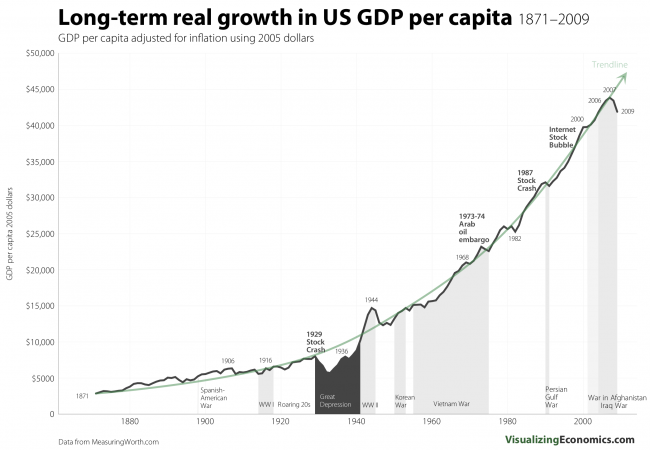
Also see the following chart from VisualizingEconomics Blog, which shows inflation adjusted US per capita GDP since the 1870s.
When you look at inflation adjusted US GDP per capita, there has been a continued growth from the 1870s on with occasional dips during recessions, which were surpassed during the following recoveries.See the chart in my earlier post, "Per Capita Real GDP At 2005 Levels" which shows inflation adjusted per capita GDP from the 1950s until the recent recession.
The recent recession set per capita GDP back to 2005 levels.
Using per family and per household income data is misleading as Leonhardt knows.
Family and household size are not constant over time. Anything that shrinks the size of the family or household, such as divorce, tendency for single and married adults to want their own place, and delayed marriage age will increase the number of families and households and shrink the income per family and household without any change in their economic well being.
Likewise, the tendency for women to work and be in two wage earner families means that there will be more marriages with two high earning spouses.
The household and family income data showing a decline in income is a product of social changes over the last 50 years. There are more divorces, more setting out on one's own, and more two high wage earner families.
It is not a reflection of the failure of the US economic engine and that engine does not need more government intervention to fix it.
The lower family and household numbers are a symptom of the success of the US, in that economic growth allows more people to live on their own, to seek divorce and not be dependent on their spouse and more people can be married to someone of either sex who earns a high income.
Also see the following chart from VisualizingEconomics Blog, which shows inflation adjusted US per capita GDP since the 1870s.

 |
| Source: VisualizingEconomics |
CBO Shows The Rich Pay Too Much In Taxes
From The Wall Street Journal "Ari Fleischer: The Latest News on Tax Fairness: A new Congressional Budget Office reports shows the share of taxes paid by the top 20% has gone up over the last 30 years, while the share of taxes paid by everyone else has gone down" by Ari Fleischer:
If fairness in paying taxes means the amount you pay is based on the amount you make, then the only group in America paying at least a "fair share" is the top 20%—people who make more than $74,000. For everyone else, the tax code is a bargain.*** The top 1% of income earners pay an average federal tax rate of 28.9%. The average federal tax rate on the top 20% is 23.2%. The 20% of taxpayers earning between $50,100 and $73,999 pay an average 15.1%, and so on down the line. The CBO report includes payroll as well as income taxes paid.
There's also another way of looking at fairness, and that's the tax burden. Here, consider the top 20% of income earners (over $74,000). They make 50% of the nation's income but pay nearly 70% of all federal taxes.
The remaining 30% of the tax burden is borne by 80% of the taxpayers, those who make less than $74,000. In short, this group's share of taxes paid, 30%, is lower than the share of income they earn, 50%.
Obama's "You Did Not Build That" Speech Is A Confession Of His Insecurities About His 2008 Presidential Election Win
We are all products of our pasts. Our perceptions of the world and people are shaped by our personal histories, our family relationships and interactions, our genetically determined physical and emotional health and life's random good and bad fortunes that befall us all.
If we grow up seeing the adults around us face the inevitable problems of life with a mature understanding that all people face hardships and setbacks at some time; that life can be both fair and unfair; that the world owes us nothing; that the best approach is not to wallow in self-pity, but to attempt to plow through the bad times, find solutions that will help us through the harsh winters, while reaching out for and seeking the support and help from family, friends and others around us that care, then we realize we are responsible for our own lives, and there are others who will help us if they can when we are in need.
If our upbringing and family are competitive, unfair and unsupportive, we will grow up jealous of others' successes and feel that there is nothing we can do to win because the cards are stacked against us and we are alone in our battles with life.
Obama is a smart, well-educated individual with weaknesses, like all of us, in some critical intellectual areas. He is particularly weak in economics, and I am sure there are other areas, but that knowledge lack does not limit his ability to be a good president.
He, and his 2008 presidential election team, ran a masterful election campaign that won him the Democratic party nomination over Hillary Clinton, the presumptive party candidate at the time. Obama also surpassed McCain who was leading in the polls until just a few weeks before the 2008 election.
Despite his tour de force 2008 presidential win, his previous Illinois State Senate and Illinois US Senate seat wins, it is clear, at least to me, that Obama's "You Did Not Build That Speech" is a statement that he feels he did not win based on his merits.
Some of his feelings are normal. Some successful individuals will feel their success is undeserved and only due to good luck. It is the common "pinch me so I wake up from this dream" response to something good, or the feeling that some have that good times must be followed by bad times.
Obama not only feels his personal success is undeserved, but he sees the government, may be as part of his childhood or as part of his admissions to a private preparatory school and then Occidental and Columbia Colleges, as responsible for his political success.
Obama's upbringing is unusual for an American. His rearing included an early childhood education in Jakarta, an absentee father, long periods of separation from his mother, little contact with his paternal relatives and a mixed race parentage when it was much less common than it is today.
When Obama talks of society's fairness, the need for government intervention, his resentment and jealousy of those more economically successful on their own merit than himself, he is reacting to his insecurities and his somewhat unique past. Without strong and supportive parental relationships and family support, government becomes your family, your protector and your provider.
Obama's "You Did Not Build That" speech reflects the world he knew growing up. It is his perception of the world and how people and families deal with life's successes and failures and who they can turn to in times of need.
If we grow up seeing the adults around us face the inevitable problems of life with a mature understanding that all people face hardships and setbacks at some time; that life can be both fair and unfair; that the world owes us nothing; that the best approach is not to wallow in self-pity, but to attempt to plow through the bad times, find solutions that will help us through the harsh winters, while reaching out for and seeking the support and help from family, friends and others around us that care, then we realize we are responsible for our own lives, and there are others who will help us if they can when we are in need.
If our upbringing and family are competitive, unfair and unsupportive, we will grow up jealous of others' successes and feel that there is nothing we can do to win because the cards are stacked against us and we are alone in our battles with life.
Obama is a smart, well-educated individual with weaknesses, like all of us, in some critical intellectual areas. He is particularly weak in economics, and I am sure there are other areas, but that knowledge lack does not limit his ability to be a good president.
He, and his 2008 presidential election team, ran a masterful election campaign that won him the Democratic party nomination over Hillary Clinton, the presumptive party candidate at the time. Obama also surpassed McCain who was leading in the polls until just a few weeks before the 2008 election.
Despite his tour de force 2008 presidential win, his previous Illinois State Senate and Illinois US Senate seat wins, it is clear, at least to me, that Obama's "You Did Not Build That Speech" is a statement that he feels he did not win based on his merits.
Some of his feelings are normal. Some successful individuals will feel their success is undeserved and only due to good luck. It is the common "pinch me so I wake up from this dream" response to something good, or the feeling that some have that good times must be followed by bad times.
Obama not only feels his personal success is undeserved, but he sees the government, may be as part of his childhood or as part of his admissions to a private preparatory school and then Occidental and Columbia Colleges, as responsible for his political success.
Obama's upbringing is unusual for an American. His rearing included an early childhood education in Jakarta, an absentee father, long periods of separation from his mother, little contact with his paternal relatives and a mixed race parentage when it was much less common than it is today.
When Obama talks of society's fairness, the need for government intervention, his resentment and jealousy of those more economically successful on their own merit than himself, he is reacting to his insecurities and his somewhat unique past. Without strong and supportive parental relationships and family support, government becomes your family, your protector and your provider.
Obama's "You Did Not Build That" speech reflects the world he knew growing up. It is his perception of the world and how people and families deal with life's successes and failures and who they can turn to in times of need.
Friday, July 20, 2012
Store Bought CFLs Emit Significant Amounts Of Skin Damaging Ultraviolet Radiation
Researchers at Stony Brook found that store bought compact fluorescent light bulbs (CFLs) emit skin damaging amounts of ultraviolet radiation. Isn't it great when Congress and the environmentalists decide what is best for us and take away our right to choose and buy old fashioned incandescent bulbs. Energy saving can never be a bad thing to them even if it harms us in other ways. May be the public is not so irrational after all. The public understands that newer technologies present new risks as it reduces an older problem. In addition to the studied radiation, CFLs also contain toxic mercury which is released if the bulbs are broken.
The public should be free to make its own choices and the public should not be treated as children that are told what to do by a paternalistic environmental lobby and Congress. If something is really better, economically and health-wise, the public will choose it without legislative or regulatory mandates.
From "New Light Bulbs May Be Harmful To Skin" on ScienceBlog:
The public should be free to make its own choices and the public should not be treated as children that are told what to do by a paternalistic environmental lobby and Congress. If something is really better, economically and health-wise, the public will choose it without legislative or regulatory mandates.
From "New Light Bulbs May Be Harmful To Skin" on ScienceBlog:
Stony Brook researchers [led by Miriam Rafailovich, PhD, Professor of Materials Science and Engineering and the Director of the Garcia Center for Polymers at Engineered Interfaces at Stony Brook] collected CFL bulbs purchased from different locations across Suffolk and Nassau counties, and then measured the amount of UV emissions and the integrity of each bulb’s phosphor coatings. Results revealed significant levels of UVC and UVA, which appeared to originate from cracks in the phosphor coatings, present in all CFL bulbs studied.Read more at http://scienceblog.com/55704/new-light-bulbs-may-be-harmful-to-skin/#DV91qrRfX5MEiyo7.99
At Stony Brook’s Advanced Energy Research and Technology Center (AERTC), the team took the same bulbs and studied the effects of exposure on healthy human skin tissue cells, including: fibroblasts, a type of cell found in connective tissue that produces collagen; and keratinocytes, an epidermal cell that produces keratin, the key structural material in the outer layer of human skin. Tests were repeated with incandescent light bulbs of the same intensity....
"Our study revealed that the response of healthy skin cells to UV emitted from CFL bulbs is consistent with damage from ultraviolet radiation," said Professor Rafailovich....Rafailovich added that incandescent light of the same intensity had no effect on healthy skin cells....
"Despite their large energy savings, consumers should be careful when using compact fluorescent light bulbs," said Professor Rafailovich. "Our research shows that it is best to avoid using them at close distances and that they are safest when placed behind an additional glass cover." [Emphasis added.]
Everyone Knows Obama Has Not Worked Out As A President But People Will Vote For Him Anyway
From The Wall Street Journal, "Noonan: A Remedial Communication Class: Lessons from three recent failures, at the Olympics and on the campaign trail" by Peggy Noonan:
The American people tell you the narrative. They look at the facts produced by your leadership, make a judgment and sum it up. The summation is spoken—the story told—at a million barbecues in a million back yards.
The narrative on the president right now is: He's not a bad guy, but it hasn't worked.
Some people will vote for him anyway, some won't. But all, actually, know it hasn't worked. That's the narrative.
Thursday, July 19, 2012
Obama Is Stalling US Engine Of Growth By Delaying Free Trade Agreements: Obama Far Behind Predecessors And Other Countries In Opening Trade
From The Washington Times, "Obama administration stalls economic engine of new free-trade pacts" by Ben Wolfgang:
"The U.S. isn’t going to make progress on trade until we get another president. I don’t know if Mitt Romney is the answer, but Obama clearly is not," said Peter Morici, a professor and international trade scholar at the University of Maryland.
Mr. Obama’s lackluster record on trade, an increasing target of the Romney campaign, stands in stark contrast to those of his predecessors.
Mr. Bush signed free-trade agreements with more than a dozen countries, including Australia, Peru, Singapore and Bahrain. President Clinton’s first term included the signing of the North American Free Trade Agreement with Canada and Mexico, the establishment of permanent normal trade relations with China and the birth of the World Trade Organization.*** While the Obama administration has failed to achieve any new deals, he says, the rest of the world is moving full steam ahead. Since 2007, the European Union has finalized or negotiated more than 20 deals. China has signed or negotiated nearly 20. [Emphasis added.]
Subscribe to:
Posts (Atom)