Friday, January 14, 2011

Hybrid Cars Are Uneconomical Under Electric Pricing Policies To Reduce Greenhouse Gases

From "Electricity pricing policies may make or break plug-in hybrid buys" on ScienceBlog:
California policies aimed at reducing electricity use and curbing greenhouse gas emissions have the unintended consequence of making new plug-in hybrid vehicles uneconomical, according to a Purdue University economist.
***
In tiered systems, consumers pay a higher rate for electricity they use beyond a certain amount. California has three rate tiers. It also has a time-of-use system, which reduces the rate during periods of low demand. In addition, Californians pay some of the highest electricity rates – an average of 14.42 cents per kilowatt hour, which is about 35 percent higher than the national average.

“The objective of a tiered pricing system is to discourage consumption. It’s meant to get you to think about turning off your lights and conserving electricity. In California, the unintended consequence is that plug-in hybrid cars won’t be economical under this system,” said Tyner, whose findings were published in the early online version of the journal Energy Policy. “Almost everyone in California reaches the third pricing tier each month. If they add a plug-in hybrid, they are charged the highest rate.”
Read the complete article here.

See my previous related post "Proxy Problem Of Carbon Based Pricing And Global Warming."

Municipalities Facing A Credit And Refinancing Crunch

From The Wall Street Journal article "New Hit to Strapped States: Borrowing Costs Up as Bond Flops; Refinancing Crunch Nears" by Michael Corkery And Ianthe Jeanne Dugan:
With the market for municipal bonds tumbling, cities, hospitals, schools and other public borrowers are scrambling to refinance tens of billions of dollars of debt this year, another sign that the once-safe market is under duress.

The muni bond market was hit with the latest wave of bad news Thursday, prompting a selloff that sent the market to its lowest level since the financial crisis.
Read the complete article here.

Wednesday, January 12, 2011

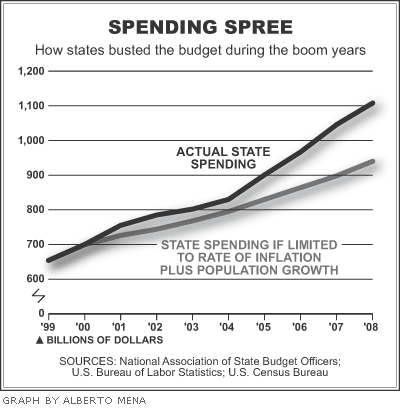
State Spending Growth Exceeded Inflation And Population Growth

From City Journal, "State Budget Bunk: A taxonomy of fiscal gimmicks, evasions, and ploys" by Steven Malanga, a chart of excess state spending over inflation and population growth:

Source: City Journal


Read the complete City Journal article here.

Monday, January 10, 2011

Air Quality Was Improving Before Clean Air Act: Significant Reductions In Sulfur Dioxide Occurred Before Clean Air Act

From "Flashback: Air Quality Trends Before 1970" by Steven F. Hayward on environmentaltrends, via Internet Archive Wayback Machine:
Most reports on air quality trends typically begin with 1970, with the passage of the first Clean Air Act and the beginning of systematic monitoring of emissions and ambient levels of air pollution. Data from early monitors and evidence from air quality models, however, show that many forms of air pollution started to decline—in some cases rapidly—before the Clean Air Act of 1970.

For sulfur dioxide, data from 21 urban monitors show that the average ambient level fell approximately 40 percent between 1962 and 1964, as shown in Figure 1. This set the stage for progress after the Clean Air Act; the national average dropped 66 percent since then. Local data for New York City show that ambient sulfur dioxide fell by almost 50 percent between 1964 and 1970....


Ambient SO2 Level, Mean Annual Average, 1962-1997


Ambient SO2 Concentrations in New York City, 1963-1972


As it is often the case, legislation just puts into law a natural, already recurring response to a problem. Legislators then can take the praise and glory for what would have happened without their involvement and legislation. In most cases, the law passage increases costs, creates unnecessary criminality and creates rigidity where flexibility is often needed.

Legislators and enforcement agencies will be able to cite statistics showing an improvement post passage of the law. However, a trend line starting from before the law's existence will almost always show that the law did not make any improvement over the pre-existing trend.


Households Paid Down Debt Instead Of Adding To Savings Accounts During Recent Recession

During the recent recession and financial crisis, households paid down debt instead of putting the extra cash into savings and retirement accounts.

From Federal Reserve Bank of New York Staff Reports, January 2011, "Household Debt and Saving during the 2007 Recession" by Rajashri Chakrabarti, Donghoon Lee, Wilbert van der Klaauw and Basit Zafar:
increase in saving―at least in 2009―did not materialize through an increase in contributions to retirement and savings accounts. If anything, such contributions actually declined on average during that year. Instead, the higher saving rate appears to reflect a considerable decline in household debt, as households paid down mortgage debt in particular. At the end of 2009, individuals expected to continue increasing their saving and paying down of debt, which is consistent with what we have observed so far in 2010. [Empahasis added]
Read the full research paper here.

Microscopic Bacteria In The Gulf Digested Much Of The Oil Spill Hydrocarbons

From "After the Great Spill: How the Gulf Cleaned Itself" by Bryan Walsh in TIME:
the Gulf proved to be much more resilient to the oil spill than scientists might have expected. The vast majority of the oil and other hydrocarbons seem to be gone, less than six months after the crude stopped flowing. And the biggest heroes of the cleanup turned out not to be the thousands of workers who scoured oil from the beaches or the shrimp-boat captains who turned their vessels into oil skimmers. It's actually microscopic bacteria in the Gulf, which digested much of the hydrocarbons while they were still deep under the surface.
Read the complete TIME article here.

Sunday, January 9, 2011

Tariffs, Lower Foreign Wages And Corporate Taxes

The following is a comment I posted on Carpe Diem blog, "Top Ten Reasons Trade is Good for America" by Mark Perry:

I think that many people who are for trade protectionism and opposed to outsourcing assume that tariffs are necessary to equalize the wage differences between lower wage foreign countries and the higher wage US to protect industries.

A worker's wage, including benefits, is usually a small part of the cost of manufactured goods. For example, for a US manufactured automobile, labor costs are about 10 percent of the selling price, and labor cost in the 10-20 percent range is a typical amount for most goods.

The other costs are materials, energy, capital, corporate taxes and foreign currency conversion rates.

Lower wages in foreign countries exporting to the US are not the primary reason for the substantially lower prices of imported goods into the US.

US corporate taxes and unfavorable US dollar foreign currency conversions are the two major causes of the comparative disadvantage of US manufacturers versus foreign manufacturers exporting to the US.

If lower foreign wages were the primary cause of US outsourcing and foreign made imports into the US, US manufacturers could increase their capital investments, increase their production efficiency and lower the percentage of labor per unit of goods until the US price differences between imported and domestic manufactured goods were negligible.

If people for protectionism understood that wage differences are not the cause of increased imports or the cause of the decline in certain industries, they would be much less in favor of tariffs. Tariffs just allow the protected industries to avoid lowering prices through competition and efficiency/productivity gains to the harm of US consumers. Sure, there are times when domestic manufacturers cite high wages as the cause of their decline, but productivity gains through increase capital investment can offset high wages. The unwillingness to make further capital investment in an industry causes it to decline. The unwillingness to continue to invest in an industry comes from expected low future profits and the availability of other, newer opportunities with much higher expected returns and profits on the investment.

Since sustainable foreign currency conversion rates are not easy to modify, the best way to protect and increase US manufacturing companies would be to lower the US corporate tax rate. It would do much more good for US manufacturers and US consumers than trade tariffs.

Saturday, January 8, 2011

CBO's Legislative Cost Scoring Process Is Antiquated, Confusing And Misleading

CBO's process is antiquated, confusing and does not provide useful information to balance the budget. Imagine a household that only has a $1000 available, goes to a casino, and loses all the money playing the slot machines. The family then comes home to an empty pantry/refrigerator/freezer, goes to the grocery store, and uses its credit card to buy food. Under CBO analysis, food buying increases the household's deficit, but not the gambling. Any sensible person knows the problem was the gambling and not the food purchases.

CBO deficit scoring of new legislation including the new healthcare law is very similar. Laws, like the new Patient Protection and Affordable Care Act, aka Obamacare, are substantial increases in the government's spending, about a trillion dollars of new costs.

CBO offsets the legislation's increased cost with revenues generated from a payroll tax, general tax increases, government medical program cost savings, such as in Medicare, penalties on employers for not providing healthcare or providing the wrong kind of healthcare, penalties on individuals for not obtaining healthcare, etc.

Congress can pass all of the revenue and cost reducing items in the new health law and others by themselves, without the trillion dollar cost-increasing provisions of the new healthcare law.

Imagine that Congress authorized and spends $X billion dollars to build an automobile bridge across the Grand Canyon. Imagine that to pay for it, Congress puts a nation national sales tax on pencils and CBO projects that the expected pencil tax revenues will equal the expected bridge building costs. Instead of being CBO deficit neutral, as CBO would state, the US really wasted an opportunity to use the new pencil tax revenue to reduce the deficit and the bridge is deficit increasing. Just like the gambling and not the food increased the family's debt in the previous example.

There are many ways for Congress to generate revenue and reduce costs. New government entitlement programs and program mandates are not required. CBO's scoring process forces Congress to link new programs with unrelated cost savings and revenue increases. CBO's scoring process allows Congress to waste deficit reduction on increased spending on new programs.

If Congress had just passed the revenue and cost reduction portions of the new healthcare law, instead of passing revenue neutral or slightly deficit reducing legislation, CBO would have probably projected about a trillion dollars in deficit reduction over the next ten years.

In effect, the passage of the new healthcare law that costs the government close to a trillion dollars is a lost opportunity to use the entire amount of those available cost reduction and revenue increases towards reducing the deficit.

CBO's cost scoring analysis misleads Congress, the media and the public because it unnecessarily links revenue production sources with costs increases. The process hides the true cost and negative budgetary impact of new government programs.

I also posted the above as a comment to The Wall Street Journal opinion piece, "The CBO's Fuzzy ObamaCare Math: Of course raising taxes and slashing Medicare will make the deficit look smaller" by Betsy McCaughey.

Friday, January 7, 2011

Why CBO Projects A Substantially Higher Cost For Healthcare Repeal Than Original Deficit Reductions

Donald Marron posted on his blog an explanation as to why repeal of healthcare cost $230 billion when CBO's original projections said the law reduced the deficit by $143 billion.

Donald Marron, a former CBO acting director and a former member of the President's Council of Economic Advisers, knows more than most people and most bloggers about the inner workings of CBO cost projections.

He wrote in his blog post, "Why Does It Cost $230 Billion to Repeal Health Reform?":
The main reason is that the 10-year budget window moved. The health debate started in 2009, so CBO used a 10-year window that ran from 2010 to 2019. It’s now 2011, so the repeal law will be judged against a 10-year window that runs from 2012 to 2021.
***
Bottom line: CBO estimated that the original legislation would reduce deficits by $143 billion over 2010-2019. CBO now estimates that repeal would increase deficits by $145 billion over the same period; the slight difference reflects the education provisions in the original legislation, the 2010 and 2011 costs that can’t be avoided, and the December 2010 changes to the law. The jump from $145 billion to $230 billion then reflects the addition of two years to the budget window.
Read Don Marron's complete blog post here.

Repeal Of The New Heathcare Law Will Not Increase The Deficit, Just As Its Passage Did Not Reduce The Deficit, Despite CBO's Opinion To The Contrary

Despite CBO's projections to the contrary, repeal of Obamacare will not increase the deficit, just as the original enactment of the new healthcare legislation did not reduce the deficit.

CBO projected expected revenues and costs of the new healthcare legislation under the assumption of a static economy, and it will use the same methodology to project the revenues and expenses of a repeal of Obamacare.

CBO does not model tax revenues. It uses the projections of the Joint Committee on Taxation (JCT). JCT uses a static model of the economy when modeling the effects of tax rates on tax revenue. JCT assumes individuals and corporations minimize taxes and modify behavior, but tax law changes do not change the projected growth rates of the US economy.

From page 19 of "Inside the JCT Revenue Estimating Process" JCT states:
"Macroeconomic" Revenue Estimates
  • standard JCT estimate incorporates behavioral responses in projecting tax revenues, but assumes that these tax and behavioral changes do not in turn ‘move the needle' of the entire US economy
  • This is termed the "Fixed GNP Constraint"
    • Generally assumes that total labor supply and investment are fixed
    • For example, we assume that a surtax on labor income will not cause taxpayers to retire early, or simply to work less hard
Unrealistically, CBO, in relying on JCT tax revenue estimates, uses estimates that the new taxes and new mandated employer costs in the new healthcare law do not change GDP growth, consumption, workforce participation rates, tax revenue estimates, or capital investment amounts. All of which will probably be lower under the new healthcare law due to increased taxes, penalties, and increased employer costs of employees.

When macro-economic economists model tax or price changes, they use more realistic models like dynamic stochastic general equilibrium (DSGE) models and not static models. DSGE models attempt to accurately reflect behavioral changes caused by tax, cost and price changes. DSGE models of the new healthcare reform law would show that the new law slows economic growth, slows employment growth, and that tax revenue will be lower than expected.

In other words, a more accurate macro-economic model of the US economy would show that repeal of the new healthcare law would increase GDP growth, increase capital investment, increase workforce participation, increase consumption and increase tax revenues. Repeal would not increase the deficit and may actually reduce the deficit more than the new healthcare law due to stronger economic growth after repeal.

See my two earlier posts about the shortcomings of CBO deficit estimates when there are tax changes:

"ObamaCare Highlights Weaknesses Of CBO Cost Estimating Process"

"A Bias Towards Tax Increases In NY Times, CBO, JTC Budget Calculators"

Thursday, January 6, 2011

Microbes Ate All The BP Spill Released Methane

From The Wall Street Journal article, "Microbes Devoured Methane From BP Spill, Study Says" by Robert Lee Hotz:
Bacteria made quick work of the tons of methane that billowed into the Gulf of Mexico along with oil from the Deepwater Horizon blowout, clearing the natural gas from the waterway within months of its release, researchers reported Friday.
Read the complete article here.

Watch the video that accompanied the article below:

Hiring A Competitor's Employee Instead Of An Unemployed Worker

My comment to "Unemployment: Why Don't Employers Fish More?" by Arnold Kling on the Econlog blog:
3. Hiring workers is an expensive capital investment. It takes a long time for a worker to learn enough about the organization to be able to contribute in a positive way.
If 3 above is correct, then it is to a firm's advantage to fill an opening with an employee from a competitor. Both firms will then have the cost of hiring, instead of just the firm with the original vacancy. The first firm then also faces the capital investment decision of investing now, hiring now, or waiting to invest, hiring later in the business cycle. It should not be too difficult to see situations where a firm wants to increase the hiring costs for a competitor as it itself hires, but also wants to wait to do so to maximize the value of its investment in a new employee. If it hires out of the pool now, the firm loses that future opportunity to increase a competitor's cost.

Wednesday, January 5, 2011

Clean Energy Production Is Not Clean

From "Rare Earths Leave Toxic Trail to Toyota, Vestas" by Stuart Biggs on Bloomberg:
Rare earth metals are key to global efforts to switch to cleaner energy -- from batteries in hybrid cars to magnets in wind turbines. Mining and processing the metals causes environmental damage that China, the biggest producer, is no longer willing to bear.
Read the complete Bloomberg article here.

Is A Bacterial Infection The Leading Cause Of Death In The US?

From "Bacteria eyed for possible role in atherosclerosis" on ScienceBlog:
Dr. Emil Kozarov and a team of researchers at the Columbia University College of Dental Medicine have identified specific bacteria that may have a key role in vascular pathogenesis, specifically atherosclerosis, or what is commonly referred to as “hardening of the arteries” — the number one cause of death in the United States.
***
The data suggest that a chronic infection may underlie the process of atherosclerosis, an infection that can be initiated by the systemic dissemination of bacteria though different “gates” in the vascular wall — as in the case of a septic patient, through intestinal infection. The data support Dr. Kozarov’s previous studies, where his team identified periodontal bacteria in carotid artery, thus pointing to tissue-destructing periodontal infections as one possible gate to the circulation.

Neither Obamacare Nor Its Repeal Fixes The Healthcare Pricing System: The Only Long Term Solution To Healthcare Costs And Medicare Is To Repair And Restore The Pricing Mechanism At The User Level

About 20 months ago, in a post on this blog, "Health Care Is A Pricing Mechanism Problem Not An Insurance Problem," I wrote that the breakdown of the pricing mechanism in healthcare, and not health insurance, is the source of the problem of the high cost of US medical services. The fix of the pricing system requires users, the consumers, to have to budget part of their own income for medical costs.

Next week, the US House Republicans will vote on and likely pass a bill to repeal Obama's landmark healthcare legislation, The Patient Protection and Affordable Care Act, colloquially and disparagingly known as Obamacare. It is extremely unlikely the US Senate will undo the new healthcare law and even if by some odd fluke, the Senate passes a repeal, President Obama will certainly veto the bill.

Unfortunately, neither the new healthcare law, nor a repeal of that law, fixes the consumer pricing mechanism for healthcare services. One strong step towards fixing medical services' pricing in the US would be complete repeal of the employer tax deduction for medical insurance as an employee benefit.

As I wrote in my earlier post:
Most users only have to consider their want of healthcare and do not have to budget and allocate their resources to get it. Without consumers allocating their income for healthcare, the economy's pricing mechanism for allocating investment resources is broken and dysfunctional. It is over allocating investment and resources to the medical industry that otherwise would go to other industries with a better return. Consumers are also using more medical services than they would with a functioning price mechanism.

Any government program must be funded, but to most people their actual expected cost of medical services is higher than they want to or can afford to pay. If people were willing to pay for medical services out of pocket, they would only need insurance for catastrophic illnesses with extraordinarily high expenses.

Most government solutions attempt in part to keep the cost borne by the average user low by subsidizing and shifting some of the unpaid cost to a few others who pay more through higher taxes. This resolution does nothing to restore the pricing mechanism, and usage and cost will continue to grow. When costs are shifted and not borne by the end-user, the government is forced to delay, ration, deny and otherwise restrict services to contain growth in costs and use. The experience of most countries with a government health care system is rationing, delays and denials of services.

The true long-term solution to our healthcare problems is to repair and restore the pricing mechanism for consumer use of health services.
Read the complete earlier post here.

Tuesday, January 4, 2011

Why We Have Too Few Women At The Top: Video: Sheryl Sandberg, COO Facebook

Sheryl Sandberg: Why we have too few women leaders | Video on TED.com:

Ms. Sandberg is the business brains of Facebook. Her excellent presentation is well worth the fifteen minutes it takes to watch it.

Dodd-Frank Is Raising Credit Costs For Low Income Consumers

From The Wall Street Journal article, "Dodd-Frank and the Return of the Loan Shark: In the name of consumer protection, Congress has pushed more Americans outside the traditional banking system" by Todd Zywicki:
The least surprising event of 2010 was that, in the wake of new federal limits on how credit-card issuers can price risk and adjust interest rates, more Americans had to go to payday lenders, pawn shops and local loan sharks in order to get credit.
***
Proponents of the 2009 Credit CARD (Card Accountability Responsibility and Disclosure) Act argued that it would protect Americans from exploitative credit-card companies by limiting penalty fees and interest-rate adjustments. For many Americans, though, the law meant higher interest rates, an increase in other fees, and reduced credit limits.

The impact was even worse for lower-income Americans, who have lost access to credit cards and were dumped in the laps of payday lenders that charge interest rates 10 times higher than credit-card companies.
Read the complete Wall St. Journal article here.

Insider Trading And Free Speech

My comment to a very good post about insider trading on Truth on the Market blog, "Some Myths About Insider Trading" by Henry G. Manne, Dean Emeritus of the George Mason University School of Law and Distinguished Visiting Professor at the Ave Maria School of Law:
There is also a free speech issue.

Price is a fundamental statement of economic information in a capitalistic society. Any government restrictions on incorporating available, accurate information in prices are an abridgment of speech. There is also an element of fraud (although technically, I would guess governments do not commit fraud). Any buyer or seller of the stock or asset, after material information is available to insiders, is trading without that information and at prices that do not incorporate that information. If not for the government insider trading restrictions on that material information, the information, and the pricing reflecting trades with that information, would be available to non-inside buyers and sellers. Later release of that information does not help buyers and sellers who trade between the time the information becomes known to insiders and the later time that it is released. A buyer or a seller is involuntarily aggrieved by the unavailability of the insider information to determine their price of a trade and accept the trading price as is. With the earlier release of the information, directly or through trades based on that information, parties voluntarily make trades with the information, accept the price as is and are not aggrieved.

It would seem to me that SEC and other legal restrictions on trading on inside information are prior abridgments of speech. It is then a question of whether there is sufficient governmental interest to allow a prior restraint of information by prohibiting insider trades and whether that interest overrides the rights of buyers or sellers to trade on complete available information during the period prior to release and after the information is known by insiders.

Sunday, January 2, 2011

World Carbon Emissions Are Possibly At or Near Peak Levels And Will Start Declining Soon

From "A Road Less Traveled: Passenger travel in the industrialized world has been stagnant for nearly a decade, researchers say" by Melinda Burns:
“A major factor behind increasing energy use and carbon dioxide emissions since the 1970s has ceased its rise, at least for the time being,” Schipper said. “If it is a truly permanent change, then future projections of carbon dioxide emissions and fuel demand should be scaled back.”

The peak travel study runs counter to government models predicting steady growth in travel demand well beyond 2030. Schipper and Millard-Ball say that their own findings are “suggestive rather than conclusive.” They speculate that highway gridlock, parking problems, high prices at the gas pump and an aging population that doesn’t commute may be contributing to peak travel. People already spend an average 1.1 hours per day traveling from one place to another, and driving speeds can’t get much faster.
The above article is based on the research paper, "Are We Reaching Peak Travel? Trends in Passenger Transport in Eight Industrialized Countries" by Adam Millard-Balla, Lee Schipper.

Below is the abstract of that paper:
Abstract
Projections of energy use and greenhouse gas emissions for industrialized countries typically show continued growth in vehicle ownership, vehicle use and overall travel demand. This growth represents a continuation of trends from the 1970s through the early 2000s. This paper presents a descriptive analysis of cross-national passenger transport trends in eight industrialized countries, providing evidence to suggest that these trends may have halted. Through decomposing passenger transport energy use into activity, modal structure and modal energy intensity, we show that increases in total activity (passenger travel) have been the driving force behind increased energy use, offset somewhat by declining energy intensity. We show that total activity growth has halted relative to GDP in recent years in the eight countries examined. If these trends continue, it is possible that an accelerated decline in the energy intensity of car travel; stagnation in total travel per capita; some shifts back to rail and bus modes; and at least somewhat less carbon per unit of energy could leave the absolute levels of emissions in 2020 or 2030 lower than today. [Emphasis added].
The reduction in future carbon emissions is projected and expected to occur without further legislation or additional government programs of carbon emission limits, a carbon tax or a carbon cap and trade system.