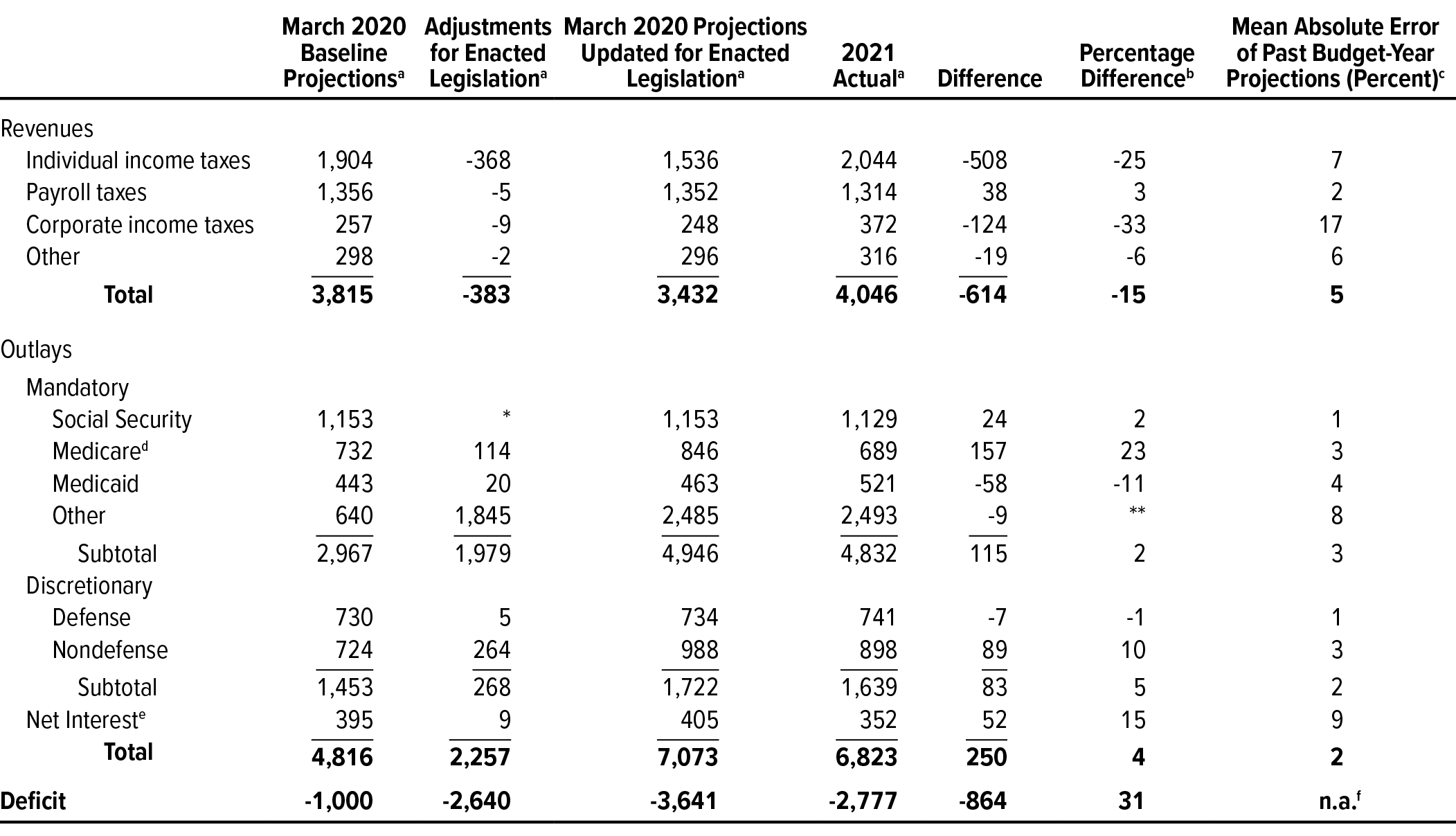
Largely because of the uncertainties associated with the pandemic and the implementation of substantial legislation, some of CBO’s projections for 2021 differed from the actual results by much larger amounts than usual. Taking all adjustments into account, the overall differences were as follows (seeTable 1):
Revenues. CBO’s projection of $3.43 trillion for federal revenues in 2021 was too low—by $614 billion, or 15 percent. That difference was three times the mean absolute error of about 5 percent in revenue projections made for the years from 1983 to 2020.5
Outlays. CBO’s projection of $7.07 trillion for federal outlays in 2021 was too high—by $250 billion, or 4 percent. That difference of 4 percent was larger than the mean absolute error of 2 percent in outlay projections made for the years from 1993 to 2020.
Deficit. The differences in revenue and outlay projections resulted in a deficit projection for 2021 that was $864 billion more than the actual amount: $3.64 trillion rather than $2.78 trillion.6 That difference was equal to 3.9 percent of gross domestic product (GDP). By comparison, the mean absolute error in deficit projections reported for 1985 to 2020 equaled 1.0 percent of GDP.
The three categories with the largest misestimates accounted for $789 billion of the deficit difference: individual income taxes, Medicare outlays, and corporate income taxes. By far the largest difference stemmed from an underestimate of receipts from individual income taxes.
Table 1.
CBO’s Budget Projections for 2021, Compared With Actual Outcomes
Veronica Greenfield (born Veronica Yvette Bennett; August 10, 1943 – January 12, 2022), known as Ronnie Spector, was an American singer who formed the girl group the Ronettes in 1957 with her elder sister Estelle Bennett and their cousin Nedra Talley. Bennett fronted the group while record producer Phil Spector produced the majority of their recording output.
For the first three quarters of 2021, Asian women’s median weekly earnings surpassed those of white men, a trend that only began last year. In the most recent quarter (July to September), Asian women earned close to 10 percent more than white men. The highest-earning Asian female groups are Taiwanese, Indian and Chinese.Asian women are hardly outliers. According to the latest 2019 census data, women of various Middle Eastern backgrounds out-earned their white counterparts: full-time working Iranian, Turkish and Palestinian women’s earnings were higher than those of white women. Moreover, a 2017 University of Michigan study found African-born black women had both higher earnings and income growth compared to white women in the US.
Wai Wah Chin, Charter President of the Chinese American Citizens Alliance Greater New York, said she is unsurprised by the latest labor statistics."The majority of Asian Americans are foreign-born and retain classic immigrant values,” Chin told me. “Hard work and extra work are mere facts of life. It’s part of survival, it’s part of facing higher hurdles, particularly in education where high-performing Asians are told they don’t belong in top schools. Still, immigrants from Asia, both male and female, prize education. They bring greater training and respect for STEM skills, which are in demand globally. The traditional immigrant family structure also allows better focus on work. Barring distortions such as biases and quotas, workers of any race, gender and ethnicity with skills in demand and who do good hard work, are naturally better compensated."
The first duty of any government is to protect its citizens, but you don’t have to be a libertarian absolutist to have noticed that COVID has been a gift that keeps on giving when it comes to the desire of federal, state and local governments to seize more power to deal with an emergency that never seems to end.
While cases of COVID-19 have fluctuated over the past two years, the number of deaths has fallen tremendously in places where vaccination rates are high. As this chart of New York City shows, deaths increased along with COVID cases in the summer of 2020. Yet a year later, even as cases spiked, the number of deaths didn’t rise as much. Today, more than 85 percent of adults in the city are vaccinated and the number of deaths over a seven-day average since June has rarely risen above 20, with multiple weeks of no deaths. When Omicron comes to the United States, the number of new cases won’t matter as much as hospitalizations and deaths — particularly since South African medical officials say symptoms are usually mild.NY Post composite
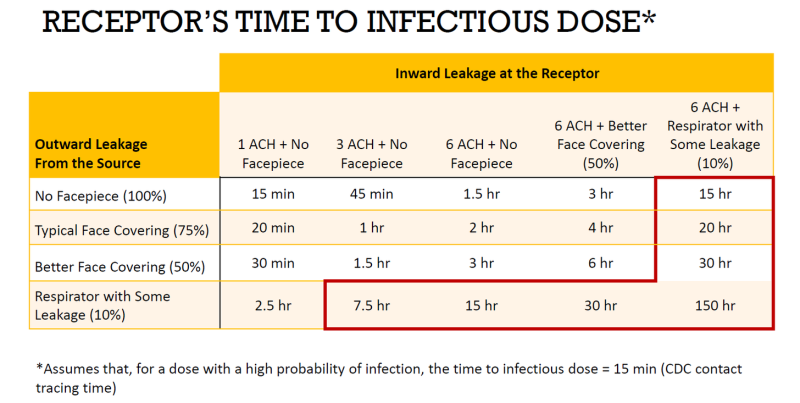
To give an idea of how ventilation increases the time to infectious dose compared to cloth (typical) masking, below is a table created using model calculations created by Dr. Lisa Brosseau, an expert with over 30 years of experience in PPE and particle filtration:
Although this table was created to illustrate the potential for high-quality respirators to decrease time to infectious dose (for workers in high-risk situations), you can also see the advantages of increased ventilation. As ACH [Air Changes Per Hour] increases, the time to infectious dose increases much more significantly than with face coverings, with differences that can be measured in hours for ventilation compared to minutes for masking. [Emphasis Added]
The U.S. is one of the few countries still recommending masks in schools as most nations let kids attend classes without face coverings.
Although states are allowed to set their own rules, the Centers for Disease Control and Prevention (CDC) suggests universal indoor masking for all students above age two regardless of vaccination status.
In fact, 68.2 percent of the 500 of the largest school districts in America still require masks, according to data analytics firm Burbio.
But there are only six other nations in the Western world that require or strongly advise kids to cover their noses and mouths. [Emphasis added]
Meanwhile, more than a dozen other countries, including the UK, the Netherlands, Norway, Sweden, Germany and Australia have since dropped their mask mandates or never had them begin with.
From Congressional Budget Office, "CBO’s Economic Forecasting Record: 2019 Update" Presentation by Edward Gamber, analyst in CBO’s Macroeconomic Analysis Division, to OECD’s Working Party of Senior Budget Officials, November 5, 2021:
In CBO’s projections, the federal budget deficit equals $3.0 trillion in fiscal year 2021 and averages $1.2 trillion per year over the 2022–2031 period, under the assumption that existing laws governing taxes and spending generally remain unchanged. Because of those large deficits, federal debt held by the public is projected to reach 103 percent of GDP at the end of fiscal year 2021 and 106 percent of GDP, the highest level in the nation’s history, in 2031.
Real GDP is projected to increase by 7.4 percent and surpass its potential level by the end of calendar year 2021. The annual growth of real GDP averages 2.8 percent from 2021 to 2025, and 1.6 percent during the 2026–2031 period. Employment is projected to grow quickly in the second half of calendar year 2021 and to surpass its prepandemic level in mid-2022.
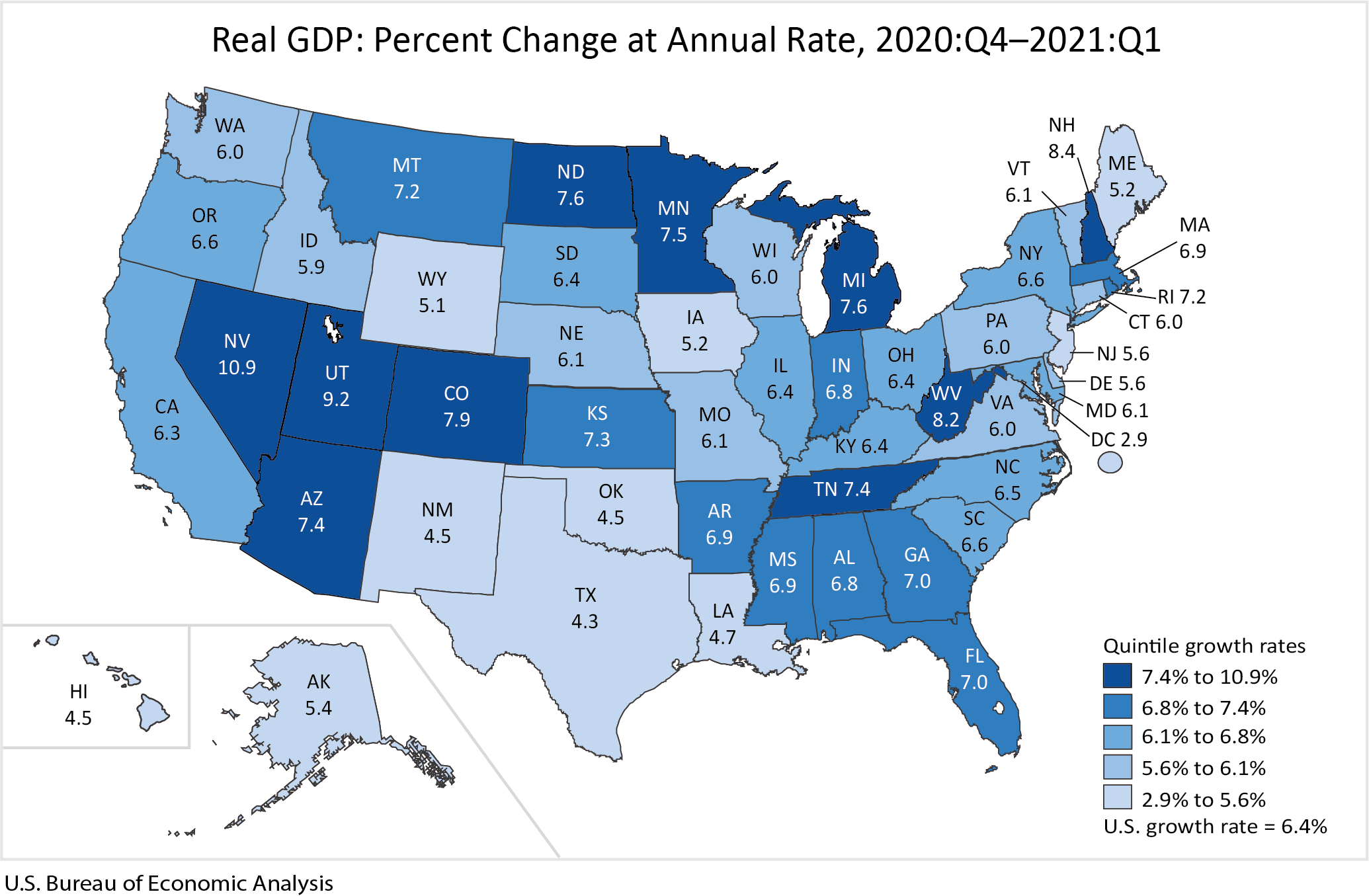
Real gross domestic product (GDP) increased in all 50 states and the District of Columbia in the first quarter of 2021, as real GDP for the nation increased at an annual rate of 6.4 percent, according to statistics released today by the U.S. Bureau of Economic Analysis. The percent change in real GDP in the first quarter ranged from 10.9 percent in Nevada to 2.9 percent in the District of Columbia.
If Larry Summers believed his argument that corporations should be taxed, he would argue for taxing not for profit corporations. His arguments are underpinned by the belief that the government is a wiser spender of the tax money than a non-governmental entity, such as a private corporation, or individual. Either Summers' argument is true for all entities or it is true for none. To tax some entities and not all entities requires the government through its tax code to be able to do a better job of picking better investments and winners over losers than our capitalistic system. Experience over hundreds of years has shown that as much as we would like to believe governments can do better than a selfish profit motive owner, the reality is that decisions affected by politics and the self-interest of politicians attempting to remain in office leads to far worse societal outcomes than capitalistic motives. Not for profits and governments are not economically self-sustaining and can only continue to fund their endeavors off the labor and profit of the private sector. Corporate owners and shareholders, who are the beneficiaries of rising asset values and stock prices, are better deciders of how to use their funds to sustain and grow our economy. Taxing corporations creates economic dead weight loss since the money spent by the consumer is less than the money received by the corporation. It also diverts monies into non-productive and inefficient attempts to reduce taxes. Even if all of Summers arguments are correct, by removing or lowering corporate taxes, the cost of government is shifted to individual taxes, and individuals will receive a truer price signal that shows how much government involvement in their daily lives really costs. With truer price signals, individuals will have a much better picture of the cost and value or lack of value of government programs.
A reprint of my decade old blog post about budgeting and deficits that I believe is currently relevant.
Sunday, March 13, 2011Budgeting And Deficit Reduction Is About Spending Less On Worthwhile Projects
Posted By Milton Recht
A comment I posted on Econbrowser, "AP: GOP budget targets agency that warned of tsunami" posted by Menzie Chinn:
Americans cannot afford to fund every worthwhile project. Budgeting is about admitting dollars are limited and setting project priorities. Just like a household that goes to the grocery with a fixed budget. The household cannot afford to buy every appealing delicious or nutritious food item in the store that catches their eye. Some items must stay on the shelf and not go in the cart.
Looking at any government project or expense in isolation is unfair. You have to look at all of the items together and decide which are the ones you want to keep and fund and which are the one you want to pass on.
Would you rather have a Tsunami warning system, headstart, a no fly zone over Libya, heating fuel subsidies for the poor, housing rent subsidies for the poor, incentives for converting to solar energy, etc. A great majority of the things the government spends money on are worthwhile, but which are the keepers and which are the unfunded and shelved.
The choices are tough. There is no right or wrong answer or choice, but it is unfair to discuss just one project in isolation. It makes it seem as if there is no reason other than politics not to fund a project and that is not the case when one is trying to reduce a deficit and balance a budget. In budgeting, sometimes very worthwhile funding must be curtailed.
It is the bright, rational do-gooder people who look at defunding of a project in isolation that are the biggest political force against budget balancing and deficit reduction. They are for deficit reduction, but they are not willing to make the hard choices, set priorities and limit funding with the understanding that some good projects will not get money.
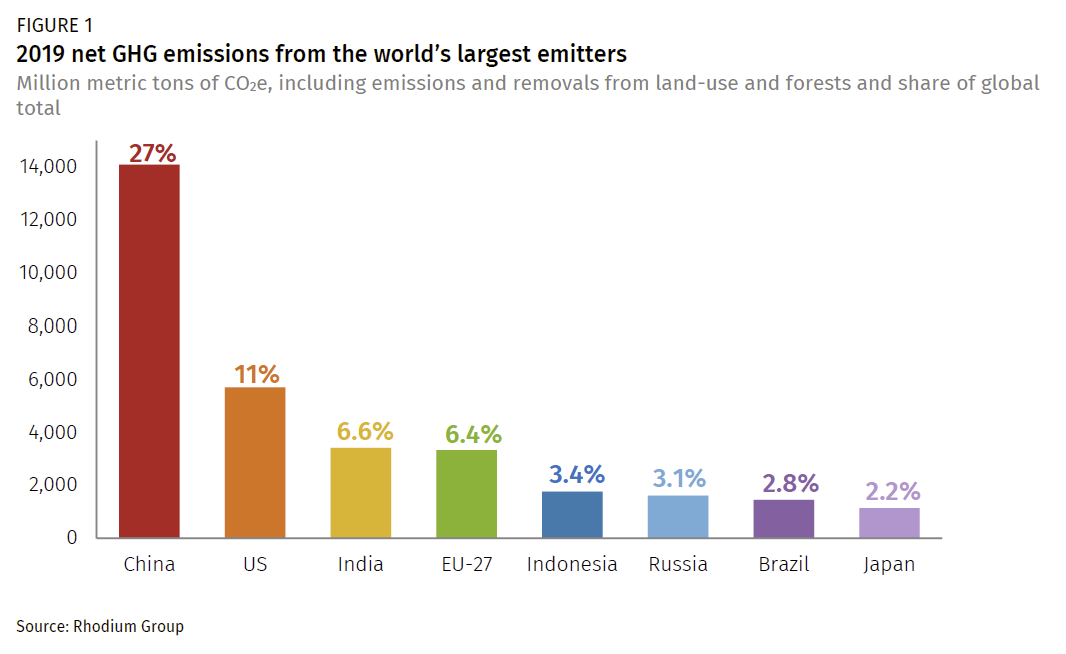
Global greenhouse gas emissions estimates for 2019
***
China alone contributed over 27% of total global emissions, far exceeding the US—the second highest emitter—which contributed 11% of the global total (Figure 1). For the first time, India edged out the EU-27 for third place, coming in at 6.6% of global emissions.
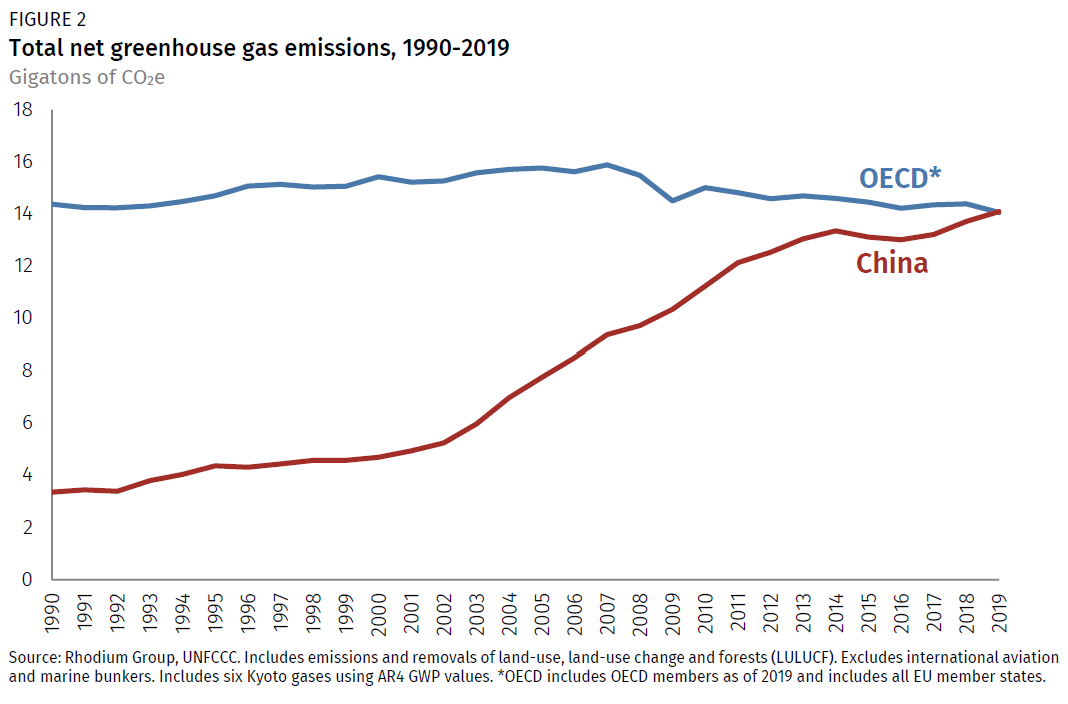
China’s emissions exceeded emissions from developed countries
In 2019, China’s GHG emissions passed the 14 gigaton threshold for the first time, reaching 14,093 million metric tons of CO2 equivalent (MMt CO2e) (Figure 2). This represents a more than tripling of 1990 levels, and a 25% increase over the past decade. As a result, China’s share of the 2019 global emissions total of 52 gigatons rose to 27%. [Footnote omitted.]
Shifts in fuel mix over time
In the United States, the generation of baseload electricity, defined by the Energy Information Administration as the minimum amount of electric power required to maintain mechanical and thermal efficiency of the grid system, historically was met through large coal-powered plants. Starting in the early 2000s, there was rapid growth in domestically produced natural gas from shale formations and other nonconventional sources. As a result, natural gas prices declined 60.1 percent between 2003 and 2019. This, combined with rapid advances in technology for renewable generation, supported a shift away from coal. In addition to being a source of baseload power itself, natural gas has the ability to quickly ramp up, which helps handle intermittency from renewable power sources like the sun or wind. Chart 3 [Below] illustrates the share of total U.S. electric power generation from 1990 to 2019, by fuel source. The chart shows the stark decline of coal and the growth in natural gas and renewable power. Relative fuel-mix contributions from nuclear and hydroelectric power sources have both remained relatively flat over the period. [Footnotes omitted.]
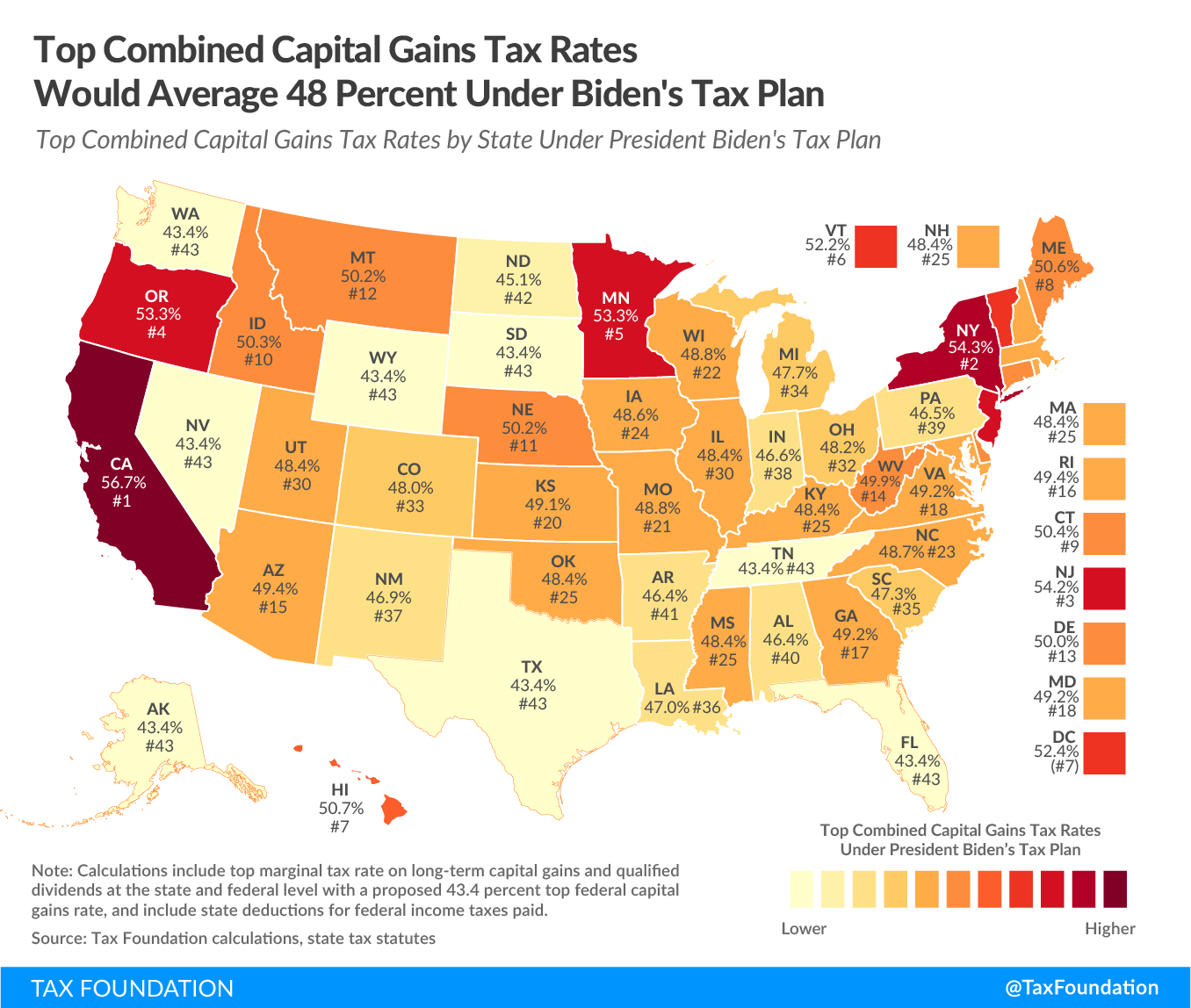
President Joe Biden’s American Families Plan will likely include a large increase in the top federal tax rate on long-term capital gains and qualified dividends, from 23.8 percent today to 39.6 percent for higher earners. When including the net investment income tax, the top federal rate on capital gains would be 43.4 percent. Rates would be even higher in many U.S. states due to state and local capital gains taxes, leading to a combined average rate of 48 percent compared to about 29 percent under current law.
Thirteen states and the District of Columbia would have a top combined capital gains tax rate north of 50 percent. California, New York, and New Jersey would have combined rates of more than 54 percent. Top combined rates in some localities would go even higher. For example, New York City levies a local capital gains rate of 3.876 percent, which means an investor would pay an all-in rate of nearly 58.2 percent. Residents of Portland, Oregon would face a top capital gains rate of 57.3 percent.
Do you see the pattern? The 10 most open states on the left—Wyoming, Arkansas, Florida, South Dakota, Utah, Nebraska, Montana, Texas, North Dakota, and Louisiana, in that order—have wildly disparate COVID mortality, ranging from Utah's 67 per 100,000 residents to South Dakota's 221. But what they have in common is politics: All 10 voted in 2020 for Donald Trump, all 10 have Republican-controlled state legislatures, all except Louisiana have a Republican governor, all except Montana have two Republican U.S. senators, and in all 10 a majority of the state's delegation to the House of Representatives hails from the GOP.
Deep red states open schools.
What about the 10 most closed states on the right side of that bar graph? Maryland, Oregon, California, Washington, New Mexico, Hawaii, Virginia, Illinois, New Jersey, and Nevada also share more in their politics than they do in the pandemic. All 10 voted for Joe Biden in 2020, all 10 have Democratic-controlled state legislatures, all except Maryland have a Democratic governor, all 10 have two Democratic U.S. senators, and in all 10 a majority of the state's House delegation sits on the left side of the aisle.
Tax collections of $11,311 per capita in the District of Columbia surpass those in any state. The five states with the highest tax collections per capita are New York ($9,829), Connecticut ($8,494), North Dakota ($7,611), New Jersey ($7,423), and Hawaii ($7,332). The five states with the lowest tax collections per capita are Tennessee ($3,286), Alabama ($3,527), South Carolina ($3,705), Mississippi ($3,767), and Arizona ($3,824).
Some of these results are less intuitive than others. For example, even though North Dakota ranks third for state and local tax collections, the resource-rich state generates a substantial part of its tax revenue from severance taxes on oil and natural gas, which are borne mainly by consumers outside North Dakota. As a result, North Dakota joins the ranks of high-tax states in terms of per capita collections even though the tax burden on North Dakotans is comparatively low.
It’s worth noting that severance taxes are only one of many examples of the “tax exporting” that states engage in. Travel taxes—such as hotel, car rental, and meal taxes—also disproportionately impact nonvoting nonresidents who have few means of redress.
From Congressional Budget Office, "Overview of the 2021 Long-Term Budget Outlook," Presentation by Phillip Swagel, CBO Director, to the Committee for Economic Development of the Conference Board, Published on Mar 24, 2021:
Covid-19 has disrupted much of human life, but Operation Warp Speed has drastically mitigated the costs of the virus. The $10 billion federal program launched in April 2020 encouraged and accelerated the development and mass manufacturing of COVID-19 vaccines, streamlined Federal approval for vaccines and their manufacture, and provided Federal funds for private vaccine research and advance-purchase orders. COVID-19 vaccines are currently being administered to the general public at least six months earlier than expected. Vaccinating the population against COVID-19 six months earlier was worth about $1.8 trillion to the U.S. alone in terms of lives saved and accelerating the return to normal schooling, work, socializing, etc. (Mulligan and Philipson 2020).
$1.9 trillion to 332,000,000, approximate current estimated US Population, is a one time payment of over $5,700 per person; over $17,000 to a family of 3 and over over $22,000 to a family of 4. It could be even more, if wealthy people are excluded from the payment. The $1,400 proposed per person is less than 25 percent of the funds available. The general public doesn't realize that they are getting scraps and that most of the money in the proposed law is used to payoff politicians' political friends and is not going into their pockets. A wiser public would demand that more of the money go directly into their own pockets.
Milton Friedman said the “society that puts equality before freedom will end up with neither,” while “the society that puts freedom before equality will end up with a great measure of both.”
***
The greatest success of the civil-rights movement wasn’t a new government program but getting government off the backs of blacks by defeating Jim Crow. Nothing the government has done since then in the name of advancing blacks has been more effective than simply ending government-sponsored discrimination. Black poverty fell by 40 percentage points between 1940 and 1960. It continued to decline in the wake of Lyndon Johnson’s Great Society interventions, but at a much slower pace.
Similarly, blacks were joining middle-class professions at a much faster pace in the 1940s, ’50s and ’60s than they would after affirmative-action programs were implemented in the 1970s. In fact, we now have evidence that suggests racial preferences have been not only ineffective in helping the black poor but also counterproductive. After the University of California system ended race-conscious admissions policies in 1996, black and Hispanic graduation rates rose dramatically.
***
If history is any guide, what blacks most need from the government is for it to get out of the way. Stop forcing poor black children to attend failing schools by denying them school choice. Stop increasing the minimum wage and pricing black young adults out of jobs. Stop implementing occupational licensing regulations that prevent black entrepreneurs from starting a business. And stop pretending that policing is a bigger problem than violent crime in poor black neighborhoods. In 2019 there were 492 homicides in Chicago, according to the Sun-Times, and only three of them involved police.
[T]his scene [from 42] does capture much of the manner in which market competition actually works to impose on bigots the costs of exercising their irrational prejudices. It depicts also the fact that many bigots, unwilling to pay those costs, change their behavior for the better.
It’s beautiful to behold!
Contrary to popular belief, such competition was at work in America during the late 19th and early 20th centuries, as Bob Higgs documents in his book [Robert Higgs, 1977, Competition and Coercion: Blacks in the American Economy, 1865-1914]. Indeed, the reality of such competition is what drove state and local governments during the Jim Crow era to forcibly impose racial discrimination by enacting Jim Crow legislation.
In 1980, The US Supreme Court ruled that that the State of California Constitution's first amendment rights can go beyond the rights provided by the US Constitution, (PruneYard Shopping Center v Robins). The US Supreme Court upheld a California court decision that a privately owned shopping mall open to the public must allow, under California state first amendment rights, the distribution of political literature and the solicitation of signatures for a petition by a group of students, despite mall rules that prohibited such activity.
Other states, besides California, have free speech protection rights in their constitutions that are more expansive and protective of speech than the US Constitution.
Twitter, Facebook, Apple, Google and numerous other technology firms are headquartered in California and subject to California laws and constitution.
Can Parler successfully sue the technology companies in California court that have removed its platform from their services? Could Parler get an immediate temporary restraining order in California stopping the removal of Parler?
Parler takes a far more laissez-faire approach, offering a platform where users, "liberated from restrictions," can publically express their ideas.
"We just want to sit back and say 'social media was supposed to be about the people. It was supposed to be about people having a free voice, being able to be, you know, liberated from restrictions,'" [Parler CEO John] Matze said. "And so that's what we are here to offer is a community town square for people to have discussions."
***
"Well, when you go out in public people say crazy things all the time," Matze responded. "Everybody has opinions and some of them might not be the norm, right? It's not against the law to have those opinions. It's not against the law to express yourself, you know. And if you like one political candidate or another or you believe or don't believe in climate change or whatever it might be, you know, you shouldn't be taken offline because of it."
Addressing his critics, Mazte asked, "Do you believe that we should have somebody in, you know, New York, let's say in the middle of Times Square telling you what you can and cannot say? Because that's what these companies are doing."
Nationwide, according to the U.S. Department of Agriculture, butter production is up 6% over the first nine months of the year and is on track to top two billion pounds for the first time since 1943.
***
Even within milk sales there’s been an interesting shift lately, with whole milk outselling 2% milk for the first time in 15 years in 2018 and building on its lead in 2019, and skim milk sales drifting downward. If you’re going to drink milk, and not smashed-up almonds mixed with water, then you might as well drink the milkiest kind of milk.
The “progress toward equality for black Americans didn’t begin in 1965,” write Harvard political scientist Robert Putnam and his co-author, Shaylyn Romney Garrett, in their new book, “The Upswing.” “By many measures, blacks were moving toward parity with whites well before the victories of the Civil Rights revolution, despite the limitations imposed by Jim Crow.” Moreover, “after the Civil Rights movement, that longstanding trend toward racial equality slowed, stopped, and even reversed.” The emphasis is the authors’.
In the 1940s and ’50s, black-white gaps were not only shrinking in income, educational attainment, homeownership rates and other measures. The gaps were shrinking at unprecedented rates that have never been repeated, even during the subsequent era of affirmative action.
If anything, the evidence shows that racial preferences have coincided with slower black upward mobility. After the University of California system ended its race-conscious admissions policies in the 1990s, black graduation rates rose. A policy intended to increase the size of the black middle class was in practice limiting its growth. It would be difficult to identify a government program coming out of the 1960s that did more to help blacks than what black were doing to help themselves before the program.
After New York became the epicenter for the pandemic in early March, with tens of thousands dying from COVID-19, experts had expected that the infection would remain as deadly in the following months.
Instead, a new investigation showed that by mid-August the death rate in those hospitalized with coronavirus-related illness had dropped from 27 percentage points to about 3 percentage points. Led by researchers at NYU Grossman School of Medicine, the study showed that a younger, healthier group of people were getting infected and were arriving at the hospital with less-severe symptoms than those infected in the spring.
However, the researchers’ analysis showed that these factors accounted for only part of the improvement in survival. The rest, they suspect, resulted from health care providers’ growing experience with the coronavirus. For example, physicians learned that resting COVID-19 patients on their stomachs rather than their backs and delaying the use of ventilators as long as possible were more effective practices, say the study authors. Drugs likely helped as well. In addition, other factors such as decreasing hospital volumes, less exposure to infection, and earlier testing and treatment, may have played a role. [Emphais added.]
***
[Leora] Horwitz [MD, an associate professor in the Department of Population Health at NYU Langone Health] says the new study, publishing online next week in the Journal of Hospital Medicine, is the most detailed analysis to date of coronavirus death rates over time. By accounting for age, obesity, and other key factors, the researchers were able to eliminate some explanations from the analysis.
He [E.D. Hirsch] cites both history and neuroscience in explaining how education went wrong. It began in the 1940s, when “schools unbolted the desks and kids were no longer facing the teacher.” Instead children were divided into small groups and instructed to complete worksheets independently with occasional input from teachers. “That was also when our verbal test scores went down and the relative ranking of our elementary schools declined on a national level.” On the International Adult Literacy Survey, Americans went from being No. 1 for children who were educated in the 1950s to fifth for those in the ’70s and 14th in the ’90s. And things have only gotten worse. Between 2002 and 2015, American schoolchildren went from a ranking of 15th to 24th in reading on the Program for International Student Assessment. [Emphasis added.]
The problem runs deeper than the style of instruction, Mr. Hirsch says. It’s the concept at its root—“child-centered classrooms,” the notion that “education is partly a matter of drawing out a child’s inborn nature.” Mr. Hirsch says emphatically that a child’s mind is “a blank slate.” On this point he agrees with John Locke and disagrees with Jean-Jacques Rousseau, who thought children’s need to develop according to their nature. Both philosophers make the “Cultural Literacy” list, but “Locke has to make a comeback” among educators, Mr. Hirsch says. “The culture is up for grabs, and elementary schools are the culture makers.”
Mr. Hirsch is a man of the left—he has said he is “practically a socialist.” But he bristles at the idea that kids should read only books by people who look like them or live like them. He recalls how reading outside his own experience enabled him “to gain perspective.”
U.S. inflation quickened in August, driven by the sharpest monthly gain in used-vehicle costs since 1969 and consistent with a gradual pickup in prices as the economy recovers from the pandemic-induced downturn.
***
Excluding volatile food and fuel costs, the so-called core CPI -- viewed by policy makers as a more reliable gauge of price trends -- also increased 0.4% from the prior month after a 0.6% jump in July that was the largest in almost three decades. A 5.4% surge in the cost of used cars and trucks accounted for more than 40% of the gain in the core index. On an annual basis, core inflation measured 1.7% following 1.6% in July.[Emphasis added.]
US productivity statistics are an average of the economy. Competitive closings of the least productive firms raises the US productivity average. The firms that remain in business do not need to become more productive for US productivity to rise. As long as the least productive firms that are closing on average have lower productivity than the average of the firms that remain, whether or not the remaining firms increase productivity, the economy wide productivity numbers will show an increase. The change in US productivity represents additive factors: the effect of low productivity firms closing, the effect of remaining firms that do not increase productivity but have a higher productivity than the closing firms, and the effect of firms that can increase the productivity of their output. When there are fewer low productivity firms in the economy and more higher productivity firms surviving, average US productivity will not show historical large productivity increases.
This chart collection looks at the availability of hospital resources and healthcare professionals in the United States and similarly wealthy countries. A related chart collection examines how the U.S.’s healthcare resources factor into the nation’s preparedness for the coronavirus pandemic.
***
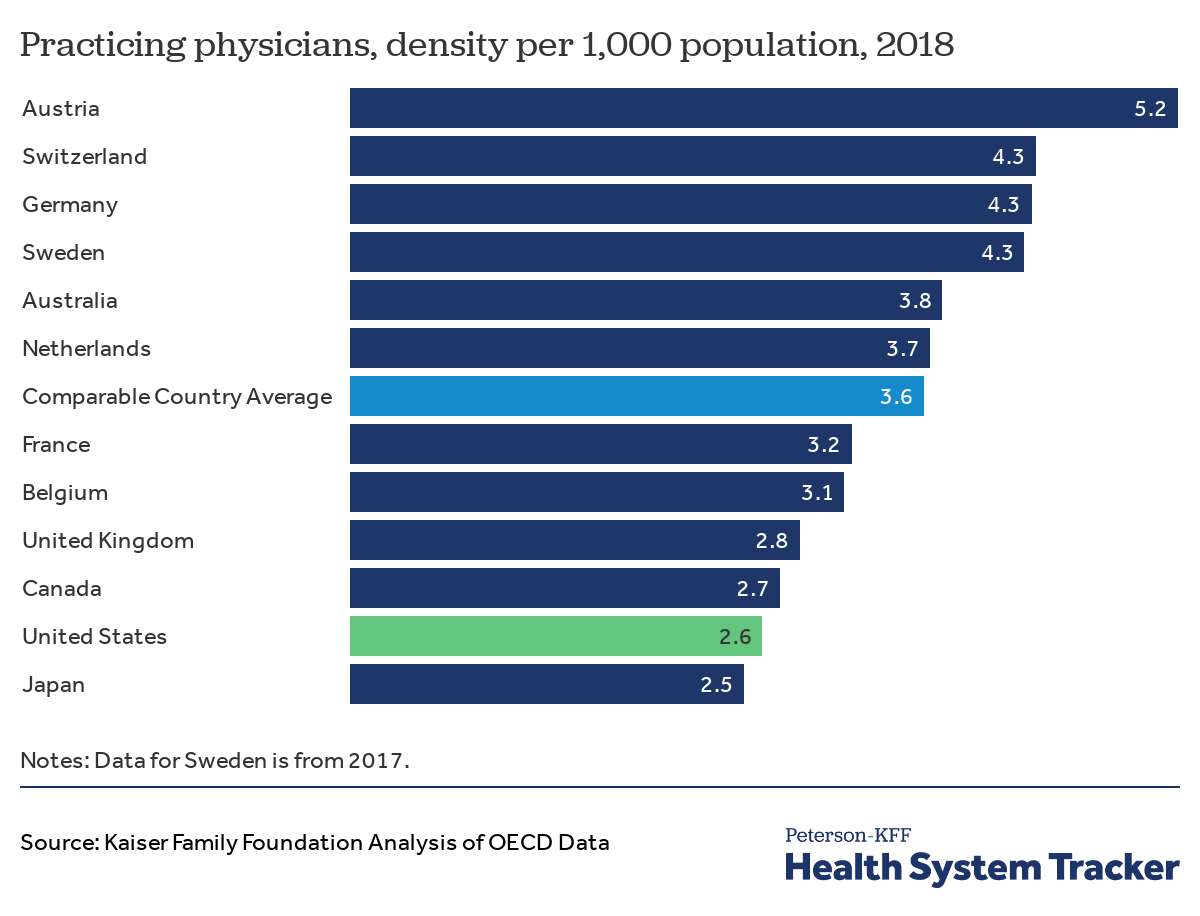
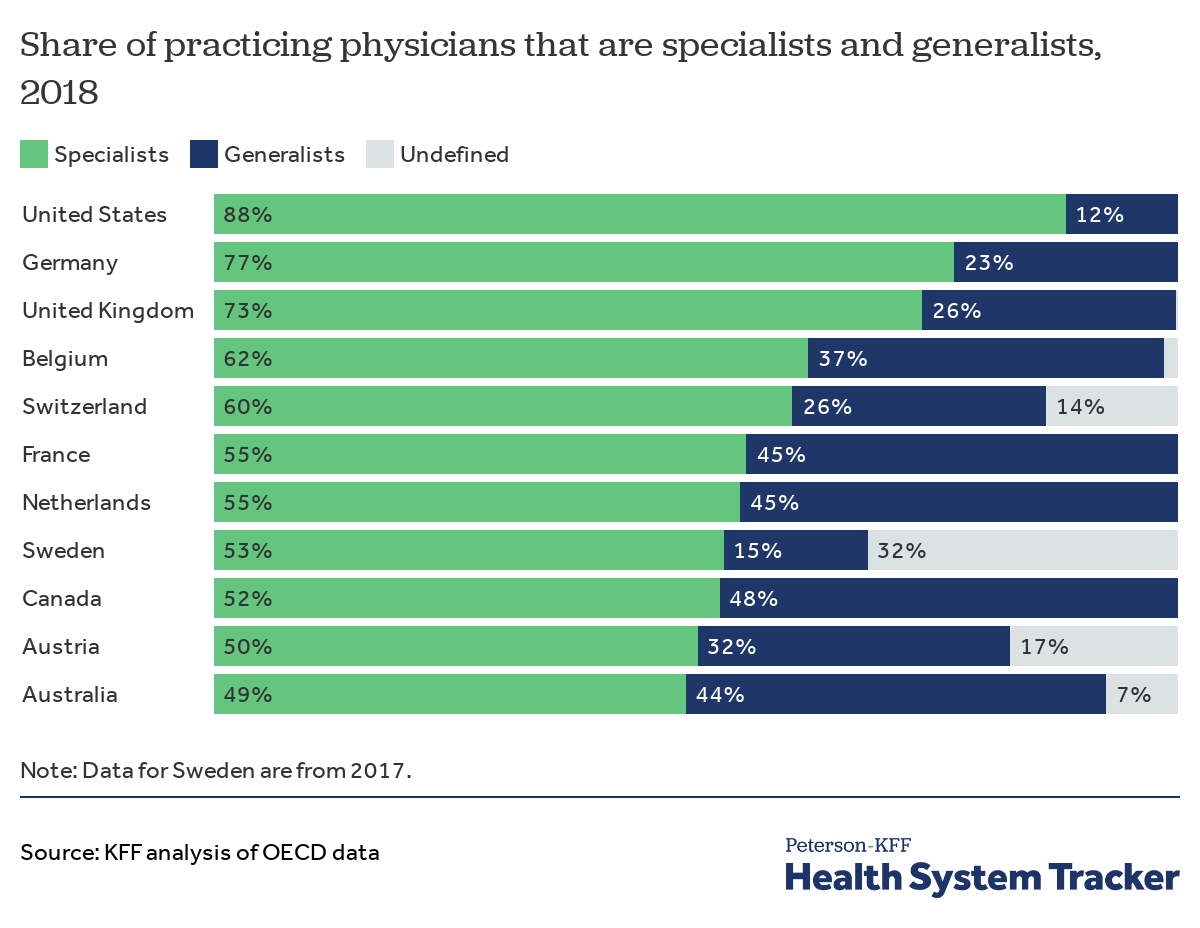
There are fewer physicians per capita in the U.S. than there are in most comparable countries
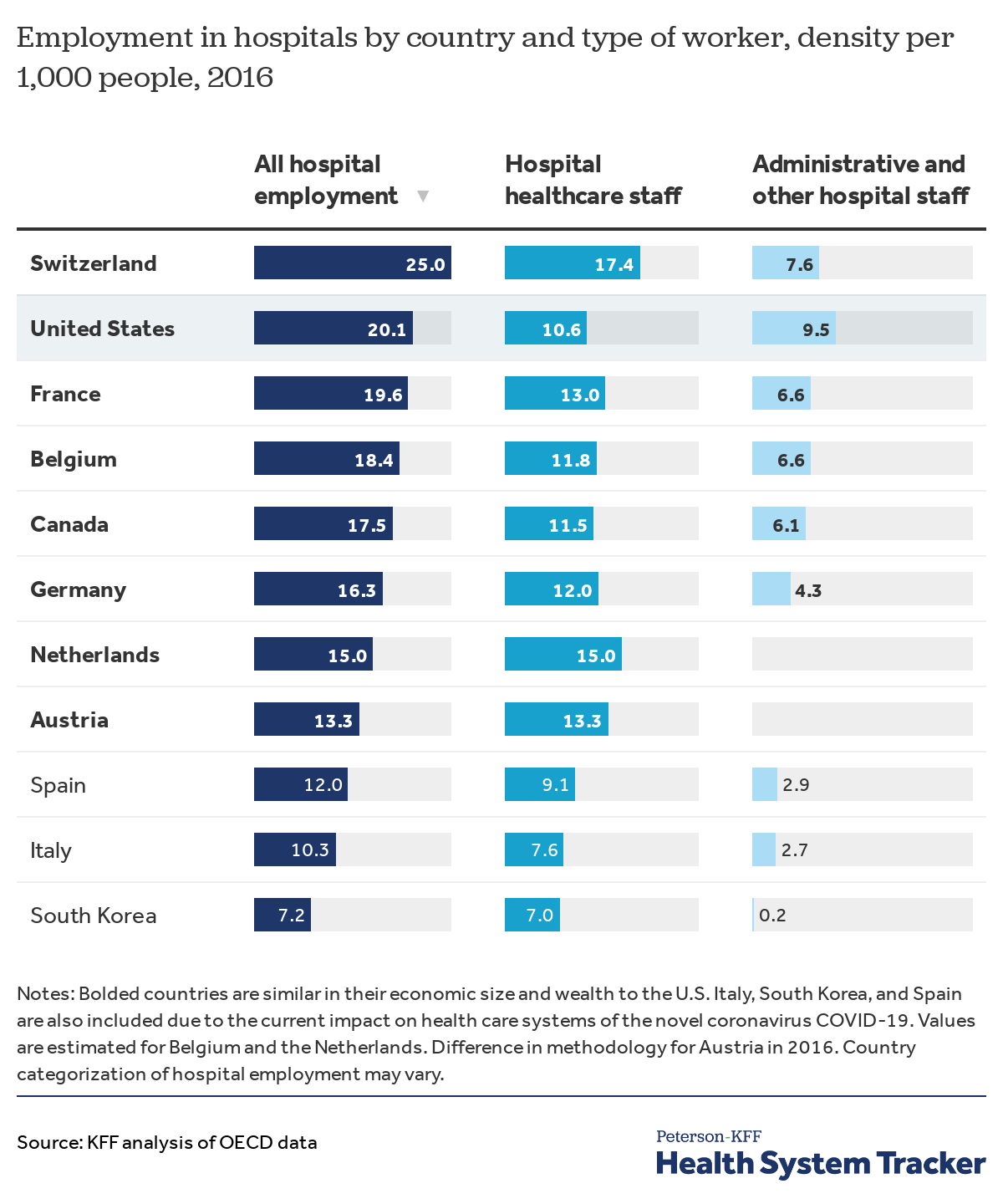
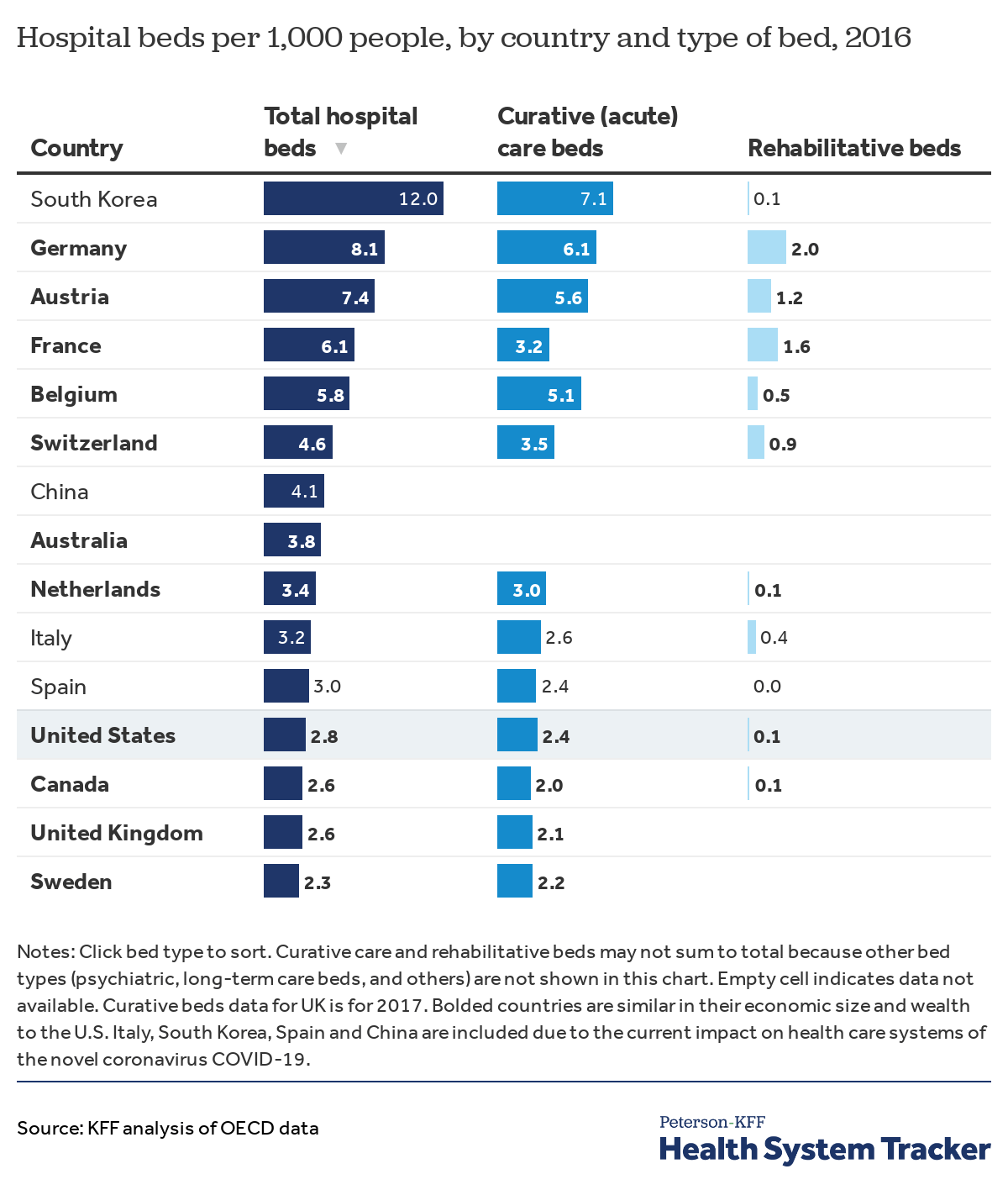
Compared to most similarly large and wealthy countries, the U.S. has fewer practicing physicians per capita but has a similar number of licensed nurses per capita. Looking specifically at the hospital setting, the U.S. has more hospital-based employees per capita than most other comparable countries, but nearly half of these hospital workers are non-clinical staff. Overall, the U.S. has fewer hospitals and hospital beds per capita compared to other similar countries.
***
U.S. hospitals have more employees than most comparable countries, but many are administrative
This map shows the real value of $100 in each state. Across the United States, the cost of living fluctuates, as prices for the same goods may be cheaper in some areas—such as rural parts of Arkansas or South Dakota—than in large cities in states like New York or California. This means that the same amount of money can buy comparatively more in a low-price state than a high-price state.