Wednesday, September 18, 2013

An Analysis Of Each State's Unfunded Pension Liability

An analysis by State Budget Solutions, a 501(c)(3) non-profit, finds that State pension plans are on average only 39 percent funded. The included table below shows each State's pension numbers.

From State Budget Solutions, "Promises Made, Promises Broken - The Betrayal of Pensioners and Taxpayers" by Cory Eucalitto:
Comprehensive research into the funded status of state level defined benefit public pension plans reveals that public employee retirement promises are underfunded by $4.1 trillion. Combined, state public pension plans are just 39 percent funded.

Figures were drawn from state Fiscal Year 2012 Comprehensive Annual Financial Reports, as well as the Comprehensive Annual Financial Reports and actuarial valuations published by individual plans. In each case, figures were from the most up-to-date valuation available at the time of research. Plans were compiled based on the United States Census Bureau's Annual Survey of Public Pensions and state-level financial reports. Therefore this includes municipal pension funds that are administered by the state.
***

StateActuarial AssetsMarket LiabilityFunded RatioUnfunded Liability
Alabama$28,136,859$83,416,28934%$55,279,430
Alaska$10,257,331$33,972,93130%$23,715,600
Arizona$30,716,205$81,099,67238%$50,383,467
Arkansas$19,914,988$55,016,30736%$35,101,319
California$459,450,490$1,100,068,95042%$640,618,460
Colorado$40,915,702$124,738,61633%$83,822,914
Connecticut$25,492,957$102,247,87425%$76,754,917
Delaware$7,862,654$16,287,44648%$8,424,792
Florida$127,891,781$280,543,39246%$152,651,611
Georgia$69,392,153$154,949,79945%$85,557,646
Hawaii$12,242,500$39,193,56331%$26,951,063
Idaho$11,657,299$25,241,56146%$13,584,262
Illinois$91,521,686$378,567,67924%$287,045,993
Indiana$25,156,363$68,175,59637%$43,019,233
Iowa$25,778,883$59,705,14443%$33,926,261
Kansas$13,278,490$46,167,69129%$32,889,201
Kentucky$26,060,181$97,225,99927%$71,165,818
Louisiana$33,578,010$108,503,08931%$74,925,079
Maine$11,076,400$24,761,72445%$13,685,324
Maryland$37,448,661$110,513,04834%$73,064,387
Massachusetts$43,493,039$132,310,59333%$88,817,554
Michigan$59,934,079$178,436,10534%$118,502,026
Minnesota$47,954,571$127,349,65538%$79,395,084
Mississippi$20,429,973$69,238,31630%$48,808,343
Missouri$48,699,412$121,416,55740%$72,717,145
Montana$7,631,673$22,633,20534%$15,001,532
Nebraska$9,058,379$22,439,82340%$13,381,444
Nevada$27,466,740$75,934,90536%$48,468,165
New Hampshire$5,861,896$19,751,86730%$13,889,971
New Jersey$85,938,988$257,614,70233%$171,675,714
New Mexico$21,397,284$64,212,78133%$42,815,497
New York$230,680,400$490,756,06247%$260,075,662
North Carolina$78,403,200$145,436,34054%$67,033,140
North Dakota$3,498,700$10,806,86232%$7,308,162
Ohio$146,123,868$433,497,66834%$287,373,800
Oklahoma$21,469,876$62,963,72434%$41,493,848
Oregon$44,943,100$120,068,76337%$75,125,663
Pennsylvania$85,323,119$241,959,10035%$156,635,981
Rhode Island$7,533,391$22,540,48133%$15,007,090
South Carolina$29,555,334$82,721,84136%$53,166,507
South Dakota$7,935,490$15,141,57252%$7,206,082
Tennessee$36,680,783$73,328,48350%$36,647,700
Texas$183,833,884$427,998,12343%$244,164,239
Utah$21,369,935$51,129,68742%$29,759,752
Vermont$3,335,632$8,853,16238%$5,517,530
Virginia$54,473,000$133,823,92141%$79,350,921
Washington$60,829,300$124,883,77749%$64,054,477
West Virginia$10,220,671$29,152,50535%$18,931,834
Wisconsin$78,940,000$138,707,03957%$59,767,039
Wyoming$6,609,063$16,284,76741%$9,675,704
Total$2,597,454,373$6,711,788,75839%$4,114,334,385

[HT: Newmark's Door]

Tuesday, September 17, 2013

Asians Have Highest Household Median Income: All Household Groups Below Pre-2001 Level

From The Wall Street Journal, Real Time Economics, "Asian Households Have Highest Income, Blacks the Lowest"
Among the race groups, Asian households had the highest median income in 2012 ($68,636). The median income for non-Hispanic White households was $57,009, and it was $33,321 for Black households. For Hispanic households the median income was $39,005. The real median incomes in 2012 of non-Hispanic White households, Black households, Asian households, and Hispanic-origin households were not statistically different from their respective 2011 medians.

median household income
Source: The Wall Street Journal

The real median household income for each of the race and Hispanic-origin groups have not yet recovered to their pre-2001 recession median household income peaks. Household income in 2012 was 6.3 percent lower for non-Hispanic Whites (from $60,849 in 1999), 15.8 percent lower for Blacks (from $39,556 in 2000), 7.7 percent lower for Asians (from $74,343 in 2000), and 11.8 percent lower for Hispanics (from $44,224 in 2000).

CBO 2013 Long-Term Budget Outlook: Full Report: US Debt To Exceed 100 Percent Of GDP

The complete CBO budget outlook report is embedded at the end of this post.

From CBO, "The 2013 Long-Term Budget Outlook:"
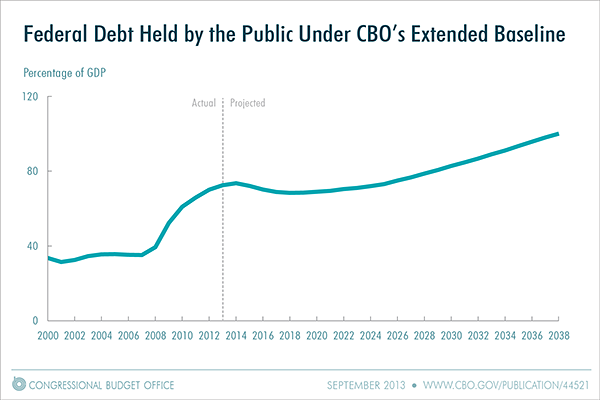
Between 2009 and 2012, the federal government recorded the largest budget deficits relative to the size of the economy since 1946, causing federal debt to soar. Federal debt held by the public is now about 73 percent of the economy’s annual output, or gross domestic product (GDP). That percentage is higher than at any point in U.S. history except a brief period around World War II, and it is twice the percentage at the end of 2007. If current laws generally remained in place, federal debt held by the public would decline slightly relative to GDP over the next several years, CBO projects. After that, however, growing deficits would ultimately push debt back above its current high level. CBO projects that federal debt held by the public would reach 100 percent of GDP in 2038, 25 years from now, even without accounting for the harmful effects that growing debt would have on the economy (see the figure below). Moreover, debt would be on an upward path relative to the size of the economy, a trend that could not be sustained indefinitely.
CBO Long-Term Budget Outlook
Source: CBO

The complete CBO 176-page report follows:

EPA Estimates Significantly Overstate Greenhouse Gas Emissions From Natural Gas Wells

From The Wall Street Journal, "U.S. Overstates Leaks by Gas-Drillers, Says Study: University of Texas Researchers Challenge Methane Emissions by Fracking" by Russell Gold:
Natural-gas drilling sites aren't leaking as much methane into the atmosphere as the federal government and critics of hydraulic fracturing had believed, according to the first study of emissions at multiple drilling sites.

The study, led by researchers at the University of Texas at Austin and published on Monday by the Proceedings of the National Academy of Sciences, is likely to ease some concerns about the impact of natural-gas extraction on the climate.

Measuring emissions at 190 sites, the study found less "fugitive methane" than previous work by the Environmental Protection Agency and some university researchers, which relied on estimates. Methane, the primary ingredient in natural gas, is a potent greenhouse gas.
***
But the measurements of gas emissions found that wells emitted about 20% less greenhouse gases than the EPA had estimated—which is less than the amount emitted by burning coal.
As a mathematical note, a 20 percent decrease is equivalent to a 25 percent increase. Starting from the estimate, the reality is 20 percent less (using 100 as an example of the estimate, 80 is 20 percent less than 100). Starting from the reality, the estimate is 25 percent more (100 is 25 percent more than 80). The EPA has overstimated the greenhouse gas emissions from natural gas wells by 25 percent.

From a global warming perspective, the heat trapping impact of methane gas is 20 times that of carbon dioxide (CO2). The EPA's overestimation of the amount of methane gas released is equivalent to saying that 5 times or 500 percent more carbon dioxide was released than actually occurred. (20 times 25 percent is 500 percent which also equals 5).

Monday, September 16, 2013

36 Percent Of Government Workers Compared To 6.6 Percent Of Private Sector Workers Belong To A Labor Union

From The Wall Street Journal, Opinion, "Members Not Only: I joined the AFL-CIO and all I got was this lousy T-shirt:"
Union Membership Share Of Government And Private Sector Workers
Source: The Wall Street Journal
***
Union share of government workers has remained more stable, though that is also helped by government rules that require dues payments once a worksite is organized.

When government workers are given the choice of membership, as in Indiana and Wisconsin in recent years, they drop out in droves. Last week the teachers union in Kenosha, Wisconsin became the latest to be decertified after it lost its bargaining monopoly under Governor Scott Walker's 2011 reform.

Friday, September 13, 2013

Lost Career Paths And Economic Plight Of Young Adults

From The Wall Street Journal, "Wanted: Jobs for the New 'Lost' Generation: Five years after the 2008 crisis, younger adults still struggle to find work" by Ben Casselman And Marcus Walker:
But the recovery has left many young people behind. The official unemployment rate for Americans under age 25 was 15.6% in August, down from a peak of nearly 20% in 2010 but still more than 2½ times the rate for those 25 and older—a gap that has widened during the recovery. Moreover, the unemployment rate ignores the hundreds of thousands of young people who have taken shelter from the weak job market by going to college, enrolling in training programs or otherwise sitting on the sidelines. Add them back in, and the unemployment rate for Americans under 25 would be over 20%.

Even those lucky enough to be employed are often struggling. Little more than half are working full time—compared with about 80% of the population at large—and 12% earn minimum wage or less. The median weekly wage for young workers has fallen more than 5% since 2007, after adjusting for inflation; for those 25 and older, wages have stayed roughly flat.
***
Economic research has shown that the first few years after college play an outsize role in determining workers' career trajectories: About two-thirds of wage growth, on average, comes in the first 10 years of a person's career. In weak economic times, graduates are likely to accept lower wages and work for smaller companies with fewer opportunities for advancement. And in many cases, they never move off that second-tier track. [Emphasis added.]

First Example Of A Working Cog Wheel Mechanism In A Living Organism Found

From Phys Org, "Functioning 'mechanical gears' seen in nature for the first time:"

This image shows cog wheels connecting the hind legs of the plant hopper, Issus. Credit: Burrows/Sutton
This image shows cog wheels connecting the hind legs of the plant hopper, Issus.
Credit: Burrows/Sutton. Source: Phys Org.
a plant-hopping insect found in gardens across Europe - has hind-leg joints with curved cog-like strips of opposing 'teeth' that intermesh, rotating like mechanical gears to synchronise the animal's legs when it launches into a jump.

The finding demonstrates that gear mechanisms previously thought to be solely man-made have an evolutionary precedent. Scientists say this is the "first observation of mechanical gearing in a biological structure".

The Material Well-Being Of The Poor In The US Is High

From The Circle Bastiat Blog, "Poverty Just Ain’t What It Used To Be" by Joseph Salerno:
A newly released report by the U.S. Census Bureau indicates that most Americans living below the bureaucratically designated “poverty line” enjoy most modern conveniences. For example more than 80 percent of U.S. households below the poverty line have a: refrigerator (97.8%); stove (96.6%); television (96.1%); microwave oven (93.1%); air conditioner (83.4%); VCR/DVD player (83.2%); and cell phone (80.9%). In addition, more than half of households beneath the poverty level also have a: clothes washer (68.7%); clothes dryer (65.3%); computer (58.2%); and landline telephone (54.9).
***
But this comparison obscures the important point that capitalism long ago solved the problem of poverty in a meaningful sense and in doing so radically transformed the very concept of poverty.

Wednesday, September 11, 2013

Comment About Top 1 And 10 Percent Income Gains Posted On NYTimes And Wall St Journal

The comment I posted about the rich getting richer on The New York Times and The Wall St Journal in response to their respective articles on the subject:
The new data is consistent with an economy of higher than normal unemployment, high number of part-time workers, low workforce participation, and low unemployment among the college educated. Saez ignores and excludes government benefits as income, but his results are also consistent with the expansion of government benefits, such as the large number of people on SNAP (Food Stamps), extended unemployment insurance, and other income based programs (for example insurance subsidies under ACA) which are disincentives to working harder and earning more.

Saez in his paper says, “The evidence suggests that top incomes earners today are not ‘rentiers’ deriving their incomes from past wealth but rather are ‘working rich,’ highly paid employees or new entrepreneurs….”

Saez also fails to adjust for international versus domestic components of US management and entrepreneur labor. Years ago, US companies only had US employees and plants. Today, many of the larger US companies have US management employees who are overseeing worldwide manufacturing and sales. You pay one salary for a company CEO that only sells in the US and you pay a much higher salary for a CEO whose company sells worldwide. The business world is getting more global. The employees responsible for managing and attaining worldwide growth are increasing and are paid more than the employees who job is strictly domestic. [NYTimes 1500 character limit ended comment here. Next few sentences appear on Wall St Journal only.] A domestic plumber is paid a decent salary. A CEO of a US plumbing company with worldwide business will be paid more than a plumber and more than a CEO of a plumbing company with only US domestic sales. Increasing globalization is increasing the income returns to the more educated and driving some of the upper income gains.

Private Sector Employee Benefits Average 29.7 Percent Of Compensation Cost: Public Sector Employee Benefits Average 35.5 Percent Of Compensation Cost

From Bureau of Labor Statistics, Economic News Release, "Employer Costs For Employee Compensation – June 2013:"
Private industry employers spent an average of $29.11 per hour worked for employee compensation in June 2013, the U.S. Bureau of Labor Statistics reported today. Wages and salaries averaged $20.47 per hour worked and accounted for 70.3 percent of these costs, while benefits averaged $8.64 and accounted for the remaining 29.7 percent. Total compensation costs for state and local government workers averaged $42.09 per hour worked in June 2013. Total compensation costs for civilian workers, which include private industry and state and local government workers, averaged $31.00 per hour worked in June 2013.
***

Table A. Relative importance of employer costs for employee compensation, June 2013
Compensation                   Civilian    Private   State, local
component                      workers     industry   government
_________________________________________________________________
Wages and salaries               69.2%       70.3%         64.5%
Benefits                         30.8        29.7          35.5
   Paid leave                     7.0         6.9           7.4
   Supplemental pay               2.4         2.8           0.8
   Insurance                      9.0         8.2          12.2
     Health benefits              8.5         7.7          11.8
   Retirement and savings         4.7         3.7           9.0
     Defined benefit              2.9         1.6           8.3
     Defined contribution         1.8         2.1           0.8
   Legally required               7.8         8.2           6.1
__________________________________________________________________

The Financial Crisis Five Years Later: US Treasury Department: September 2013

The Financial Crisis Five Years Later: RESPONSE, REFORM, AND PROGRESS: US Treasury Department: September 2013:

Tuesday, September 10, 2013

Teaching Coping, Social Functioning And Problem Solving Skills To High School Students Improves Grades, Social Skills And Depression

Adding an in-school cognitive-behavioral intervention program that teaches coping techniques, social functioning skills, and problem solving skills, improves high school students health behaviors, social skills, severe depression, and academic performance.

From the National Institute of Health, "Lifestyle intervention improves high schoolers’ health, social skills, grades:"
A teacher-delivered intervention program promoting healthy lifestyles improved health behaviors, social skills, severe depression, and academic performance in high school adolescents, a study has found. Routine integration of such programs into health education curricula in high school settings may be an effective way to prevent high-risk teen populations from becoming overweight or obese, and could lead to improved physical health, psychosocial skills, and academic outcomes, according to the study.

The study, supported by the National Institute of Nursing Research (NINR), part of the National Institutes of Health, appears in the online September issue of the American Journal of Preventive Medicine. It is one of the first studies to report multiple immediate improvements that were sustained over time using a teacher-delivered, cognitive-behavioral skills-building intervention program incorporated into a high school health education class. Cognitive-behavioral skills training teaches coping techniques, social functioning skills, and problem solving skills.

Saturday, September 7, 2013

Rooftop Solar Panels Hinder Firefighting And Endanger Firefighters

From Yahoo News, "Rooftop solar panels become new enemy of U.S. firefighters" by By Daniel Kelley, Reuters:
...solar panels pose a growing threat to firefighters, who may suffer electrical shocks from panels that typically cannot be turned off, said John Drengenberg, consumer safety director for Underwriters Laboratories.

Even when systems are equipped with shutoffs, any light can keep panels and their wires energized, Drengenberg said.

Gaining access to roofs gives firefighters advantages such as venting gases, and the panels get in the way, said Ken Willette, who manages the public fire protection division at the National Fire Protection Association.

Thursday, September 5, 2013

Half Of The US Population Lives In Less Than 5 Percent Of US Counties

From Business Insider, "Half Of The United States Lives In These Counties" by Walter Hickey and Joe Weisenthal:
Using Census data, we've figured out that half of the United States population is clustered in just the 146 biggest counties out of over 3000.

Here's the map, with said counties shaded in. [The original website has a list of the 146 counties shaded as blue.]

Source: Business Insider


Wednesday, September 4, 2013

2003 And 2009 Videos Of Addresses By Ronald Coase On Markets, Firms And Property Rights

In memory of Ronald Coase, 1910-2013.

University of Chicago statement about Ronald Coase.

I have embedded two relatively recent video lectures by Ronald Coase below:

Centennial (17th Annual) Coase Lecture:

The 17th annual Coase Lecture, presented by Ronald Coase on April 1, 2003 (56 minutes):


Markets, Firms and Property Rights Conference

From The University of Chicago, "Ronald Coase: 'Markets, Firms and Property Rights' " recorded November 23, 2009 (25 minutes):
This address by Ronald Coase (Clifton R. Musser Professor Emeritus of Economics at the University of Chicago Law School) to the conference "Markets, Firms and Property Rights: A Celebration of the Research of Ronald Coase" was recorded November 23, 2009.

Friday, August 30, 2013

GDP Per Capita At Pre-Recession Level

From The Wall Street Journal, Real time Economics, "Five and a Half Years Later, Output Returns to Per-Person Peak" by Ben Casselman:
Four years after the recession officially ended, U.S. per capita economic output has finally returned to its pre-crisis peak.
Source: The Wall Street Journal

Obamacare's Marginal Tax Increases Will Undo A Decade of Worker After-tax Productivity Gains and Decrease Consumer Spending And Labor

From supply and demand (in that order) blog, "Average Marginal Labor Income Tax Rates under the Affordable Care Act" by Casey B. Mulligan:
The ACA [Affordable Care Act aka Obamacare] has not been introduced into a tax-free economy, so its marginal tax rate hikes add to marginal tax rates already in effect. I estimate that, by 2015, the average marginal after-tax share among household heads and spouses with near-median weekly earnings will have fallen to 0.50 from 0.60 in 2007, largely from the ACA but also from other expansions in safety net programs. That is a massive 17 percent reduction in the reward to working – akin to erasing a decade of labor productivity growth without the wealth effect – that would be expected to significantly depress the amounts of labor and consumer spending in the economy even if the wage elasticity of labor supply were small (but not literally zero). The large tax rate increases are the primary reason why it is unlikely that labor market activity will return even near to its pre-recession levels as long as the ACA’s work disincentives remain in place.

Thursday, August 29, 2013

Cheap Shale Gas Undercutting Nuclear Power

From Via Media, "Shale Kills a Nuclear Plant" by Walter Russell Mead:
In that sense, the shale boom has been green. Natural gas emits roughly half the carbon that coal does, so to the extent that it displaces coal, it is decreasing US emissions. But the economic ripples are also hitting nuclear power—a zero-emissions energy source: This week a Vermont nuclear plant was forced to shut down.
***
But leaving aside the emotionalism of public opinion about nuclear power versus, say, coal, the Vermont [nuclear power plant] shuttering is a reminder that economics rules the energy roost. If natural gas stays dirt-cheap, we will see more nuclear plants close unless researchers figure out a way to cut down on the capital and operating costs of such facilities. Similarly, cheap gas will continue to undercut wind and solar, given current technologies. Leaders interested in weaning nations off of dirty-burning, high-emitting energy sources would do better to invest government dollars in research and development rather than fighting market currents with subsidies.

71 Percent Of Minimum-Wage Employees In The Restaurant Industry Are Younger Than 25

From The Wall Street Journal, "'McWages' Can Be the Path to the Middle Class: Fast-food protestors won't tell you that a $15 an hour wage will mean losing jobs." by Phil Hickey:
Consider the facts about the minimum wage. The majority of workers who earn a minimum wage in the United States work outside of the restaurant industry. In reality, only 5% of the 10 million restaurant employees earn the minimum wage. Those who do are predominantly teenagers working part-time jobs. According to the Bureau of Labor Statistics, 71% of minimum-wage employees in the restaurant industry are under the age of 25; 47% are teenagers.

Washington politicians, labor unions and the media often portray service jobs as inferior or less valuable to society than other kinds of employment. Instead of degrading this type of hard work, critics might consider the pride that many restaurant workers take in their jobs and the skills they learn.

The U.S. restaurant industry is vital to the country's economic growth and has helped fuel the recovery now underway. While employment nationwide grew by 1.7% in 2012, restaurant industry employment grew 3.4%—making 2012 the 13th consecutive year that the restaurant industry has outperformed overall U.S. employment growth.

Many Americans rely on the additional income and flexibility these jobs offer as they seek to balance their careers with family responsibilities. Most industry workers, some 57%, are students with irregular schedules, teenagers saving for school or people who need a job with flexible hours that fit their busy lives. Part-time, entry-level work fills a critical need in the nation's workforce.

Wednesday, August 28, 2013

3 Years Before Radioactive Water Leak From Fukushima Reactor Reaches US Coast, But Radiation Will Be Below Safety Levels

From "Fukushima radioactive plume to reach US in three years" on ScienceBlog:
In the paper, researchers from the Centre of Excellence for Climate System Science and others used a range of ocean simulations to track the path of the radiation from the Fukushima incident.

The models identified where it would likely travel through the world’s oceans for the next 10 years.

"Observers on the west coast of the United States will be able to see a measurable increase in radioactive material three years after the event," said one of the paper’s authors, Dr Erik van Sebille.

"However, people on those coastlines should not be concerned as the concentration of radioactive material quickly drops below World Health Organisation safety levels as soon as it leaves Japanese waters."

Renters In Investor Owned Homes Are Changing Neighborhoods; Reducing Home Values, Lowering Voter Turnout, Increasing Crime

From The New York Times, "As Renters Move In and Neighborhoods Change, Homeowners Grumble" by Shaila Dewan:
Across the country, a growing number of single-family rentals provides an option for many who lost their homes in the housing crash through foreclosure and for those who cannot obtain a mortgage under today’s tougher credit conditions. But the decline in homeownership is also changing many neighborhoods in profound ways, including reduced home values, lower voter turnout and political influence, less social stability and higher crime.

"When there are fewer homeowners, there is less ‘self-help,’ like park and neighborhood cleanup, neighborhood watch,” said William M. Rohe, a professor at the University of North Carolina at Chapel Hill who has just completed a review of current research on homeownership’s effects. Even conscientious landlords and tenants invest less in their property than owner-occupants, he said. “Who’s going to paint the outside of a rental house? You’d almost have to be crazy."
***
In hundreds of neighborhoods that once attracted first-time home buyers, investors have stepped in, buying up tens of thousands of homes for the rental market. That has helped put paying tenants in a number of homes that were vacant or becoming eyesores.

Tuesday, August 27, 2013

Playing Violent Video Games Reduces Agressive And Bullying Behavior In Vulnerable Teens

From "Video games do not make vulnerable teens more violent" on ScienceBlog:
Do violent video games such as ‘Mortal Kombat,’ ‘Halo’ and ‘Grand Theft Auto’ trigger teenagers with symptoms of depression or attention deficit disorder to become aggressive bullies or delinquents?

No, according to Christopher Ferguson of Stetson University and independent researcher Cheryl Olson from the US in a study published in Springer’s Journal of Youth and Adolescence. On the contrary, the researchers found that the playing of such games actually had a very slight calming effect on youths with attention deficit symptoms and helped to reduce their aggressive and bullying behavior.
Ferguson and Olson studied 377 American children, on average 13 years of age, from various ethnic groups who had clinically elevated attention deficit or depressive symptoms. The children were part of an existing large federally funded project that examines the effect of video game violence on youths.
***
Regarding concerns about some young mass homicide perpetrators having played violent video games, Ferguson stated, "Statistically speaking it would actually be more unusual if a youth delinquent or shooter did not play violent video games, given that the majority of youth and young men play such games at least occasionally."

Should The US Tax Government Benefits In Excess Of The State Poverty Level?

From Political Calculations Blog, "Are U.S. Welfare Benefits Too Generous?"
Map Of Welfare Benefits As Percentage Of State Poverty Level
Source: Political Calculations

Here's an idea: let's require that the federal, state and local government agencies responsible for dispensing welfare benefits issue 1099 tax forms to welfare recipients documenting the full value of the benefits they received and also to the IRS.

The welfare recipients would then have to report this unearned income on their federal tax returns. Any amount provided in excess of the difference between the federal poverty level that applies in their state and any regular income they may have earned should then be taxed at the same rates that apply for unearned income.

NYC Has Smallest Yearly Home Price Increase Of 20 US Cities

From Bloomberg, "Home Prices in 20 U.S. Cities Increased at Slower Pace" by Victoria Stilwell:
All 20 cities in the index showed a year-over-year increase, paced by gains of 24.9 percent in Las Vegas and 24.5 percent in San Francisco. New York showed the smallest increase at 3.3 percent.

One Blogger Finds The US Government Is One-Fifth As Productive As The Private Sector

From Political Calculations Blog, "The Relative Productivity of Private vs Public Sector Employees:"
But we wondered how does the productivity of federal civilian employees compare with that of employees in the private sector?
***
This summer, as part of the cost-cutting measures related to the budget sequester required by the Budget Control Act of 2011, President Obama acted to discontinue the operations of the Department of Labor's International Labor Comparisons (ILC) program, which converts the economic statistics produced by other nations' governments to adhere to U.S. standards and definitions, which allows for direct apples-to-apples comparisons to be made between the nations' economic data.
***
On 27 June 2013, the non-profit Conference Board announced that it would take over reporting the international labor comparisons.
***
As best as we can tell from its job postings since its announcement, the private sector Conference Board will hire at least two and possibly three people to do the work that would appear to have required 16 dedicated bureaucrats when the same work was done by the U.S. federal government.
***
That would mean that the federal government employees who were previously doing the work would appear to be less than one-fifth as productive as their private sector peers in working to produce the same output.

The Teachers Unions First Then The Students

From The Wall Street Journal, "Holder vs. Martin Luther King Jr.: Justice sues Louisiana to block vouchers for minority children:"
Late last week, Justice asked a federal court to stop 34 school districts in the Pelican State from handing out private-school vouchers so kids can escape failing public schools. Mr. Holder's lawyers claim the voucher program appears "to impede the desegregation progress" required under federal law. Justice provides little evidence to support this claim, but there couldn't be a clearer expression of how the civil-rights establishment is locked in a 1950s time warp.

Passed in 2012, Louisiana's state-wide program guarantees a voucher to students from families with incomes below 250% of poverty and who attend schools graded C or below. The point is to let kids escape the segregation of failed schools, and about 90% of the beneficiaries are black.
***
In any case, segregation is hardly the main obstacle to learning that it was for minority children in the days of "separate but equal." Today's civil-rights outrage is the millions of poor kids who can't escape failing schools whatever their racial make up.

Our guess—confirmed by sources in Louisiana—is that this lawsuit isn't really about integration. It's about helping the teachers union repeal the voucher law by any legal means, and the segregation gambit is the last one available. Justice gives this strategy away when it claims "jurisdiction over Louisiana" even for vouchers for students in districts without desegregation orders.

Monday, August 26, 2013

My Comment Posted On NY Times Economix About Wage Stagnation Over The Last Decade

My comment posted on The New York Times, Economix, "Wage Stagnation and Market Outcomes" by Jared Bernstein:
The problem with aggregated wage data is that it does not correct for the effect of an aging workforce, or look at the wages of the workers who are the most productive.

With the post-WWII baby boom bubble entering retirement years, more older people are giving up full-time higher paying jobs for lower paying part-time work. This effect depresses the average hourly wage. Productive workers are getting raises and this effect offsets the decline in average real wages from older workers. The two effects together make wages look stagnant.

With fewer future workers in the pipeline, companies have invested in more capital, making workers much more productive.

Given the slowdown in US birthrates since the 1960s, it is not at all surprising that in the last decade as we get to baby boom retirement age, average wages for the entire workforce will look like they are stagnating.

Averages hide many wage increases. As an example of averages hiding effects, suppose the average age of a workforce is constant over a decade, does that mean that [there] aren't many workers who are a decade older? Of course not! Likewise, a retiring but working workforce, along with new inexperienced entrants at lower wages in conjunction with more capital investment will makes wages look stagnant and far behind productivity growth.

Saturday, August 24, 2013

Americans Consume 13 Grams Of Naturally Occurring MSG Glutamate Ion Everyday In Common Foods Like Proteins, Cheese, Tomatoes And Peas

From BuzzFeed, "The Notorious MSG’s Unlikely Formula For Success: The “umami” craze has turned a much-maligned and misunderstood food additive into an object of obsession for the world’s most innovative chefs. But secret ingredient monosodium glutamate’s biggest secret may be that there was never anything wrong with it at all." by John Mahoney:
According to FDA estimates, we consume 13 grams of glutamic acid [glutamate ion of MSG] in food every day, and it comes to us in one of three ways: Proteins are long chains of amino acids bound together, and most proteins contain some glutamic acid. Some foods, like Parmesan cheese, tomatoes, seaweed, or soy sauce also contain “free” glutamic acid, which is not bound with other aminos in proteins and is what our tongue reacts to when we taste umami. Fermentation can also significantly increase the amount of free glutamic acid found in a food.

The third way we typically consume glutamic acid is from MSG — the FDA estimates that most of us eat a little over a half a gram of it every day. If you eat Doritos, you’ve just eaten MSG. Same with practically any other snack with cheese powder, Kentucky Fried Chicken, many types of cold cuts, canned soups, soy sauce, and hundreds of other processed foods. MSG is made by pairing a single glutamic acid ion with a single sodium ion to form a salt — hence the full name, monosodium glutamate. When we eat MSG, our saliva dissolves the sodium ion from the glutamate ion, releasing free glutamic acid almost immediately and signaling to our brains that we’re eating something tasty and protein-rich.
Source: BuzzFeed


NYC Is In The Top Quarter Of The Most Income Segregated Large Cities In The US

From The Federal Reserve Bank of Atlanta, Real Estate Research, August 23, 2013, "Does Sprawl Really Cause Segregation?" by Elora Raymond, graduate research assistant, Center for Real Estate Analytics, the Atlanta Fed's research department/PhD student, School of City and Regional Planning, Georgia Institute of Technology:
The bar chart below shows the largest cities in America, arrayed from most integrated to most segregated. The cities with the most sprawl are colored red; the most compact are colored teal. We can see that compact New York and sprawling Atlanta have similarly high levels of income segregation, as do Chicago and Detroit. At the lower end of the spectrum, dense Portland and sprawling Tampa are similarly well-integrated.

Segregation of Poverty, by City
Source: Federal Reserve Bank of Atlanta

More Than 3/4 Of Manufacturing Jobs Lost During The Recession Have Not Returned

From The Wall Street Journal, Real Time Economics, "Number of the Week: Manufacturing Nowhere Near Regaining Lost Jobs" by Timothy Aeppel:
22%: The share of U.S. manufacturing jobs lost during the recent downturn that has been regained during the recovery.

American manufacturing was creamed in the recession. From December 2007 to December 2009, factories shed nearly 2.3 million jobs, or 16.5% of the sector’s total. Of course, the recession ended in June of 2009—but factories kept dumping workers for months thereafter. The rest of the economy suffered big job losses in the downturn too, but nowhere near the bloodbath in manufacturing. Jobs in all other categories combined fell about 5% during the same two-year period.
Source: The Wall Street Journal
Since December of 2009, factories have added 504,000 jobs—a tidy gain, to be sure, but one that represents less than a quarter of the jobs lost during the meltdown. The rest of the economy, meanwhile, has done considerably better. The U.S. has regained 6.2 million non-manufacturing jobs since December of 2009—which means the rest of the economy has regained more than 96% of the jobs lost.

Tips For Avoiding A Wrong-Way Driver Head-On Collision: Video

From The Journal News, lohud.com, "Tips: Improve your chances of dodging a wrong-way driver: Experts offer suggestions on how to avoid these head-on accidents" by Theresa Juva-Brown:
Driving school instructor gives advice on encountering a wrong way driver: Steve Mochel, owner of Fresh Green Light driving school, talks about what to do to avoid a collision with a wrong way driver. (Video by Ricky Flores/The Journal News)
An estimated 360 people each year are killed in wrong-way collisions on the nation’s highways, the National Transportation Safety Board said in a recent report. Some 60 percent of those crashes involve alcohol and nearly 80 percent occur between 6 p.m. and 6 a.m. Wrong-way crashes on highways are relatively rare, but they are often fatal when they do occur because they usually involve head-on collisions, the agency noted.

Percentagewise, About Half As Many Of Today's College Grads, Compared To 1970 Grads, Are From The Bottom Income Quartile

From The Wall Street Journal, "Richard Vedder: The Real Reason College Costs So Much: The expert on the economics of higher education explains how subsidies fuel rising prices and why there's a 'bubble' in student loans and college enrollment." by Allysia Finley:
Today, only about 7% of recent college grads come from the bottom-income quartile compared with 12% in 1970 when federal aid was scarce. All the government subsidies intended to make college more accessible haven't done much for this population, says Mr. [Richard] Vedder. They also haven't much improved student outcomes or graduation rates, which are around 55% at most universities (over six years).

Friday, August 23, 2013

Explanation Of Dynamic Versus Static Scoring Of Changes To US Tax Policy: Tax Foundation Video

From Tax Foundation, "Dollars to Donuts on Dynamic Scoring" by Richard Morrison:


Link to the video on youtube.

Employers That Check Criminal Backgrounds Hire More African Americans

From The Wall Street Journal, "Jason Riley: Jobless Blacks Should Cheer Background Checks: Research suggests that employers who use them are less likely to racially discriminate." by Jason L Riley:
But the whole premise of the EEOC's [Equal Employment Opportunity Commission] campaign against criminal-background checks may be off-base if the goal is to increase job opportunities for minorities, ex-offenders or anyone with a spotty work history.

On the contrary, an October 2006 study in the Journal of Law and Economics, "Perceived Criminality, Criminal Background Checks, and the Racial Hiring Practices of Employers," found that "employers that check criminal backgrounds are in general more likely to hire African Americans," according to Harry Holzer of Georgetown University and his two co-authors. "[T]he adverse consequence of employer-initiated background checks on the likelihood of hiring African Americans is more than offset by the positive effect of eliminating statistical discrimination." These researchers surmise that employers who can screen for prison records are less likely to rely on prejudice when hiring.

Blacks aren't the only beneficiaries. Analyzing "employer willingness to hire other stigmatized groups of workers (such as workers with gaps in their employment history)," they found the same pattern.

Thursday, August 22, 2013

3200 Utilities Make Up US Electrical Power Grid, But Technological Change Creates Uncertainty

From Bloomberg Businessweek, "Why the U.S. Power Grid's Days Are Numbered" by Chris Martin, Mark Chediak, and Ken Wells:
There are 3,200 utilities that make up the U.S. electrical grid, the largest machine in the world. These power companies sell $400 billion worth of electricity a year, mostly derived from burning fossil fuels in centralized stations and distributed over 2.7 million miles of power lines. Regulators set rates; utilities get guaranteed returns; investors get sure-thing dividends. It’s a model that hasn’t changed much since Thomas Edison invented the light bulb. And it’s doomed to obsolescence.

That’s the opinion of David Crane, chief executive officer of NRG Energy, a wholesale power company based in Princeton, N.J. What’s afoot is a confluence of green energy and computer technology, deregulation, cheap natural gas, and political pressure that, as Crane starkly frames it, poses “a mortal threat to the existing utility system.” He says that in about the time it has taken cell phones to supplant land lines in most U.S. homes, the grid will become increasingly irrelevant as customers move toward decentralized homegrown green energy. Rooftop solar, in particular, is turning tens of thousands of businesses and households into power producers. Such distributed generation, to use the industry’s term for power produced outside the grid, is certain to grow.
***
An unusually frank January report by the Edison Electric Institute (EEI), the utilities trade group, warned members that distributed generation and companion factors have essentially put them in the same position as airlines and the telecommunications industry in the late 1970s. "U.S. carriers that were in existence prior to deregulation in 1978 faced bankruptcy," the report states. "The telecommunication businesses of 1978, meanwhile, are not recognizable today." Crane prefers another analogy. Like the U.S. Postal Service, he says, "utilities will continue to serve the elderly or the less fortunate, but the rest of the population moves on."

Companies Cutting Spousal Health Benefits To Offset Obamacare's Added Business Costs

From Bloomberg, "UPS Ending Health Coverage for Spouses Signals Cost Cuts" by Alex Nussbaum & Mary Jane Credeur:
The nation’s fourth-largest employer [United Parcel Service Inc. (UPS)] said yesterday that it will no longer offer health coverage beginning Jan. 1 to spouses who can get it though another company. UPS cited the 2010 health-care law as part of its thinking, saying it would increase costs and provide other insurance options for spouses.

The shift is a sign of corporate America’s increasing willingness to make deep changes to benefits once taken as a given by workers. The health-care overhaul, estimated to boost business expenses by 2 percent to 4 percent next year, is adding to the momentum that has already spurred higher deductibles and surcharges for covering dependents.
While it makes economic sense for UPS not to offer health insurance to a spouse of a worker, if the spouse can obtain insurance from their own employer. The spouse may see an increase in the cost of their health insurance coverage if their employer's benefits are more expensive, have higher deductibles, etc.

Bottom Fifth Of Americans Well Above Middle Of World Income Distribution

From John Goodman's Health Policy Blog, "Another View of Inequality" by John Goodman:

Source: The Washington Post
This graph is from Branko Milanovic, the lead economist at the World Bank’s research group. Dylan Matthews explains:
... if you’re in the United States, the mere fact that you live there means that you are not (with some exceptions) poor in the global sense. The bottom fifth of Americans are still well above the middle of the world income distribution.

Americans Entering Workforce Later And Staying Longer

From The Wall Street Journal, "Elderly More Likely to Be Employed Than Teens" by Ben Casselman:
The decline in youth employment is part of a broader shift in working patterns. Americans are entering the workforce later and staying in it longer than at any time in history. Andrew Sum, a Northeastern University economist and expert in youth employment, points to a remarkable statistic: A decade ago, a 16- or 17-year-old boy was twice as likely to have a job as his 70-year-old grandfather. Today, the grandfather is actually more likely to have a job than the boy. That’s an amazing shift in so short a period of time.
Source: The Wall Street Journal

Monday, August 19, 2013

CDC Study Finds Lyme Disease Much More Prevalent Than Reported: 10 Percent (30,000) Of Yearly Diagnosed Lyme Disease Cases (300,000) Are Reported

From Centers for Disease Control and Prevention (CDC), Press Release, Monday, August 19, 2013, "CDC provides estimate of Americans diagnosed with Lyme disease each year:"
Preliminary estimates released by the Centers for Disease Control and Prevention indicate that the number of Americans diagnosed with Lyme disease each year is around 300,000. The preliminary estimates were presented Sunday night in Boston at the 2013 International Conference on Lyme Borreliosis and Other Tick-Borne Diseases.

This early estimate is based on findings from three ongoing CDC studies that use different methods, but all aim to define the approximate number of people diagnosed with Lyme disease each year. The first project analyzes medical claims information for approximately 22 million insured people annually for six years, the second project is based on a survey of clinical laboratories and the third project analyzes self-reported Lyme disease cases from a survey of the general public.

Each year, more than 30,000 cases of Lyme disease are reported to CDC, making it the most commonly reported tick-borne illness in the United States. The new estimate suggests that the total number of people diagnosed with Lyme disease is roughly 10 times higher than the yearly reported number. This new estimate supports studies published in the 1990s indicating that the true number of cases is between 3- and 12-fold higher than the number of reported cases. [Emphasis added]

Fannie Mae, Freddie Mac Inflating Earnings And Ability To Pay Dividends To US By Not Following Financial Institution Accounting Practices Of Writing Off Delinquent Loans

Based on earnings that do not follow financial institution accounting practices, Fannie Mae and Freddie Mac are reporting high earnings and paying $10.2 and $4.4 billion, respectively, in dividends to the US government. Without an accurate accouting accounting statement, are we sure the two GSE's can afford to make the payments?

From Bloomberg, "Fannie Mae, Freddie Mac Ignoring Write-Offs, Report Says" by Clea Benson & Cheyenne Hopkins:
Fannie Mae and Freddie Mac, which have reported record profits after a taxpayer bailout, are ignoring billions of dollars in potential losses on overdue loans as they take three years to adopt a new accounting system, a government auditor said in a letter made public today.

The accounting change should be made immediately and could have a material impact on the companies’ finances, according to the Aug. 5 letter to Federal Housing Finance Agency Acting Director Edward J. DeMarco from Steve Linick, the regulator’s inspector general.

"Three years appears to be an inordinately long period," Linick wrote in the letter posted on his office’s website today.
***
“A substantial percentage of the GSEs’ recent earnings and the subsequent dividend paid to Treasury was a result of decreasing loan-loss reserves,” said Tim Rood, a former Fannie Mae (FNMA) executive and now managing director at Collingwood Group LLC, a financial services consulting firm based in Washington. "If the new accounting standard being imposed on them stopped or slowed the release of those reserves, it would have a direct and negative effect on the amount of dividend payments."

Delinquency Deadline

Fannie Mae and Freddie Mac buy mortgages from lenders and package them into securities on which they guarantee principal and interest payments. The FHFA, which oversees Washington-based Fannie Mae and McLean, Virginia-based Freddie Mac, ordered the companies in April 2012 to start writing off all loans delinquent for at least 180 days, a standard practice for regulated financial institutions.

Minority Voter Turnout Dramatically Rising Nationwide

From The Wall Street Journal, "Hillary's Racial Politics: She makes a polarizing pitch that ignores trends in voter turnout:"
...May 2013 Census Bureau study on "The Diversifying Electorate—Voting Rates by Race and Hispanic Origin in 2012 (and Other Recent Elections)."

The study, based on data from the November 2012 Current Population Survey, shows that minority voter turnout nationwide has been rising—dramatically so. Take blacks, who as recently as 1996 had a low voter turnout rate of 53%.

As the nearby chart shows, black turnout has jumped in each of the last four presidential elections. In 2012, black turnout as a share of all eligible voters exceeded the turnout of non-Hispanic white voters—66.2% to 64.1%. Nearly five million more African-Americans voted in 2012 (17.8 million) than voted in 2000 (12.9 million). In both 2008 and 2012, black voters even exceeded their share of the eligible black voting age population. In 2012, blacks made up 12.5% of the eligible electorate but 13.4% of those voting.

Source: The Wall Street Journal

Friday, August 16, 2013

Smart Phones Use More Power Than A Mid-Size Refrigerator

From The Week, "Your iPhone uses more energy than a refrigerator: And smartphone energy consumption is only going to increase" By Carmel Lobello:
How much energy does it take to power your smartphone addiction?

The average iPhone uses more energy than a midsize refrigerator, says a new paper by Mark Mills, CEO of Digital Power Group, a tech investment advisory. A midsize refrigerator that qualifies for the Environmental Protection Agency's Energy Star rating uses about 322 kW-h a year, while your iPhone uses about 361 kW-h if you stack up wireless connections, data usage, and battery charging.

The paper, rather ominously titled "The Cloud Begins With Coal: Big Data, Big Networks, Big Infrastructure, and Big Power," details how the world's Information Communication Technology (ITC) ecosystem — which includes smartphones, those high-powered Bloomberg terminals on trading floors, and server farms that span the size of seven football fields — are taking up a larger and larger slice of the world's energy pie.

The slice right now, according to Mills, is about 10 percent, or 1,500 terawatt hours of energy per year.

Processed, Packaged Foods Gave Women The Freedom To Enter The Workforce

From Bloomberg, "How Wonder Bread Fed the Women's Movement" by Megan McArdle:
Michael Hobbes explains the obvious in his discussion of Michael Moss's book, "Salt Sugar Fat: How the Food Giants Hooked Us"that stuff is in it because without it, your food will quickly go bad, and/or taste terrible.
***
Hobbes blames capitalism, which has forced companies to sell us salt-sugar-and-fat-laden foods because if they don’t, they’ll lose market share. But a more accurate culprit would be “women who would like to do something other than spending the equivalent of a full modern workweek preparing food.” That’s right -- in the Victorian era, keeping the family fed took well north of 30 hours a week. Getting out of the kitchen meant that the industrial supply chain had to take over many of the tasks that women used to do by hand, from plucking chickens to baking bread.

These innovations are the reason that the average modern woman spends only four to five hours a week on food. If we were making everything from fresh, raw, unprocessed ingredients, our food would contain much less sugar and fat and salt, and it would contain many more hours of our lives. Clearly, most of us are not willing to make that trade-off.

I don’t mean to say that the industrialization of our supply chain was caused by the women’s movement -- 1950s housewives were big fans of packaged and processed food. Rather, the causation goes the other way: no pre-packaged foods, no women’s liberation. We’d still be in the kitchen, making marinara from the fresh tomatoes we’d grown in our own gardens.
***
Besides, most people don’t feel they can afford to spend $20 a week just on bread, that being what it would cost to procure a daily fresh loaf from my nearest bakery. You can similarly multiply the costs of other foods, if you want them absolutely fresh -- so fresh that they don’t require preservation and flavor enhancement.

Wednesday, August 14, 2013

Total Household Debt Falls To Lowest Level Since 2006

From The Wall Street Journal, "Household Debt at Lowest Level Since 2006: Mortgage Balances Fall as Consumers Boost Spending, New York Fed Report Finds" by Eric Morath:
U.S. households are holding less debt and are behind on fewer bills than at any time since before the recession began, putting consumers on a sounder footing to support a stronger economic recovery.

Total household debt, including mortgages, credit cards and auto loans, fell by $78 billion in the second quarter to $11.15 trillion, the lowest level since 2006, according to a report released Wednesday by the Federal Reserve Bank of New York.

The amount of bills 30 or more days late fell by $3.3 billion during the quarter, also reaching the lowest level in seven years.