Wednesday, February 12, 2020

US Mortgage Foreclosures At 35-Year Low

From The Wall Street Journal, "The Daily Shot: U.S. Foreclosure Rate Drops to 35-Year Low" by Lev Borodovsky:
According to the Mortgage Bankers Association, US mortgage delinquencies as a share of total loans dropped to the lowest level in recent decades.
Source: The Wall St Journal, The Daily Shot

And the percentage of mortgages in foreclosure is now the lowest in 35 years.
Source: The Wall St Journal, The Daily Shot


Tuesday, February 4, 2020

Post Recession, Share Of Job Vacancies Requiring A Bachelor’s Degree Increased From 23 Percent In 2007 To 37 Percent In 2019

From "Structural Increases In Skill Demand After The Great Recession" by Peter Q. Blair and David J. Deming, NBER Working Paper 26680:
ABSTRACT
In this paper we use detailed job vacancy data to estimate changes in skill demand in the years since the Great Recession. The share of job vacancies requiring a bachelor’s degree increased by more than 60 percent between 2007 and 2019, with faster growth in professional occupations and high-wage cities. Since the labor market was becoming tighter over this period, cyclical “upskilling” is unlikely to explain our findings.

PAPER
Our main finding is that skill demand has increased substantially in the decade following the Great Recession. The share of online job vacancies requiring a bachelor’s degree increased from 23 percent in 2007 to 37 percent in 2019, an increase of more than 60 percent. Most of this increase occurred between 2007 and 2010, consistent with the finding that the Great Recession provided an opportunity for firms to upgrade skill requirements in response to new technologies (Hershbein and Kahn 2018).

We present several pieces of evidence suggesting that the increase in skill demand is structural, rather than cyclical. We replicate the findings of Hershbein and Kahn (2018)and Modestino, Shoag, and Ballance (2019), who show that skill demands increased morein labor markets that were harder hit by the Great Recession. However, when we extendthe sample forward and adjust for differences in the composition of online vacancies, we find that this cyclical “upskilling” fades within a few years. In its place, we find longrun structural increases in skill demand across all labor markets. In fact, we show that the increase in skill demand post-2010 is larger in higher-wage cities. We also find much larger increases in the demand for education in professional, high-wage occupations such as management, business, science and engineering.
***
Our results suggest that increasing demand for educated workers is likely a persistent feature of the U.S. economy post-recession.

Thursday, January 23, 2020

Homeowners Not Selling: Lowest Inventory Level Of Existing Homes For Sale From Records Since 1982

From The Wall Street Journal, Real Time Economics | Newsletter, "Newsletter: The Number Of Homes For Sale Is At A Record Low" by Jeffrey Sparshott:
The inventory of existing homes for sale last month fell to the lowest level in records dating back to 1982, a potential stumbling block for homebuyers and catalyst for accelerating price gains. "Low inventory remains a problem, with first-time buyers affected the most,” said National Association of Realtors chief economist Lawrence Yun.
Source: The Wall St Journal, Real Time Economics

Monday, January 13, 2020

Germany's Phase Out Of Nuclear Energy Caused Substantial Social Costs: Primarily Increased Pollution Mortality Risk: 1100 Excess Deaths Per Year

From "The Private and External Costs of Germany's Nuclear Phase-Out" by Stephen Jarvis, University of California, Berkeley - Energy and Resources Group, Olivier Deschenes, University of California, Santa Barbara - College of Letters & Science - Department of Economics; National Bureau of Economic Research (NBER); IZA Institute of Labor Economics, and Akshaya Jha, Carnegie Mellon University, NBER Working Paper No. w26598, Date Written: December 2019, Posted: 31 Dec 2019:
Abstract
Many countries have phased out nuclear electricity production in response to concerns about nuclear waste and the risk of nuclear accidents. This paper examines the impact of the shutdown of roughly half of the nuclear production capacity in Germany after the Fukushima accident in 2011. We use hourly data on power plant operations and a novel machine learning framework to estimate how plants would have operated differently if the phase-out had not occurred. We find that the lost nuclear electricity production due to the phase-out was replaced primarily by coal-fired production and net electricity imports. The social cost of this shift from nuclear to coal is approximately 12 billion dollars per year. Over 70% of this cost comes from the increased mortality risk associated with exposure to the local air pollution emitted when burning fossil fuels. Even the largest estimates of the reduction in the costs associated with nuclear accident risk and waste disposal due to the phase-out are far smaller than 12 billion dollars.
From the research paper's conclusion:
Conclusions and Policy Discussion
Following the Fukashima disaster in 2011, German authorities made the unprecedented decision to: (1) immediately shut down almost half of the country's nuclear power plants and (2) shut down all of the remaining nuclear power plants by 2022. We quantify the full extent of the economic and environmental costs of this decision. Our analysis indicates that the phase-out of nuclear power comes with an annual cost to Germany of roughly $12 billion per year. Over 70% of this cost is due to the 1,100 excess deaths per year resulting from the local air pollution emitted by the coal-fired power plants operating in place of the shutdown nuclear plants. Our estimated costs of the nuclear phase-out far exceed the right-tail estimates of the benefits from the phase-out due to reductions in nuclear accident risk and waste disposal costs.

Friday, January 10, 2020

Based On Socioeconomic Factors, 13 Of The 15 Best Regions For African-Americans Are Located In The South: The Other Two, Maryland And DC, Border Southern States

From City Journal, "Against Tribal America: Racialism, from any side of the political spectrum, is a recipe for disaster." by Joel Kotkin:
Evaluating factors like income differentials, homeownership, business ownership, migration, and educational achievement, a study by the Center for Opportunity Urbanism (where I’m [Joel Kotkin] executive director) found that, ironically, 13 of the 15 best regions for African-Americans are today located in the old Confederacy, while the other two—Washington and Baltimore—were in border states. The worst performers were Democratic strongholds like Boston, Milwaukee, San Francisco, Minneapolis, and Los Angeles. Blue-state policies—including environmental regulations and higher taxes—also drive out blue-collar businesses that tend to hire minorities and raise housing and other costs. The biggest gap between minority and white homeownership rates—a critical component of the persistent divergence in wealth by race—can be found in left-leaning states like Rhode Island, New York, Massachusetts, and Connecticut.

Thursday, January 9, 2020

US Census Population Growth From 1790-2020 By Decade Chart: 2010-2020 Slowest Decade Population Growth Since First Census In1790

From Brookings, "The 2010s may have seen the slowest population growth in U.S. history, census data show: A 2020 census preview of population and congressional reapportionment" by William H. Frey, January 2, 2020:
The nation’s population growth from 2018 to 2019 grew by a mere 0.48%, according to newly released Census Bureau estimates. This is the lowest annual growth rate since 1918, and caps off a decade that should show the slowest 10-year population growth since the first census was taken in 1790.
Source: Brookings

Tuesday, January 7, 2020

Average Age Of US Motor Vehicles

From Federal Reserve Bank of St. Louis, Economic Research, "The Cyclicality of the Aging U.S. Motor Vehicle Fleet" by Bill Dupor:
American car owners have been replacing their vehicles less frequently, causing the U.S. motor vehicle fleet to age (Figure 1).
***
Source: Federal Reserve Bank of St. Louis

Source: Federal Reserve Bank of St. Louis
Figure 2 plots an index of the number of vehicles in use (green line) and an index of per capita new-vehicle sales (blue line). [Each variable in Figure 2 is measured in per capita terms.]

Wednesday, December 18, 2019

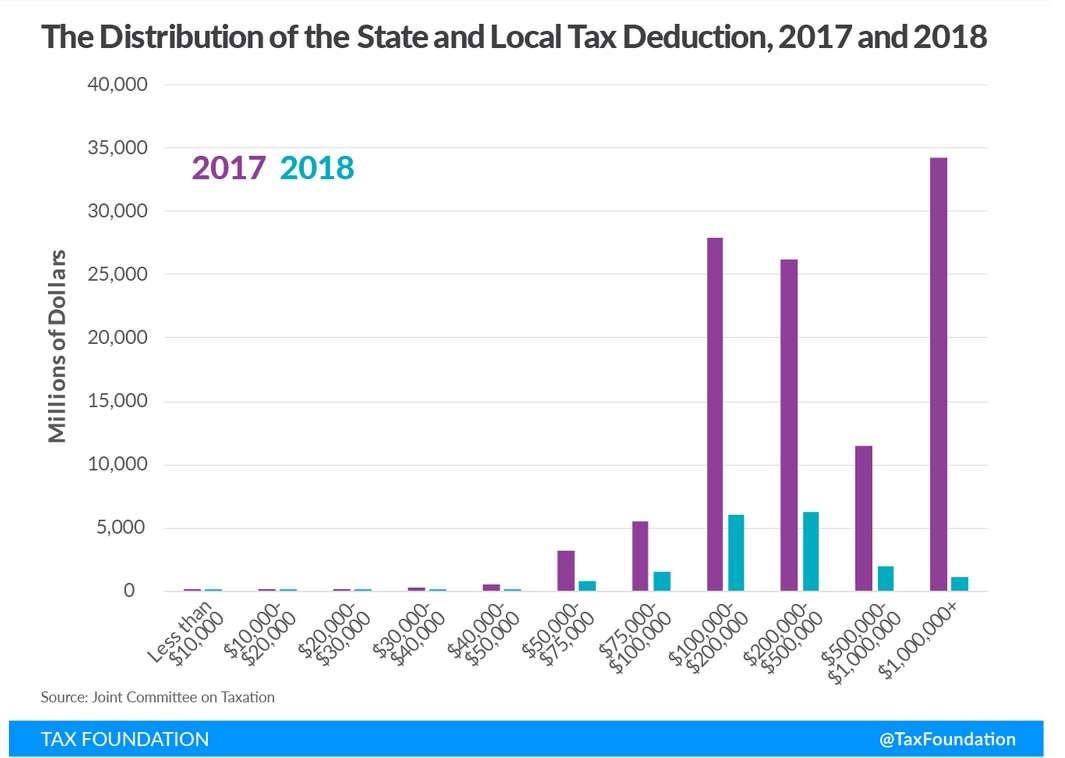
Pre And Post SALT Deduction Tax Cap Chart Shows Wealthy Benefit The Most From SALT Deduction

From Reason, "Eat The Rich? House Democrats Plan To Pass Huge Tax Break for Wealthy Homeowners. The party that's calling for huge tax increases on the wealthy is about to hand wealthier Americans a big tax break that will add to the federal budget." by Eric Boehm:
Democrats are trying to sell the repeal of the SALT caps as a middle-class tax break, but historical evidence shows that it almost exclusively benefits high-earning homeowners who live in parts of the country where you must pay high taxes.
Source: reason 
"Jurisdictions with higher-income residents received more of a benefit than those with lower-income residents," Nicole Kaeding, a vice president at the Tax Foundation, a nonpartisan tax policy center, explained to the House Ways and Means Committee at a hearing earlier this year. "In some ways, it allowed high-tax states and localities to export their tax liabilities to taxpayers in other states, particularly low-tax, low-income states."

Friday, December 13, 2019

It’s What You Study In College - Not Where You Study That Determines Earnings After Graduation

From E21, "For Most College Students, It’s What You Study—Not Where You Study" by Preston Cooper:
[H]ow much students earn after graduating college—where a student goes matters far less than what she chooses to study.

That is one of the principal takeaways from the updated College Scorecard, a federal dataset that reveals how much students at thousands of colleges and universities can expect to earn in their first year after graduation. Critically, the earnings data are now broken down by program of study, so prospective students can compare the earnings of, say, a history major and an engineering major who graduated from the same school. Not every program has data available, but statistics are mostly complete for the large public universities that enroll most of the nation’s undergraduates.

It is probably no surprise that majors like engineering, computer science, and nursing out-earn majors such as history, psychology, and English literature in the job market. At the University of Maryland-College Park, for instance, a history major can expect to earn just $29,000 in her first year after graduation, while a civil-engineering major at the same school has a median starting salary of nearly $65,000.
Source: E21

Friday, December 6, 2019

Unmeasured Illegal Activities Add Over 1 Percent To US GDP

From The Wall Street Journal, "GDP Doesn’t Include Proceeds of Crime. Should It? Sales of illegal drugs would have added $111 billion to U.S. gross domestic product, according to estimate" by Jo Craven McGinty:
When the U.S. calculates its gross domestic product, it only includes things that are legal. But if the wares of drug dealers, pimps, bookies and other black-market denizens were included, the GDP would expand by more than 1%, according to one estimate.
***
Illegal Activities GDP Effect
Source: The Wall St Journal
***
... Canada has found that accounting for illicit sales of cannabis alone would add around 0.4% to its GDP. The U.K. has estimated that prostitution and illegal drugs represent around 0.4% of its GDP. And in the U.S., Rachel Soloveichik, a research economist with the Bureau of Economic Analysis, has estimated that in 2017, illegal activities would have added more than 1% to the GDP. She presented her analysis last month at the IMF Statistical Forum.

Monday, December 2, 2019

My Comment To WSJ, "How To Fix College Admission": My Answer Is, "Increase Supply"

Highly rated, highly prestigious colleges and universities deny admission to numerous undergraduate applicants who are as qualified as those that are accepted. Qualified applicants demand for admission to the top colleges exceeds the supply of available openings. In most other unregulated situations of unfilled demand, the producer of the service or product, or competitors, would increase the supply to meet the excess demand. Historical prestige and third party college rankings create a barrier that prevent newcomers and lower ranked colleges from competing for the applicants to the top tier schools. As I suggest in the following Wall Street Journal comment, prestige colleges and universities should expand geographically in the US to meet the needs of the excess demand of qualified applicants.

My published comment to The Wall Street Journal, "How to Fix College Admissions: Getting into a top school is a stressful, unpredictable process. Here are 10 ways to make it fairer and more transparent."
Increase supply to meet demand. Top ranked universities and colleges need to geographically expand their brand names. Put campuses across the US to increase enrollment. If their [sic] were multiple campuses across the US that were affiliated or under direct control of top ranked universities, then many more applicants to top schools could get degrees from top ranked schools. There are many qualified PhD's in and outside the US who cannot currently get university teaching or tenure positions. Use them to create prestigious schools across the US. Like any other product, there are winners with big market share and prestige and losers with low prestige and [low] market share. One way would be to eliminate the not for profit status of colleges and universities. A profit motive would force schools to expand their brands across the US, to expand their market share and to meet he [the] needs of a wider range of students, e.g. imagine a Harvard community college 2 year degree in every state.

Thursday, November 21, 2019

Americans Are Moving At The Lowest Rate

From The Wall Street Journal, Real Time Economics, "Newsletter: Americans Are Moving at the Lowest Rate on Record" by Jeffrey Sparshott:
Americans are moving at the lowest rate on record. New Census Bureau data show 9.8% of the U.S. population age 1 and older changed addresses over the past year, the smallest share in records dating back to 1948. The latest figures highlight a long-term decline in American mobility—through much of the 1950s and 1960s around 20% of the population moved to a new home each year.
***
Source: The Wall St Journal, Real Time Economics

Tuesday, November 19, 2019

US Attorney General William P Barr's Speech at the Barbara K Olson Memorial Lecture at the Federalist Society's 2019 National Lawyers Convention

From the US Justice Department speeches, "Attorney General William P. Barr Delivers the 19th Annual Barbara K. Olson Memorial Lecture at the Federalist Society's 2019 National Lawyers Convention," Washington, DC, Friday, November 15, 2019:

Remarks as Prepared for Delivery
Good Evening. Thank you all for being here. And thank you to Gene [Meyer] for your kind introduction.

It is an honor to be here this evening delivering the 19th Annual Barbara K. Olson Memorial Lecture. I had the privilege of knowing Barbara and had deep affection for her. I miss her brilliance and ebullient spirit. It is a privilege for me to participate in this series, which honors her.

The theme for this year’s Annual Convention is “Originalism,” which is a fitting choice — though, dare I say, a somewhat “unoriginal” one for the Federalist Society. I say that because the Federalist Society has played an historic role in taking originalism “mainstream.” While other organizations have contributed to the cause, the Federalist Society has been in the vanguard.

A watershed for the cause was the decision of the American people to send Ronald Reagan to the White House, accompanied by his close advisor Ed Meese and a cadre of others who were firmly committed to an originalist approach to the law. I was honored to work with Ed in the Reagan White House and be there several weeks ago when President Trump presented him with the Presidential Medal of Freedom. As the President aptly noted, over the course of his career, Ed Meese has been among the Nation’s “most eloquent champions for following the Constitution as written.”

I am also proud to serve as the Attorney General under President Trump, who has taken up that torch in his judicial appointments. That is true of his two outstanding appointments to the Supreme Court, Justices Neil Gorsuch and Brett Kavanaugh; of the many superb court of appeals and district court judges he has appointed, many of whom are here this week; and of the many outstanding judicial nominees to come, many of whom are also here this week.

***********

I wanted to choose a topic for this afternoon’s lecture that had an originalist angle. It will likely come as little surprise to this group that I have chosen to speak about the Constitution’s approach to executive power.

I deeply admire the American Presidency as a political and constitutional institution. I believe it is, one of the great, and remarkable innovations in our Constitution, and has been one of the most successful features of the Constitution in protecting the liberties of the American people. More than any other branch, it has fulfilled the expectations of the Framers.

Unfortunately, over the past several decades, we have seen steady encroachment on Presidential authority by the other branches of government. This process I think has substantially weakened the functioning of the Executive Branch, to the detriment of the Nation. This evening, I would like to expand a bit on these themes.

I.

First, let me say a little about what the Framers had in mind in establishing an independent Executive in Article II of the Constitution.

The grammar school civics class version of our Revolution is that it was a rebellion against monarchial tyranny, and that, in framing our Constitution, one of the main preoccupations of the Founders was to keep the Executive weak. This is misguided. By the time of the Glorious Revolution of 1689, monarchical power was effectively neutered and had begun its steady decline. Parliamentary power was well on its way to supremacy and was effectively in the driver’s seat. By the time of the American Revolution, the patriots well understood that their prime antagonist was an overweening Parliament. Indeed, British thinkers came to conceive of Parliament, rather than the people, as the seat of Sovereignty.

During the Revolutionary era, American thinkers who considered inaugurating a republican form of government tended to think of the Executive component as essentially an errand boy of a Supreme legislative branch. Often the Executive (sometimes constituted as a multi-member council) was conceived as a creature of the Legislature, dependent on and subservient to that body, whose sole function was carrying out the Legislative will. Under the Articles of Confederation, for example, there was no Executive separate from Congress.

Things changed by the Constitutional Convention of 1787. To my mind, the real “miracle” in Philadelphia that summer was the creation of a strong Executive, independent of, and coequal with, the other two branches of government.

The consensus for a strong, independent Executive arose from the Framers’ experience in the Revolution and under the Articles of Confederation. They had seen that the War had almost been lost and was a bumbling enterprise because of the lack of strong Executive leadership. Under the Articles of Confederation, they had been mortified at the inability of the United States to protect itself against foreign impositions or to be taken seriously on the international stage. They had also seen that, after the Revolution, too many States had adopted constitutions with weak Executives overly subordinate to the Legislatures. Where this had been the case, state governments had proven incompetent and indeed tyrannical.

From these practical experiences, the Framers had come to appreciate that, to be successful, Republican government required the capacity to act with energy, consistency and decisiveness. They had come to agree that those attributes could best be provided by making the Executive power independent of the divided counsels of the Legislative branch and vesting the Executive power in the hands of a solitary individual, regularly elected for a limited term by the Nation as a whole. As Jefferson put it, ‘[F]or the prompt, clear, and consistent action so necessary in an Executive, unity of person is necessary….”

While there may have been some differences among the Framers as to the precise scope of Executive power in particular areas, there was general agreement about its nature. Just as the great separation-of-powers theorists– Polybius, Montesquieu, Locke – had, the Framers thought of Executive power as a distinct specie of power. To be sure, Executive power includes the responsibility for carrying into effect the laws passed by the Legislature – that is, applying the general rules to a particular situation. But the Framers understood that Executive power meant more than this.

It also entailed the power to handle essential sovereign functions – such as the conduct of foreign relations and the prosecution of war – which by their very nature cannot be directed by a pre-existing legal regime but rather demand speed, secrecy, unity of purpose, and prudent judgment to meet contingent circumstances. They agreed that – due to the very nature of the activities involved, and the kind of decision-making they require – the Constitution generally vested authority over these spheres in the Executive. For example, Jefferson, our first Secretary of State, described the conduct of foreign relations as “Executive altogether,” subject only to the explicit exceptions defined in the Constitution, such as the Senate’s power to ratify Treaties.

A related, and third aspect of Executive power is the power to address exigent circumstances that demand quick action to protect the well-being of the Nation but on which the law is either silent or inadequate – such as dealing with a plague or natural disaster. This residual power to meet contingency is essentially the federative power discussed by Locke in his Second Treatise.

And, finally, there are the Executive’s powers of internal management. These are the powers necessary for the President to superintend and control the Executive function, including the powers necessary to protect the independence of the Executive branch and the confidentiality of its internal deliberations. Some of these powers are express in the Constitution, such as the Appointment power, and others are implicit, such as the Removal power.

One of the more amusing aspects of modern progressive polemic is their breathless attacks on the “unitary executive theory.” They portray this as some new-fangled “theory” to justify Executive power of sweeping scope. In reality, the idea of the unitary executive does not go so much to the breadth of Presidential power. Rather, the idea is that, whatever the Executive powers may be, they must be exercised under the President’s supervision. This is not “new,” and it is not a “theory.” It is a description of what the Framers unquestionably did in Article II of the Constitution.

After you decide to establish an Executive function independent of the Legislature, naturally the next question is, who will perform that function? The Framers had two potential models. They could insinuate “checks and balances” into the Executive branch itself by conferring Executive power on multiple individuals (a council) thus dividing the power. Alternatively, they could vest Executive power in a solitary individual. The Framers quite explicitly chose the latter model because they believed that vesting Executive authority in one person would imbue the Presidency with precisely the attributes necessary for energetic government. Even Jefferson – usually seen as less of a hawk than Hamilton on Executive power – was insistent that Executive power be placed in “single hands,” and he cited the America’s unitary Executive as a signal feature that distinguished America’s success from France’s failed republican experiment.

The implications of the Framers’ decision are obvious. If Congress attempts to vest the power to execute the law in someone beyond the control of the President, it contravenes the Framers’ clear intent to vest that power in a single person, the President. So much for this supposedly nefarious theory of the unitary executive.

II.

We all understand that the Framers expected that the three branches would be jostling and jousting with each other, as each threatened to encroach on the prerogatives of the others. They thought this was not only natural, but salutary, and they provisioned each branch with the wherewithal to fight and to defend itself in these interbranch struggles for power.

So let me turn now to how the Executive is presently faring in these interbranch battles. I am concerned that the deck has become stacked against the Executive. Since the mid-60s, there has been a steady grinding down of the Executive branch’s authority, that accelerated after Watergate. More and more, the President’s ability to act in areas in which he has discretion has become smothered by the encroachments of the other branches.

When these disputes arise, I think there are two aspects of contemporary thought that tend to operate to the disadvantage of the Executive.

The first is the notion that politics in a free republic is all about the Legislative and Judicial branches protecting liberty by imposing restrictions on the Executive. The premise is that the greatest danger of government becoming oppressive arises from the prospect of Executive excess. So, there is a knee-jerk tendency to see the Legislative and Judicial branches as the good guys protecting society from a rapacious would-be autocrat.

This prejudice is wrong-headed and atavistic. It comes out of the early English Whig view of politics and English constitutional experience, where political evolution was precisely that. You started out with a King who holds all the cards; he holds all the power, including Legislative and Judicial. Political evolution involved a process by which the Legislative power gradually, over hundreds of years, reigned in the King, and extracted and established its own powers, as well as those of the Judiciary. A watershed in this evolution was, of course, the Glorious Revolution in 1689.

But by 1787, we had the exact opposite model in the United States. The Founders greatly admired how the British constitution had given rise to the principles of a balanced government. But they felt that the British constitution had achieved only an imperfect form of this model. They saw themselves as framing a more perfect version of separation of powers and a balanced constitution.

Part of their more perfect construction was a new kind of Executive. They created an office that was already the ideal Whig Executive. It already had built into it the limitations that Whig doctrine aspired to. It did not have the power to tax and spend; it was constrained by habeas corpus and by due process in enforcing the law against members of the body politic; it was elected for a limited term of office; and it was elected by the nation as whole. That is a remarkable democratic institution – the only figure elected by the Nation as a whole. With the creation of the American Presidency, the Whig’s obsessive focus on the dangers of monarchical rule lost relevance.

This fundamental shift in view was reflected in the Convention debates over the new frame of government. Their concerns were very different from those that weighed on 17th century English Whigs. It was not Executive power that was of so much concern to them; it was danger of the legislative branch, which they viewed as the most dangerous branch to liberty. As Madison warned, the “legislative department is everywhere extending the sphere of its activity, and drawing all power into its impetuous vortex.” And indeed, they viewed the Presidency as a check on the Legislative branch.

The second contemporary way of thinking that operates against the Executive is a notion that the Constitution does not sharply allocate powers among the three branches, but rather that the branches, especially the political branches, “share” powers. The idea at work here is that, because two branches both have a role to play in a particular area, we should see them as sharing power in that area and, it is not such a big deal if one branch expands its role within that sphere at the expense of the other.

This mushy thinking obscures what it means to say that powers are shared under the Constitution. Constitution generally assigns broad powers to each of the branches in defined areas. Thus, the Legislative power granted in the Constitution is granted to the Congress. At the same time, the Constitution gives the Executive a specific power in the Legislative realm – the veto power. Thus, the Executive “shares” Legislative power only to the extent of the specific grant of veto power. The Executive does not get to interfere with the broader Legislative power assigned to the Congress.

In recent years, both the Legislative and Judicial branches have been responsible for encroaching on the Presidency’s constitutional authority. Let me first say something about the Legislature.

A.

As I have said, the Framers fully expected intense pulling and hauling between the Congress and the President. Unfortunately, just in the past few years, we have seen these conflicts take on an entirely new character.

Immediately after President Trump won election, opponents inaugurated what they called “The Resistance,” and they rallied around an explicit strategy of using every tool and maneuver available to sabotage the functioning of his Administration. Now, “resistance” is the language used to describe insurgency against rule imposed by an occupying military power. It obviously connotes that the government is not legitimate. This is a very dangerous – indeed incendiary – notion to import into the politics of a democratic republic. What it means is that, instead of viewing themselves as the “loyal opposition,” as opposing parties have done in the past, they essentially see themselves as engaged in a war to cripple, by any means necessary, a duly elected government.

A prime example of this is the Senate’s unprecedented abuse of the advice-and-consent process. The Senate is free to exercise that power to reject unqualified nominees, but that power was never intended to allow the Senate to systematically oppose and draw out the approval process for every appointee so as to prevent the President from building a functional government.

Yet that is precisely what the Senate minority has done from his very first days in office. As of September of this year, the Senate had been forced to invoke cloture on 236 Trump nominees — each of those representing its own massive consumption of legislative time meant only to delay an inevitable confirmation. How many times was cloture invoked on nominees during President Obama’s first term? 17 times. The Second President Bush’s first term? Four times. It is reasonable to wonder whether a future President will actually be able to form a functioning administration if his or her party does not hold the Senate.

Congress has in recent years also largely abdicated its core function of legislating on the most pressing issues facing the national government. They either decline to legislate on major questions or, if they do, punt the most difficult and critical issues by making broad delegations to a modern administrative state that they increasingly seek to insulate from Presidential control. This phenomenon first arose in the wake of the Great Depression, as Congress created a number of so-called “independent agencies” and housed them, at least nominally, in the Executive Branch. More recently, the Dodd-Frank Act’s creation of the Consumer Financial Protection Branch, a single-headed independent agency that functions like a junior varsity President for economic regulation, is just one of many examples.

Of course, Congress’s effective withdrawal from the business of legislating leaves it with a lot of time for other pursuits. And the pursuit of choice, particularly for the opposition party, has been to drown the Executive Branch with “oversight” demands for testimony and documents. I do not deny that Congress has some implied authority to conduct oversight as an incident to its Legislative Power. But the sheer volume of what we see today – the pursuit of scores of parallel “investigations” through an avalanche of subpoenas – is plainly designed to incapacitate the Executive Branch, and indeed is touted as such.

The costs of this constant harassment are real. For example, we all understand that confidential communications and a private, internal deliberative process are essential for all of our branches of government to properly function. Congress and the Judiciary know this well, as both have taken great pains to shield their own internal communications from public inspection. There is no FOIA for Congress or the Courts. Yet Congress has happily created a regime that allows the public to seek whatever documents it wants from the Executive Branch at the same time that individual congressional committees spend their days trying to publicize the Executive’s internal decisional process. That process cannot function properly if it is public, nor is it productive to have our government devoting enormous resources to squabbling about what becomes public and when, rather than doing the work of the people.

In recent years, we have seen substantial encroachment by Congress in the area of executive privilege. The Executive Branch and the Supreme Court have long recognized that the need for confidentiality in Executive Branch decision-making necessarily means that some communications must remain off limits to Congress and the public. There was a time when Congress respected this important principle as well. But today, Congress is increasingly quick to dismiss good-faith attempts to protect Executive Branch equities, labeling such efforts “obstruction of Congress” and holding Cabinet Secretaries in contempt.

One of the ironies of today is that those who oppose this President constantly accuse this Administration of “shredding” constitutional norms and waging a war on the rule of law. When I ask my friends on the other side, what exactly are you referring to? I get vacuous stares, followed by sputtering about the Travel Ban or some such thing. While the President has certainly thrown out the traditional Beltway playbook, he was upfront about that beforehand, and the people voted for him. What I am talking about today are fundamental constitutional precepts. The fact is that this Administration’s policy initiatives and proposed rules, including the Travel Ban, have transgressed neither constitutional, nor traditional, norms, and have been amply supported by the law and patiently litigated through the Court system to vindication.

Indeed, measures undertaken by this Administration seem a bit tame when compared to some of the unprecedented steps taken by the Obama Administration’s aggressive exercises of Executive power – such as, under its DACA program, refusing to enforce broad swathes of immigration law.

The fact of the matter is that, in waging a scorched earth, no-holds-barred war of “Resistance” against this Administration, it is the Left that is engaged in the systematic shredding of norms and the undermining of the rule of law. This highlights a basic disadvantage that conservatives have always had in contesting the political issues of the day. It was adverted to by the old, curmudgeonly Federalist, Fisher Ames, in an essay during the early years of the Republic.

In any age, the so-called progressives treat politics as their religion. Their holy mission is to use the coercive power of the State to remake man and society in their own image, according to an abstract ideal of perfection. Whatever means they use are therefore justified because, by definition, they are a virtuous people pursing a deific end. They are willing to use any means necessary to gain momentary advantage in achieving their end, regardless of collateral consequences and the systemic implications. They never ask whether the actions they take could be justified as a general rule of conduct, equally applicable to all sides.

Conservatives, on the other hand, do not seek an earthly paradise. We are interested in preserving over the long run the proper balance of freedom and order necessary for healthy development of natural civil society and individual human flourishing. This means that we naturally test the propriety and wisdom of action under a “rule of law” standard. The essence of this standard is to ask what the overall impact on society over the long run if the action we are taking, or principle we are applying, in a given circumstance was universalized – that is, would it be good for society over the long haul if this was done in all like circumstances?

For these reasons, conservatives tend to have more scruple over their political tactics and rarely feel that the ends justify the means. And this is as it should be, but there is no getting around the fact that this puts conservatives at a disadvantage when facing progressive holy far, especially when doing so under the weight of a hyper-partisan media.

B.

Let me turn now to what I believe has been the prime source of the erosion of separation-of-power principles generally, and Executive Branch authority specifically. I am speaking of the Judicial Branch.

In recent years the Judiciary has been steadily encroaching on Executive responsibilities in a way that has substantially undercut the functioning of the Presidency. The Courts have done this in essentially two ways: First, the Judiciary has appointed itself the ultimate arbiter of separation of powers disputes between Congress and Executive, thus preempting the political process, which the Framers conceived as the primary check on interbranch rivalry. Second, the Judiciary has usurped Presidential authority for itself, either (a) by, under the rubric of “review,” substituting its judgment for the Executive’s in areas committed to the President’s discretion, or (b) by assuming direct control over realms of decision-making that heretofore have been considered at the core of Presidential power.

The Framers did not envision that the Courts would play the role of arbiter of turf disputes between the political branches. As Madison explained in Federalist 51, “the great security against a gradual concentration of the several powers in the same department, consists in giving to those who administer each department the necessary constitutional means and personal motives to resist encroachments of the others.” By giving each the Congress and the Presidency the tools to fend off the encroachments of the others, the Framers believed this would force compromise and political accommodation.

The “constitutional means” to “resist encroachment” that Madison described take various forms. As Justice Scalia observed, the Constitution gives Congress and the President many “clubs with which to beat” each other. Conspicuously absent from the list is running to the courts to resolve their disputes.

That omission makes sense. When the Judiciary purports to pronounce a conclusive resolution to constitutional disputes between the other two branches, it does not act as a co-equal. And, if the political branches believe the courts will resolve their constitutional disputes, they have no incentive to debate their differences through the democratic process — with input from and accountability to the people. And they will not even try to make the hard choices needed to forge compromise. The long experience of our country is that the political branches can work out their constitutional differences without resort to the courts.

In any event, the prospect that courts can meaningfully resolve interbranch disputes about the meaning of the Constitution is mostly a false promise. How is a court supposed to decide, for example, whether Congress’s power to collect information in pursuit of its legislative function overrides the President’s power to receive confidential advice in pursuit of his executive function? Nothing in the Constitution provides a manageable standard for resolving such a question. It is thus no surprise that the courts have produced amorphous, unpredictable balancing tests like the Court’s holding in Morrison v. Olson that Congress did not “disrupt the proper balance between the coordinate branches by preventing the Executive Branch from accomplishing its constitutionally assigned functions.”

Apart from their overzealous role in interbranch disputes, the courts have increasingly engaged directly in usurping Presidential decision-making authority for themselves. One way courts have effectively done this is by expanding both the scope and the intensity of judicial review.

In recent years, we have lost sight of the fact that many critical decisions in life are not amenable to the model of judicial decision-making. They cannot be reduced to tidy evidentiary standards and specific quantums of proof in an adversarial process. They require what we used to call prudential judgment. They are decisions that frequently have to be made promptly, on incomplete and uncertain information and necessarily involve weighing a wide range of competing risks and making predictions about the future. Such decisions frequently call into play the “precautionary principle.” This is the principle that when a decision maker is accountable for discharging a certain obligation – such as protecting the public’s safety – it is better, when assessing imperfect information, to be wrong and safe, than wrong and sorry.

It was once well recognized that such matters were largely unreviewable and that the courts should not be substituting their judgments for the prudential judgments reached by the accountable Executive officials. This outlook now seems to have gone by the boards. Courts are now willing, under the banner of judicial review, to substitute their judgment for the President’s on matters that only a few decades ago would have been unimaginable – such as matters involving national security or foreign affairs.

The Travel Ban case is a good example. There the President made a decision under an explicit legislative grant of authority, as well has his Constitutional national security role, to temporarily suspend entry to aliens coming from a half dozen countries pending adoption of more effective vetting processes. The common denominator of the initial countries selected was that they were unquestionable hubs of terrorism activity, which lacked functional central government’s and responsible law enforcement and intelligence services that could assist us in identifying security risks among their nationals seeking entry. Despite the fact there were clearly justifiable security grounds for the measure, the district court in Hawaii and the Ninth Circuit blocked this public-safety measure for a year and half on the theory that the President’s motive for the order was religious bias against Muslims. This was just the first of many immigration measures based on good and sufficient security grounds that the courts have second guessed since the beginning of the Trump Administration.

The Travel Ban case highlights an especially troubling aspect of the recent tendency to expand judicial review. The Supreme Court has traditionally refused, across a wide variety of contexts, to inquire into the subjective motivation behind governmental action. To take the classic example, if a police officer has probable cause to initiate a traffic stop, his subjective motivations are irrelevant. And just last term, the Supreme Court appropriately shut the door to claims that otherwise-lawful redistricting can violate the Constitution if the legislators who drew the lines were actually motivated by political partisanship.

What is true of police officers and gerrymanderers is equally true of the President and senior Executive officials. With very few exceptions, neither the Constitution, nor the Administrative Procedure Act or any other relevant statute, calls for judicial review of executive motive. They apply only to executive action. Attempts by courts to act like amateur psychiatrists attempting to discern an Executive official’s “real motive” — often after ordering invasive discovery into the Executive Branch’s privileged decision-making process — have no more foundation in the law than a subpoena to a court to try to determine a judge’s real motive for issuing its decision. And courts’ indulgence of such claims, even if they are ultimately rejected, represents a serious intrusion on the President’s constitutional prerogatives.

The impact of these judicial intrusions on Executive responsibility have been hugely magnified by another judicial innovation – the nationwide injunction. First used in 1963, and sparely since then until recently, these court orders enjoin enforcement of a policy not just against the parties to a case, but against everyone. Since President Trump took office, district courts have issued over 40 nationwide injunctions against the government. By comparison, during President Obama’s first two years, district courts issued a total of two nationwide injunctions against the government. Both were vacated by the Ninth Circuit.

It is no exaggeration to say that virtually every major policy of the Trump Administration has been subjected to immediate freezing by the lower courts. No other President has been subjected to such sustained efforts to debilitate his policy agenda.

The legal flaws underlying nationwide injunctions are myriad. Just to summarize briefly, nationwide injunctions have no foundation in courts’ Article III jurisdiction or traditional equitable powers; they radically inflate the role of district judges, allowing any one of more than 600 individuals to singlehandedly freeze a policy nationwide, a power that no single appellate judge or Justice can accomplish; they foreclose percolation and reasoned debate among lower courts, often requiring the Supreme Court to decide complex legal issues in an emergency posture with limited briefing; they enable transparent forum shopping, which saps public confidence in the integrity of the judiciary; and they displace the settled mechanisms for aggregate litigation of genuinely nationwide claims, such as Rule 23 class actions.

Of particular relevance to my topic tonight, nationwide injunctions also disrupt the political process. There is no better example than the courts’ handling of the rescission of DACA. As you recall, DACA was a discretionary policy of enforcement forbearance adopted by President Obama’s administration. The Fifth Circuit concluded that the closely related DAPA policy (along with an expansion of DACA) was unlawful, and the Supreme Court affirmed that decision by an equally divided vote. Given that DACA was discretionary — and that four Justices apparently thought a legally indistinguishable policy was unlawful —President Trump’s administration understandably decided to rescind DACA.

Importantly, however, the President coupled that rescission with negotiations over legislation that would create a lawful and better alternative as part of a broader immigration compromise. In the middle of those negotiations — indeed, on the same day the President invited cameras into the Cabinet Room to broadcast his negotiations with bipartisan leaders from both Houses of Congress — a district judge in the Northern District of California enjoined the rescission of DACA nationwide. Unsurprisingly, the negotiations over immigration legislation collapsed after one side achieved its preferred outcome through judicial means. A humanitarian crisis at the southern border ensued. And just this week, the Supreme Court finally heard argument on the legality of the DACA rescission. The Court will not likely decide the case until next summer, meaning that President Trump will have spent almost his entire first term enforcing President Obama’s signature immigration policy, even though that policy is discretionary and half the Supreme Court concluded that a legally indistinguishable policy was unlawful. That is not how our democratic system is supposed to work.

To my mind, the most blatant and consequential usurpation of Executive power in our history was played out during the Administration of President George W. Bush, when the Supreme Court, in a series of cases, set itself up as the ultimate arbiter and superintendent of military decisions inherent in prosecuting a military conflict – decisions that lie at the very core of the President’s discretion as Commander in Chief.

This usurpation climaxed with the Court’s 2008 decision in Boumediene. There, the Supreme Court overturned hundreds of years of American, and earlier British, law and practice, which had always considered decisions as to whether to detain foreign combatants to be purely military judgments which civilian judges had no power to review. For the first time, the Court ruled that foreign persons who had no connection with the United States other than being confronted by our military on the battlefield had “due process” rights and thus have the right to habeas corpus to obtain judicial review of whether the military has a sufficient evidentiary basis to hold them.

In essence, the Court has taken the rules that govern our domestic criminal justice process and carried them over and superimposed them on the Nation’s activities when it is engaged in armed conflict with foreign enemies. This rides roughshod over a fundamental distinction that is integral to the Constitution and integral to the role played by the President in our system.

As the Preamble suggests, governments are established for two different security reasons – to secure domestic tranquility and to provide for defense against external dangers. These are two very different realms of government action.

In a nutshell, under the Constitution, when the government is using its law enforcement powers domestically to discipline an errant member of the community for a violation of law, then protecting the liberty of the American people requires that we sharply curtail the government’s power so it does not itself threaten the liberties of the people. Thus, the Constitution in this arena deliberately sacrifices efficiency; invests the accused with rights that that essentially create a level playing field between the collective interests of community and those of the individual; and dilutes the government’s power by dividing it and turning it on itself as a check, at each stage the Judiciary is expressly empowered to serve as a check and neutral arbiter.

None of these considerations are applicable when the government is defending the country against armed attacks from foreign enemies. In this realm, the Constitution is concerned with one thing – preserving the freedom of our political community by destroying the external threat. Here, the Constitution is not concerned with handicapping the government to preserve other values. The Constitution does not confer “rights” on foreign enemies. Rather the Constitution is designed to maximize the government’s efficiency to achieve victory – even at the cost of “collateral damage” that would be unacceptable in the domestic realm. The idea that the judiciary acts as a neutral check on the political branches to protect foreign enemies from our government is insane.

The impact of Boumediene has been extremely consequential. For the first time in American history our armed forces is incapable of taking prisoners. We are now in a crazy position that, if we identify a terrorist enemy on the battlefield, such as ISIS, we can kill them with drone or any other weapon. But if we capture them and want to hold them at Guantanamo or in the United States, the military is tied down in developing evidence for an adversarial process and must spend resources in interminable litigation.

The fact that our courts are now willing to invade and muck about in these core areas of Presidential responsibility illustrates how far the doctrine of Separation of Powers has been eroded.

III.

In this partisan age, we should take special care not to allow the passions of the moment to cause us to permanently disfigure the genius of our Constitutional structure. As we look back over the sweep of American history, it has been the American Presidency that has best fulfilled the vision of the Founders. It has brought to our Republic a dynamism and effectiveness that other democracies have lacked.

At every critical juncture where the country has faced a great challenge –

– whether it be in our earliest years as the weak, nascent country combating regional rebellions, and maneuvering for survival in a world of far stronger nations;

– whether it be during our period of continental expansion, with the Louisiana Purchase, and the acquisition of Mexican territory;

– whether it be the Civil War, the epic test of the Nation;

– World War II and the struggle against Fascism;

– the Cold War and the challenge of Communism;

– the struggle against racial discrimination;

– and most recently, the fight against Islamist Fascism and international terrorism.

One would have to say that it has been the Presidency that has stepped to the fore and provided the leadership, consistency, energy and perseverance that allowed us to surmount the challenge and brought us success.

In so many areas, it is critical to our Nation’s future that we restore and preserve in their full vigor our Founding principles. Not the least of these is the Framers’ vision of a strong, independent Executive, chosen by the country as a whole.

Wednesday, October 2, 2019

More Voters Are Angry At The Media Than At Trump Or His Foes

From Rasmussen Reports, October 02, 2019, "Voters Are Madder at the Media Than at Trump or His Foes":
Voters are mad at President Trump and his political opponents, but they’re angriest at the media these days.

A new Rasmussen Reports national telephone and online survey shows that 53% of Likely U.S. Voters are angry at the president, with 39% who are Very Angry.
***
Forty-nine percent (49%) are angry at Trump’s political opponents, including 32% who are Very Angry.
***
But 61% of voters are angry at the media; .... This includes 40% who are Very Angry ... .

Friday, September 27, 2019

Realized Capital Gains Are Sensitive To Tax Rates

From Tax Foundation, "JCT Report Shows Capital Gains are Sensitive to Taxation" September 25, 2019, by Scott Eastman:
Earlier this month, the Joint Committee on Taxation (JCT) reminded us that capital gains taxes can drastically impact realizations. This is because taxpayers can choose when they sell an asset and pay capital gains taxes. This effect could be eliminated by taxing all capital gains under a mark-to-market system. Mark-to-market taxation of capital gains would eliminate this realization effect but also increase taxes on saving.

Under current law, capital gains—or the value of an asset in excess of its cost basis— are not taxed until an asset is sold (or “realized”). The option to time when capital gains are realized allows taxpayers to minimize their tax bill, and makes capital gain realizations sensitive to tax rates.
***
Realized Capital Gains Affected By Tax Rates: Chart
Source: Tax Foundation

Monday, September 23, 2019

Updated: Let The Consumer Choose. Comment To WSJ, "How to Cut Emissions Without Wrecking the Economy"

My published comment to The Wall Street Journal, Commentary, "How to Cut Emissions Without Wrecking the Economy: A proposal for carbon dividends, backed by the broadest climate coalition in American history" by Christopher Crane and Ted Halstead:
Global warming is a world-wide problem. The US has a competitive profit motive private sector that constantly reduces production costs using fewer resources and more efficient production processes. The result is reductions in energy use and carbon output and the US is producing more with less energy per unit. Over the last few years, the US has seen a decline in its total CO2 equivalent emissions. While the US has reduced its green house gas output, the rest of the world has not. Virtue signaling, like the Paris Accord, will not reduce emissions. A carbon tax goes to the government and is not a private sector efficiency incentive nor an incentive to realistic approaches, such as carbon capture, nuclear, hydropower and hydrothermal power. Taxes, even refunded carbon based, increase prices, reduce output and wages, create deadweight loss and increase unemployment. Instead of a tax, put a carbon use number, like calories and mpg, on a product and let the consumer choose.

Addendum
A reply I posted to a comment to my comment in the previous article:
A carbon tax creates inefficiency through the creation of a tax wedge. The price consumers pay, price plus carbon tax, is less than the amount the producer receives for the goods produced, the price without the carbon tax. The tax goes to the government and not the producer. The differential creates a space where inefficient producers can sell their goods at a price higher than similar goods prior to the carbon tax, if they have lower carbon taxes. The carbon tax amount will be decided by bureaucrats and not the marketplace leading to loopholes and market distortions. Non-existing clean power producers, windmill, etc., will have to build new plants and power storage facilities to meet demand. Constructing new clean power facilities will produce carbon emissions. The startup carbon tax may prohibit them, unless they are exempted or subsidized. Exemptions and subsidies will lead to non-taxed carbon emissions. Better to let the consumer choose based on producer's carbon use. Label it.

Wednesday, September 4, 2019

An Expectation View Of The 2008 Housing Crisis

Back in October 2008, I published a list on this blog [below] of some possible future sociological and economic scenarios that would affect the then current prices of homes through a change in expectation. In looking at that list today, it surprises me that so many occurred.
Tuesday, October 21, 2008, "Home Values Were Not In A Bubble" Posted By Milton Recht:
***
In a rational expectations, efficient market world which is the world economic research finds we live in, house price changes are due to changes in the expectations of the economic fundamentals related to the need, demand and value of houses. Thus, current house prices reflect their true economic value and homes are not undervalued whether due to the unavailability of credit or for other reasons. Arms-length housing market transactions, of which there are still many, occur at the true current price of housing.
***
Some of the possible future scenarios which would decrease the current value of a home are:
  1. a significant and long-term decline in household formation.
  2. a significant and long-term decline in population growth in the US due to changes in birthrate or immigration policies.
  3. an increase in adult children living in their parents home (including after marriage or cohabitation).
  4. an expectation of an increase in mortality or a shortening of life expectancy due to war, disease or natural or man made disasters. [Add opioids and suicide.]
  5. a change in our preferences so as to prefer multi-family or apartment type dwellings as opposed to single family homes decreasing the need for single family homes.
  6. a significant increase in the costs of owning and maintaining a home which lowers its economic value to a purchaser because of the expected increase cash outflow during ownership.
  7. a decline in both household income or the expected growth rate of household income.
  8. an alternative technology for building homes which will dramatically reduce the costs of building new houses.
  9. a change in home related taxation such as a denial of mortgage interest or real estate taxes deductions.
  10. a substantial expected increase in real estate taxes.
  11. other possibilities that affect the economic value of a home that I have not mentioned.
Some ideas mentioned above are testable. For example, I was going to mention global warming but a recent paper about house price declines in California observed that the decline is greater in central California than along the coast which is contrary to what would happen to house prices along the coast due to rising sea levels due to global warming. See the paper by OFHEO, "Recent Trends in House Price", pages 4 and 5 and note 6 at http://www.ofheo.gov/media/research/pricesandfinancing.pdf. [The Office of Federal Housing Enterprise Oversight (OFHEO) no longer exist and I am unaware of an updated weblink to the paper.]

The point of this post is that to most economists who believe in economic value, efficient markets and rational expectations, the current decline in home prices is a rational response to a change in expectations about the value of homes. If there were not this belief that current homes are fairly valued, then buyers would be buying up and warehousing the depressed priced homes, the foreclosed homes and abandoned homes. The fact that buyers are not rushing in shows that the current prices of homes are fair and homes are not undervalued.

Friday, July 26, 2019

US Regional GDP Change: Chart Of Past 4 Quarters

From The Wall Street Journal, "Real Time Economics: The Outlook is Getting ‘Worse and Worse’ " by Jeffrey Sparshott, and Likhitha Butchireddygari, Jul 26, 2019:
For the first time in two years, all 50 states and Washington, D.C., saw an increase in real GDP in the first quarter of 2019. But the Northeast and mid-Atlantic regions have underperformed for the past four quarters, while the Southwest and Rocky Mountain regions have outpaced the country.
***
Source: The Wall St Journal, Real Time Economics

Thursday, July 25, 2019

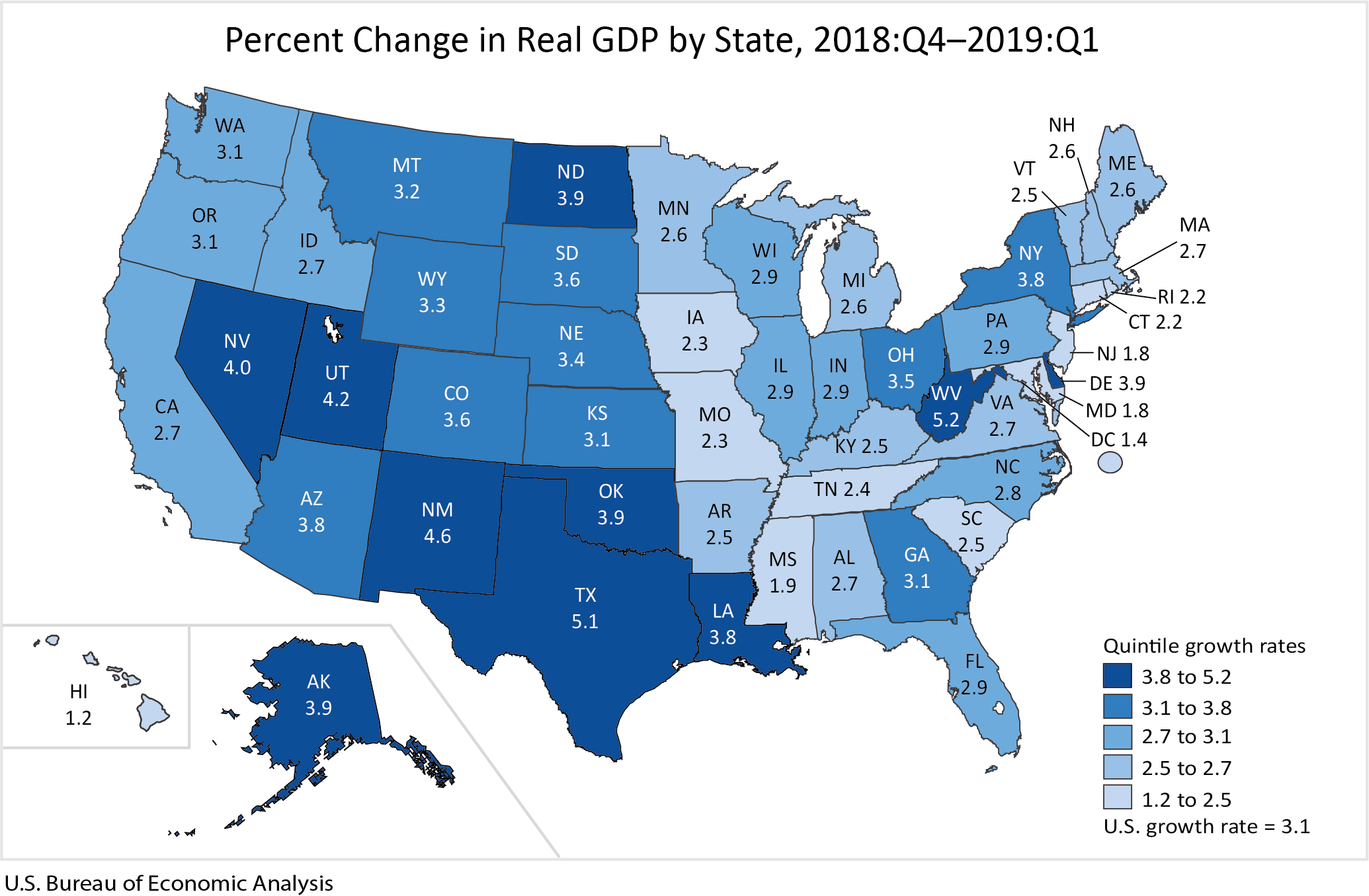
Gross Domestic Product by State, First Quarter 2019: Map

From US Bureau of Economic Analysis, "Gross Domestic Product by State, First Quarter 2019: West Virginia Had the Fastest Growth in the First Quarter":
Real gross domestic product (GDP) increased in all 50 states and the District of Columbia in the first quarter of 2019, according to statistics released today by the U.S. Bureau of Economic Analysis. The percent change in real GDP in the first quarter ranged from 5.2 percent in West Virginia to 1.2 percent in Hawaii.
Source: US Bureau of Economic Analysis

Friday, July 12, 2019

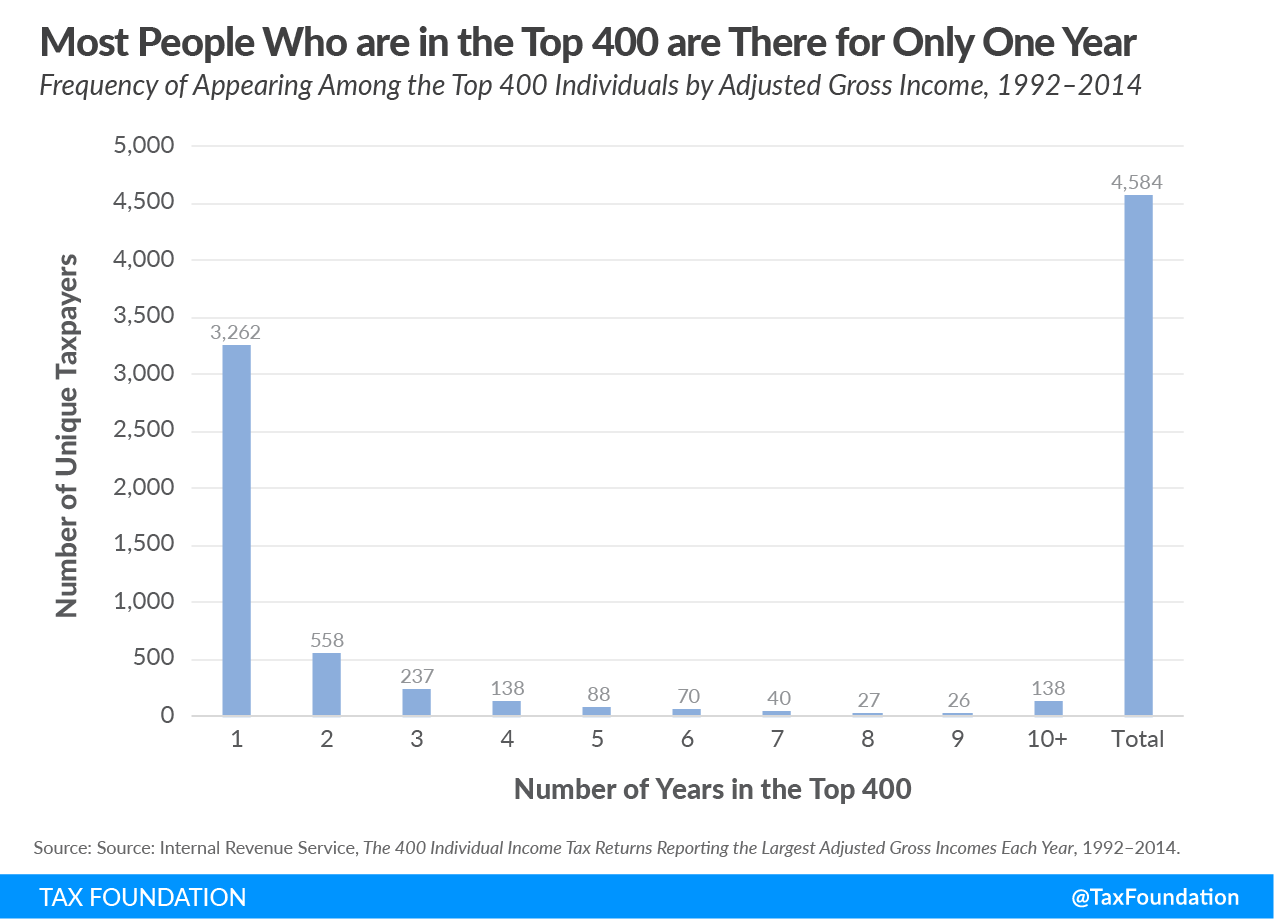
Over 70 Percent Of Very High (Top 400) Income Earners Are In That Top Tier For Only One Year

The US has a high turnover of people in the very high income brackets. A higher tax on people earning very high incomes affects many more people than elected officials lead us to believe. Over a 22- 23 12-13 year period, 4500 people entered the class of the top 400 earners for at least one year. Fifty percent of income earners are in the top 10 percent for at least one year during their lifetimes. 11 percent will be in the top 1 percent. Any higher tax on the rich will hit many more taxpayers than politicians tell us.

From Tax Foundation, "How Much Turnover Is There Among the Richest Americans?" by Robert Bellafiore and Aida Vazquez-Soto:
As scholars and everyday taxpayers continue to debate this issue and the question of increasing taxes on the richest Americans, one observation to keep in mind is the high degree of turnover among the highest-income Americans.

The following chart, using data from the Internal Revenue Service (IRS), shows the frequency of those filing who make the top 400 individual income tax returns with the highest adjusted gross income from 1992 to 2014. Of the 4,584 people who made it into the top 400 at some point over that period, 3,262 qualified for only one year. In other words, 71.2 percent of those who were in the top 400 made it once and not again.
***
Source: Tax Foundation

As The Cato Institute noted, "High Turnover Among America’s Rich" by Chelsea Follett, January 8, 2016:
Your odds of “making it to the top” might be better than you think, although it’s tough to stay on top once you get there.

According to research from Cornell University, over 50 percent of Americans find themselves among the top 10 percent of income-earners for at least one year during their working lives. Over 11 percent of Americans will be counted among the top 1 percent of income-earners (i.e., people making at minimum $332,000 per annum) for at least one year.

How is this possible? Simple: the rate of turnover in these groups is extremely high.

Just how high? Some 94 percent of Americans who reach “top 1 percent” income status will enjoy it for only a single year. Approximately 99 percent will lose their “top 1 percent” status within a decade.