The lack of high paying employment opportunities without a college degree increased the demand for degrees, reduced university price competition, and increased tuition. Additionally, in 1971, the US Sup Ct in Griggs v Duke Power effectively outlawed aptitude testing of employees as discriminatory, made the college degree the major source of signaling competency and removed the major alternative career path to a degree. The anti-discrimination employment laws passed to increase minority hires were used to question dismissals due to underperformance. Employers became more cautious in hiring and increased their education requirements. Fed loans are a response and not the main cause of higher tuition.
Saturday, March 17, 2018
My Comment To "You Can’t Work Your Way Through College Anymore" in WSJ Opinion.
My published comment to The Wall Street Journal Opinion, "You Can’t Work Your Way Through College Anymore: In 1956, I waited tables for $1 an hour. That was enough to pay for one-sixth of my Yale education." by Richard R. West, March 16, 2018:

Monday, November 20, 2017
Accounting Facilitates Media Attacks On Capitalism And Profits: My WSJ Comment
My published comment in the Wall Street Journal, Opinion, "Quit Modifying Capitalism: Profits should be pure, generated from price signals between buyers and sellers." by Andy Kessler:
The accounting profession gives cover to attack capitalistic profit-making companies by overstating profits and ignoring economic sustainability. For example, investors expect a risk-adjusted total return of dividends and price appreciation as compensation. Yet, investors are treated as if their taking on the risk of loss of their money is done without expectation of anything in return from companies. Likewise, interest expense on debt reduces profit but principal payment does not. As if, a household's wages only have to pay the interest portions of mortgage and credit card debt and not the repayment of the money owed. Most media focuses on profits solely, but without a repayment of debt and a risk-adjusted return of capital, very few companies would exist and most entrepreneurial activity would cease. When governments regulate companies and industries and distort market prices, governments negatively affect the economic sustainability and survivability of firms, lowering GDP growth.
Tuesday, November 7, 2017
Mortgage Interest Deduction: Reprint Of My 2011 Published Comment
Reprint of my June 15, 2011 published comment on the mortgage interest tax deduction in The New York Times and on this blog, "Comment On Mortgage Interest Deduction In NY Times Economix Blog:"
Wednesday, June 15, 2011
Comment On Mortgage Interest Deduction In NY Times Economix Blog
Posted By Milton Recht
My comment to Economix in The New York Times, "The Misunderstood Mortgage Interest Deduction" by Casey B. Mulligan:
Actually, the consumer mortgage interest deduction is irrelevant because mortgage interest rates will adjust (rise) to account for the government tax deduction subsidy. The subsidy will increase the demand for mortgages, but not necessarily increase the overall demand for homes. A homebuyer has a fixed monthly cash flow to divide among taxes, home-related payments (including mortgage interest), other spending and savings. Lowering tax payments through a mortgage deduction will free up cash for home-related payments, which will increase the demand for larger mortgages. The availability of cash for a higher mortgage amount will allow consumers to increase their mortgage to home value ratio or to purchase a more expensive home. Either way, mortgage interest rates will rise due to increased demand for purchase mortgage funds for a larger principal amount and due to the increased risk of homeowner default due to the higher amount of debt and leverage, absent a government guarantee against homeowner default.
The mortgage interest rate will rise until taxes and mortgage payments are in equilibrium again, such that the combined money on taxes and house payments remains the same with or without a mortgage deduction. The government mortgage guarantee (direct and implicit), GNMA, FNMA, etc., prevents more debt and more leverage, i.e. a higher mortgage amount for the same house price, from coming into play. The government guarantee prevents the mortgage interest rate from risk adjusting for the increased risk of homeowner default from the higher mortgage to home value ratio and for the increased amount of household debt. Interest rates will increase solely due to increased demand for mortgage funds due to the tax subsidy created by the interest deduction. Mortgage interest rates will not rise due to increase homeowner default risk, until payment from the government mortgage guarantee agencies, (GSEs), is itself in doubt.
The interest deduction increases demand for mortgage funds, acts as a subsidy, which raises interest rates. A new equilibrium point will be set to meet the demand for more funds, which should be the same as without the interest deduction because the increase in mortgage interest rates will lower demand for mortgage funds until the total of tax payments and house payments are where they were without the mortgage interest deduction. The interest deduction should have no effect on overall demand for housing. Demand for housing is generally affected by other economic factors, such as a region's economic growth, employment opportunities, availability of homes, population mobility, etc. Additionally, the GSEs guarantees will allow homeowners to take on higher mortgage amounts in excess of their risk levels.
Friday, November 3, 2017
Job Growth By Sector: Chart 2016 Vs 2017
From MarketWatch, "Opinion: Factory jobs are in; retail jobs are out" by Rx Nutting:
 |
| Source: MarketWatch |
The Gender Pay Gap Would Narrow From 78 Percent to 90 Percent If Just 10 Percent More Women Entered Male-Dominated High Paying Fields
From The New York Times, "Six Myths About Choosing a College Major" by Jeffrey J Selingo:
Women are now the clear majority on college campuses, making up 56 percent of students enrolled this fall. They are also more likely than men to graduate.
But when it comes to selecting a major, what women choose tends to segregate them into lower paying fields, such as education and social services, according to a report that Georgetown University’s Center on Education and the Workforce will publish later this year. Just look at some of the highest paying fields and the proportion of women who major in them: business economics (31 percent), chemical engineering (28 percent), computer science (20 percent), electrical engineering (10 percent), mechanical engineering (8 percent).
*** Dr. [Anthony P.] Carnevale [director of the Georgetown center] wouldn’t speculate as to why women make their choices. But he notes that if the proportion of women in fields where men dominate increased by just 10 percent, the gender pay gap would narrow considerably from 78 cents paid to women for every dollar men receive to 90 cents for every dollar men receive. [Emphasis added.]
Sunday, October 22, 2017
My Posted Comment To Larry Summers' Washington Post Piece Against Lowering Corporate Taxes
My posted comment to The Washington Post, Wonkblog, "Lawrence Summers: One last time on who benefits from corporate tax cuts" by Lawrence H. Summers:
If Larry Summers believed his argument that corporations should be taxed, he would argue for taxing not for profit corporations. His arguments are underpinned by the belief that the government is a wiser spender of the tax money than a non-governmental entity, such as a private corporation, or individual. Either Summers' argument is true for all entities or it is true for none. To tax some entities and not all entities requires the government through its tax code to be able to do a better job of picking better investments and winners over losers than our capitalistic system. Experience over hundreds of years has shown that as much as we would like to believe governments can do better than a selfish profit motive owner, the reality is that decisions affected by politics and the self-interest of politicians attempting to remain in office leads to far worse societal outcomes than capitalistic motives. Not for profits and governments are not economically self-sustaining and can only continue to fund their endeavors off the labor and profit of the private sector. Corporate owners and shareholders, who are the beneficiaries of rising asset values and stock prices, are better deciders of how to use their funds to sustain and grow our economy. Taxing corporations creates economic dead weight loss since the money spent by the consumer is less than the money received by the corporation. It also diverts monies into non-productive and inefficient attempts to reduce taxes. Even if all of Summers arguments are correct, by removing or lowering corporate taxes, the cost of government is shifted to individual taxes, and individuals will receive a truer price signal that shows how much government involvement in their daily lives really costs. With truer price signals, individuals will have a much better picture of the cost and value or lack of value of government programs.
Wednesday, October 18, 2017
My WSJ Comment On The Proposed Tax Law Changes
My published comment to the Wall Street Journal opinion, "Where Critics of Tax Reform Go Wrong: Tax Policy Center’s models don’t simulate how the GOP plan would draw investment to the U.S." by Laurence Kotlikoff and Jack Mintz:
Summers, Krugman and the Tax Policy Center are either naive, afraid the tax changes will succeed in improving the economy, or at worst not being honest. Opponents act as if a new tax law is forever and cannot be undone if it creates economic problems. The proposed tax law changes are modifying tax rates, tax brackets, and deductions. Economic growth, business capital investment, productivity, employment participation and wage growth are low and need to be raised. The proposed tax plan is a reasonable and sensible attempt to fix these problems. The IRS infrastructure to collect taxes exists and will continue to exist. If huge deficits arise, we will know quickly after the proposed tax law goes into effect. Neither political party wants deficits to increase from the tax changes. (One party doesn't seem to mind deficit increases due to entitlements programs.) If deficit increases occur from the new tax law, both parties of Congress will agree to quickly amend the tax laws to raise more revenue. The proposed tax changes are worth a try.
Wednesday, September 27, 2017
Unified Framework For Tax Reform
From Speaker Paul Ryan, Press Release, "UNIFIED FRAMEWORK FOR FIXING OUR BROKEN TAX CODE:"
Monday, September 25, 2017
Single Mother College Enrollment Has Doubled: Single Mothers Are 19 Percent Of College Enrolled Women, But Graduate At Half The Rate Of Non-Parenting Women: Time For Colleges To Have Daycare, Child Friendly Spaces, Supportive Services
From Institute For Women’s Policy Research, "Single Mothers in College: Growing Enrollment, Financial Challenges, and the Benefits of Attainment" by Melanie Kruvelis, Lindsey Reichlin Cruse, M.A., and Barbara Gault, Ph.D:
Single student mothers are growing in both absolute numbers and as a share of the college population.
*** The number of single mothers in college more than doubled between the 1999-00 and 2011-12 school years, to reach nearly 2.1 million students—or 11 percent of all undergraduates—as of 2012. The growth in single mothers in college was more than twice the rate of growth seen among the overall undergraduate student population (42 percent) over the same time period. Among female undergraduates, 19 percent were single mothers as of 2011-12.
Source: Institute For Women’s Policy Research
Women of color in college are especially likely to be single parents. Nearly two in five Black women (37 percent) and over one-quarter of American Indian/Alaska Native women (27 percent) are raising a child without the support of a spouse or partner while in college, compared with 19 percent of Hispanic women, 17 percent of women of two or more races, 14 percent of White women, and 7 percent of Asian/Pacific Islander women. These data demonstrate the importance of supporting single mothers’ postsecondary attainment to improving equity in higher education access and success.
Source: Institute For Women’s Policy Research *** Single Mothers are Less Likely than their Peers to Complete College Single mothers have low rates of college degree attainment: as of 2015, just 31 percent of single mothers ages 25 and older held a bachelor’s degree or higher, compared with 54 percent of comparable married mothers and 40 percent of comparable women overall.
Once enrolled, single mothers are much less likely than married mothers and women without children to complete college. Only 28 percent of single mothers who entered college between 2003 and 2009 earned a degree or certificate within 6 years, compared with 40 percent of married mothers, and 57 percent of women students who were not parenting. [Footnotes and Citations Omitted]


Thursday, September 21, 2017
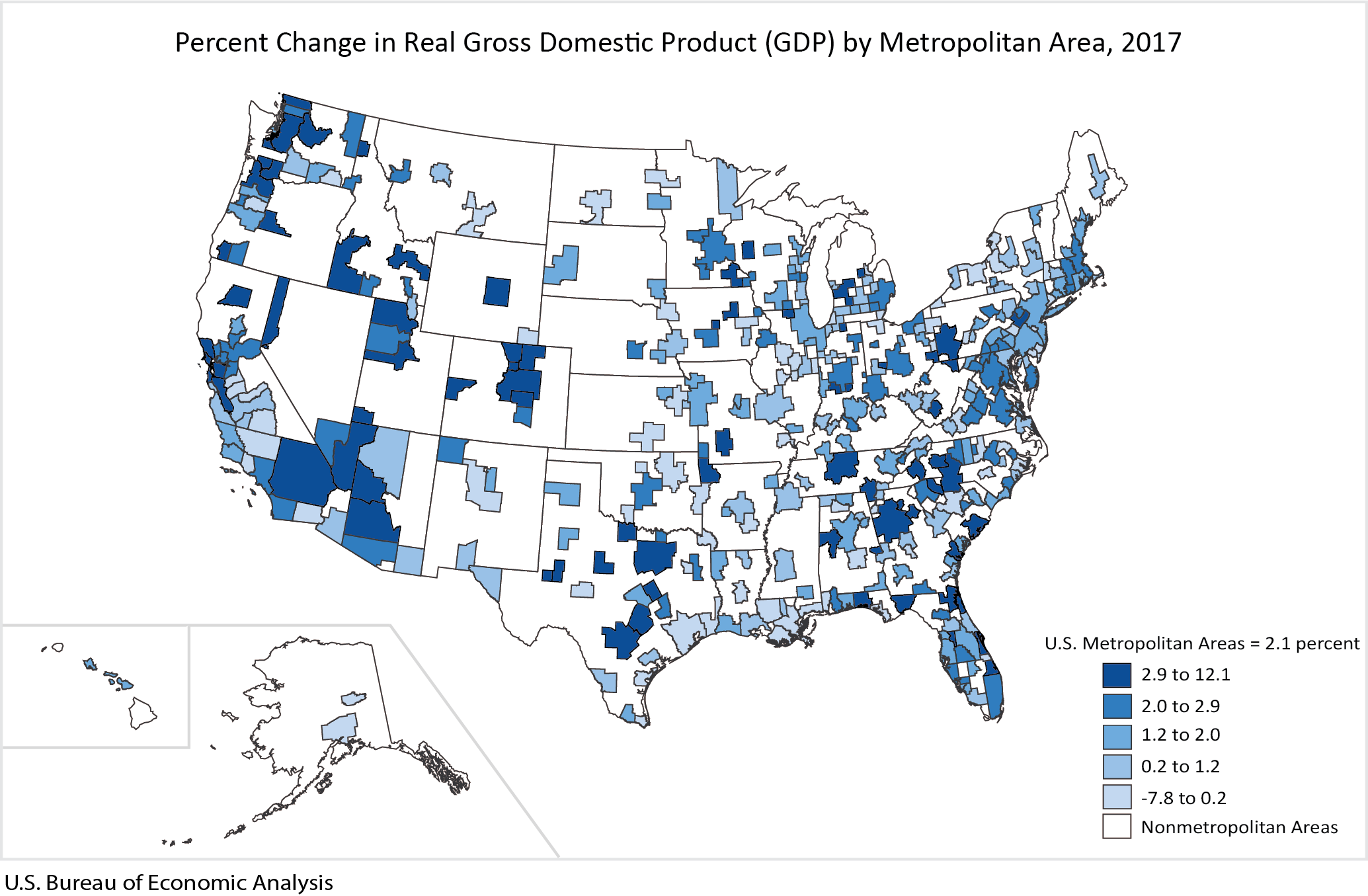
2016 GDP Growth By Large And Small Metropolitan Areas: San Francisco-Oakland-Hayward, CA And Bend-Redmond, OR Had The Highest GDP Growth For Large And Small Metro Areas
From US Department of Commerce, Bureau of Economic Analysis, "Gross Domestic Product by Metropolitan Area, 2016: Professional and Business Services Led Growth Across Metropolitan Areas in 2016:"
Real gross domestic product (GDP) increased in 267 out of 382 metropolitan areas in 2016 according to statistics on the geographic breakout of GDP released today by the Bureau of Economic Analysis. Real GDP by metropolitan area growth ranged from 8.1 percent in Lake Charles, LA and Bend-Redmond, OR to -13.3 percent in Odessa, TX (table 2 [Omitted]).
Source: Bureau of Economic Analysis *** Large Metropolitan Area Highlights
- Of the large metropolitan areas, those with population greater than two million, San Francisco-Oakland-Hayward, CA (5.4 percent) and Austin-Round Rock, TX (4.9 percent) were the fastest growing metropolitan areas. Real GDP growth in San Francisco-Oakland-Hayward, CA was led by growth in finance, insurance, real estate, rental, and leasing, while growth in Austin-Round Rock, TX was led by professional and business services.
- The only large metropolitan area that declined was Houston-The Woodlands-Sugar Land, TX (-3.0 percent). The real GDP decline in Houston-The Woodlands-Sugar Land, TX was led by a decline in natural resources and mining.
Small Metropolitan Area Highlights
- Of the small metropolitan areas, those with population less than two million, Bend-Redmond, OR (8.1 percent) and Lake Charles, LA (8.1 percent) were the fastest growing metropolitan areas. Bend-Redmond, OR was led by growth in finance, insurance, real estate, rental, and leasing, while Lake Charles, LA was led by growth in nondurable-goods manufacturing.
- The largest declines in real GDP for small metropolitan areas were in Odessa, TX (-13.3 percent) and Casper, WY (-11.6 percent). Natural resources and mining subtracted from growth in each of these metropolitan areas.
Thursday, September 7, 2017
Costliest US Storms: Inflation Adjusted
From MarketWatch, "Hurricane Irma slams Caribbean islands as two other hurricanes churn in Atlantic" by Sara Sjolin and Ciara Linnane:
 |
| Source: MarketWatch |
Tuesday, September 5, 2017
Increasing Number Of Medical School Graduates Will Not Practice Medicine: Choosing Lucrative Alternative Careers Instead
From Bloomberg Businessweek, "Med School Grads Go to Work for Hedge Funds: More are starting biotech companies or joining consulting or financial firms instead of practicing—all while the U.S. suffers a shortage of doctors." by Anne Mostue:
[M]ore people are coming out of medical school and choosing not to practice medicine. Instead, they’re going into business—starting biotech and medical device companies, working at private equity firms, or doing consulting. In a 2016 survey of more than 17,000 med school grads by the Physicians Foundation and health-care recruitment firm Merritt Hawkins, 13.5 percent said they planned to seek a nonclinical job within three years. That’s up from 9.9 percent in 2012. A separate Merritt Hawkins survey asks final-year residents: “If you were to begin your education again, would you study medicine or would you select another field?” In 2015, 25 percent answered “another field,” up from 8 percent in 2006. Among the reasons they cited: a lack of free time, educational debt, and the hassle of dealing with insurance companies and other third-party payers.*** Medical students have more options nowadays. Medical and business schools are teaming up to offer joint degrees. There were 148 students enrolled in M.D.-MBA programs in 2016, up from 61 in 2003, according to the AAMC. At Harvard Medical School, in a class of about 160 students, about 14 will pursue the joint degree, and an additional 25 or 30 will do master’s in other areas, such as law and public policy.
Friday, September 1, 2017
Chart Of Average Annual Sales Of Selected Grocery Catergories Over Past Four Years
From The Wall Street Journal, "Big Food Faces Pressure From Retailers Demanding Discounts: Campbell says failed talks with big retailer on soup promotions will hurt sales" by Annie Gasparro, Sarah Nassauer and Heather Haddon:
 |
| Source: The Wall Street Journal |
Wednesday, August 30, 2017
A Reprint Of My 2010 Post, "Regulators Increase Systemic Risk" In Response To Janet Yellen
In response to Janet Yellen, a reprint of my April 28, 2010, blog post, "Regulators Increase Systemic Risk" on why we need to reverse some of the discretionary powers over banks given to the Fed after the 2008 financial crisis
A comment I wrote to the Wall Street Journal article, "Great Moments in Financial Regulation: Apple IPO deemed too risky" by Paul Atkins:"Markets froze in the fall of 2008 because no one could be sure of the financial condition of financial institutions and their counterparties. For all the government's extraordinary intervention, the markets showed their greatest improvement after the Fed's imperfect stress tests were made public in early 2009."[See my previous post, "Obama's New Bank Restrictions Increase Systemic Risk: The VIX Rose 19 Percent"]
It was not uncertainty about the condition of the financial institutions that caused the markets to crash. It was the uncertainty about government intervention that created the mess. The Government arbitrarily backstopped Bear but not Lehman. Unlike with the investment banks, the government can step in and takeover commercial banks at anytime by declaring them unsound.
Investors did not know or understand the government's game plan (if there was any at all) for dealing with the housing crisis effects on bank asset values and whether the banks were going concerns or going out of business concerns. Was the government going to close large banks or keep them open? What was the status of uninsured creditors and collateralized lenders? The private sector did not know or understand what contractual rights it had with troubled banks and companies, or whether the government would shut them down or allow them to continue.
Passing the stress test, even though it was a charade for the most part, meant the government was going to leave those banks alone. The markets began to breathe again because investors understood the government was backing away.
The markets froze in response to the government's action, not because the government was inactive, did too little or was ineffectual. Once the stress tests clarified that the government was done meddling in the banks, the markets began toclamcalm down. The stress tests revealed more about the likelihood of future government action than it did about the condition of the banks. The stress tests added clarity to future government action; not clarity to the banks' balance sheets.
The Dodd bill will increase systemic risks and market failures because it will give more power and discretion to the regulators to act against financial institutions. Powers that allow government intervention in markets and financial institutions increase systemic risks exactly because regulators do not act as investors or perceive risk the same way investors and other market participants perceive risk. Government and regulators are an additional, unpredictable, non-diversifiable risk that restricts investors' options during a financial crisis.
When regulators intervene, investors lose the value of their investments in the financial institution. Since the financial crisis, all corporate bondholders, not just GM's and Chrysler's, mortgage lenders, and collateralized lenders face more systemic risk than before the crisis.
Giving more financial regulatory power to government will spread and increase the systemic risk in the financial sector. It will not lower systemic risk.
Tuesday, August 15, 2017
CBO’s Budget and Economic Outlook: 2017 to 2027
From Congressional Budget Office, "CBO’s Budget and Economic Outlook: 2017 to 2027," August 15, 2017, Presentation by Sam Papenfuss, Deputy Assistant Director for CBO’s Budget Analysis Division, at the National Association of State Auditors, Comptrollers and Treasurers annual conference:
Thursday, August 10, 2017
NY And Other Large Metropolitan Areas Have Highest Wage Inequality: Map
From MarketWatch, "Why there’s so much inequality in big U.S. cities" by Jillian Berman:
Run through a list of some of the most populated metropolitan areas in the country — New York City, San Francisco, Houston, Chicago — and they all have something in common besides their size. They’re extremely unequal.
In all of these cities, wages for workers in the top 10% of earners are six to seven times those of workers in the bottom 10%, according to a report published Thursday by the Federal Reserve Bank of New York. While income inequality has been ticking up nationally since the 1980s, it’s now particularly pronounced in large metropolitan areas, according to the New York Fed.
“Larger metropolitan areas tend to be more unequal than smaller metropolitan areas and that was not always true,” Jaison Abel, a research officer at the New York Fed, told reporters Thursday.
Source: MarketWatch

Monday, August 7, 2017
Consumption Inequality Much Lower Than Income Inequality
From MarketWatch, "Is inequality getting worse? That depends how you measure it" by Steve Goldstein:
"Consumption and Income Inequality in the U.S. Since the 1960s" by Bruce D. Meyer, James X. Sullivan, NBER Working Paper No. 23655, Issued in August 2017:
Research paper abstract:Consumption inequality hasn’t grown as much as income inequality
Source: MarketWatch
Bruce Meyer of the University of Chicago and James Sullivan of the University of Notre Dame argue that consumption, rather than income, should be examined. Using income to measure inequality is a problem for a few reasons. For one, it’s measured before tax, it’s not person weighted (a family with one person is measured the same as one with six people) and it may underrepresent the impact of government transfers. Income measures also don’t capture consumption out of financial wealth as well as durables such as housing and cars.
Consumption, they say, may be a better way to measure well being, since it better reflects disparities in access to credit or accumulation of assets. Consumption also is more closely associated with other measures of poverty than income is.

"Consumption and Income Inequality in the U.S. Since the 1960s" by Bruce D. Meyer, James X. Sullivan, NBER Working Paper No. 23655, Issued in August 2017:
Official income inequality statistics indicate a sharp rise in inequality over the past five decades. These statistics do not accurately reflect inequality because income is poorly measured, particularly in the tails of the distribution, and current income differs from permanent income, failing to capture the consumption paid for through borrowing and dissaving and the consumption of durables such as houses and cars. We examine income inequality between 1963 and 2014 using the Current Population Survey and consumption inequality between 1960 and 2014 using the Consumer Expenditure Survey. We construct improved measures of consumption, focusing on its well-measured components that are reported at a high and stable rate relative to national accounts. While overall income inequality (as measured by the 90/10 ratio) rose over the past five decades, the rise in overall consumption inequality was small. The patterns for the two measures differ by decade, and they moved in opposite directions after 2006. Income inequality rose in both the top and bottom halves of the distribution, but increases in consumption inequality are only evident in the top half. The differences are also concentrated in single parent families and single individuals. Although changing demographics can account for some of the changes in consumption inequality, they account for little of the changes in income inequality. Consumption smoothing cannot explain the differences between income and consumption at the very bottom, but the declining quality of income data can. Asset price changes likely account for some of the differences between the measures in recent years for the top half of the distribution.
Charitable Deductions Are Disincentives To Social Responsibility.
My published comment to The Wall Street Journal, "Charities Coax Lawmakers to Rethink Tax Plan: Nonprofits pitch idea of ‘universal’ tax deduction for charitable contributions, which would likely decline if Congress were to double standard deduction" by Richard Rubin:
Charitable deductions are disincentives to community and social responsibility.See my very similar, earlier post on this blog, "The Problem With Charitable Tax Deductions."
Charitable deductions focus on organizational structure and not compassionate actions. If I invite and feed a poor person in my house on Thanksgiving, the tax deduction is not available. If I donate food or money to a food bank or church that feeds the same person, I get a deduction.
If I grocery shop or cook a meal for a needy, ill senior in my neighborhood, no deduction. If I donate to an organization that has volunteers who do the same thing, I get a deduction.
The required organizational structures add a middle layer of inefficiency and bureaucracy, which reduces the effectiveness, timeliness, and value of charitable giving.
When there is suffering, such as an earthquake, we do not need tax deductions to motivate us to send money, food, etc.
Eliminate charitable deductions. If the government takes too much money so we cannot donate as much as we like to charities, fight for lower taxes.
Thursday, August 3, 2017
Ten Countries Use Merit-Based (Points-Based) Immigration Systems
From Federation for American Immigration Reform, "Merit-Based Immigration Systems", Fact Sheet | March 2017:
Merit-based immigration systems are in use in the following countries:
- Australia[4]
- Austria[5]
- Canada[6]
- Denmark[7]
- Germany[8]
- Hong Kong[9]
- Japan[10]
- New Zealand[11]
- South Korea[12]
- United Kingdom[13]
*** [Footnotes:][4] Australian Skilled Migration Program https://www.border.gov.au/Trav/Work/Skil[5] Criteria-Based Immigration to Austria, http://www.migration.gv.at/en/types-of-immigration/permanent-immigration-red-white-red-card.html Quebec-Selected Skilled Worker Program http://www.cic.gc.ca/EnGlish/immigrate/quebec/index.asp[6] Canadian Federal Skilled Worker Program http://www.cic.gc.ca/english/immigrate/skilled/apply-factors.asp Quebec[7] Danish Fast Track and Positive List Migration Schemes https://www.nyidanmark.dk/en-us/coming_to_dk/work/work.htm[8] Germany recently implemented a limited, merit-based immigration scheme for “Highly-Qualified Workers” http://www.bamf.de/EN/Migration/Arbeiten/BuergerDrittstaat/Hochqualifizierte/hochqualifizierte-node.html[9] Hong Kong Quality Migrant Admission Scheme http://www.immd.gov.hk/eng/services/visas/quality_migrant_admission_scheme.html[10] Japanese Points-Based Preferential Immigration Treatment for Highly Skilled Foreign Professionals http://www.immi-moj.go.jp/newimmiact_3/en/[11] New Zealand Migrant Category Resident Visa Program https://www.immigration.govt.nz/new-zealand-visas/apply-for-a-visa/about-visa/skilled-migrant-category-resident-visa[12] South Korea F-2 Point System http://koreanconsulting.typepad.com/files/pointsystem.pdf[13] U.K. Work Visas https://www.gov.uk/browse/visas-immigration/work-visas
Friday, July 28, 2017
Eight US Cities Account For 40 Percent Of High Paying Tech Job Openings
From The Wall Street Journal, Real Time Economics, "The Best $100,000+ Tech Jobs Are Increasingly Concentrated in Just 8 Cities: High prices aren't enough to stop the momentum of the leading tech cities" by Josh Zumbrun:
The eight leading U.S. tech hubs account for slightly less than 10% of U.S. jobs and about 13% of overall job postings. But the cities — Seattle, San Francisco, San Jose, Austin, Raleigh, Washington, Baltimore and Boston [Highlight added] — account for more than 27% of the listings for U.S. tech jobs, research from Jed Kolko, the chief economist of the job-search website Indeed, shows.
That’s already a striking concentration, but tech jobs with the highest salaries are even more centralized. Among jobs that typically pay over $100,000, nearly 40% of openings are in those eight cities.
Subscribe to:
Posts (Atom)