The international tax literature Roger Gordon and James Hines summarize in their 2002 article shows that mobile capital flows from high-tax to low-tax jurisdictions. In any set of competing countries, relative rates of taxation determine investment flows. In other words, America’s high corporate tax rates are driving investments abroad and causing firms to rethink expansion plans in the United States. The loss in revenues, or in effective taxes paid, should not shock us.Read the complete article here.
*** But for investment purposes, the important figure is the effective average tax rate (EATR), or the difference between the pre-tax return and the post-tax return on investment, expressed as a fraction of pre-tax economic profits. More simply, it is the tax liability that a firm may expect to incur as a fraction of pre-tax economic profits. The EATR differs from the statutory rate because it allows for other features of the tax code, such as depreciation allowances or interest rate deductions, which enable firms to ultimately pay less than the statutory rate.
A 1998 paper by Michael Devereux and Rachel Griffith shows that the EATR is the critical tax rate determining where firms locate investment. Countries with high EATRs lose, while capital flows to the low EATR jurisdictions.
EATR=Effective Avg Tax Rate:
EMTR=Effective Marginal Tax Rate
Wednesday, February 16, 2011
High US Corporate Tax Rates Are Driving Investments Abroad
From "Race to the Top of the Laffer Curve" by Aparna Mathur in the Journal of the American Enterprise Institute:


Tuesday, February 15, 2011
Need Technological Solutions To Global Warming: Greenhouse Gas Emission Reduction Is Insufficient
From "If greenhouse gas emissions stopped now, Earth still would likely get warmer" in ScienceBlog:
There would continue to be [climate] warming even if the most stringent policy proposals were adopted, because there still would be some emission of heat-trapping greenhouse gases such as carbon dioxide and methane. But the new research shows that even if all emissions were stopped now, temperatures would remain higher than pre-Industrial Revolution levels because the greenhouse gases already emitted are likely to persist in the atmosphere for thousands of years.
In fact, it is possible temperatures would continue to escalate even if all cars, heating and cooling systems and other sources of greenhouse gases were suddenly eliminated, said Kyle Armour, a UW doctoral student in physics. That’s because tiny atmospheric particles called aerosols, which tend to counteract the effect of greenhouse warming by reflecting sunlight back into space, would last only a matter of weeks once emissions stopped, while the greenhouse gases would continue on.
New York Stock Exchange Sold To Frankfurt Stock Exchange
From Bloomberg News article, "Deutsche Boerse Buys NYSE to Create Largest Owner of Exchanges" by Nandini Sukumar and Nina Meht:
Deutsche Boerse AG, operator of the Eurex futures platform and Frankfurt Stock Exchange, agreed to buy New York Stock Exchange parent NYSE Euronext in a deal that creates the world’s largest owner of equities and derivatives markets.Read the complete article here.
Teaser Rate Mortgage Borrowers Defaulted Before Rates Reset To Higher Levels
Home buyers who used low teaser rate, adjustable rate mortgages defaulted before the borrowing rates reset to a higher level. Along with yesterday's Wall Street Journal article that the housing markets now suffering the biggest housing decline were not the markets with housing bubbles, it is becoming more clear that neither the types of mortgages, subprime, ARM, etc. nor high interest rate payments were the cause of our high rate of mortgage defaults or housing price decline.
From The Wall Street Journal article, "Option ARM Time Bomb Blows Early, Easing Damage to U.S. Housing" by Prashant Gopal and Jody Shenn:
From The Wall Street Journal article, "Option ARM Time Bomb Blows Early, Easing Damage to U.S. Housing" by Prashant Gopal and Jody Shenn:
This was the year thousands of U.S. homeowners with option adjustable-rate mortgages were supposed to default as their payments spiked.*** About $600 billion of the loans were made from 2005 through 2007, according to industry newsletter Inside Mortgage Finance. Of those packaged into bonds, some 20 percent have been liquidated at losses to investors, and almost half of the remaining ones are at least 30 days delinquent, in foreclosure or have been seized by lenders, according to data from JPMorgan.
“It’s not that option ARMs weren’t a bad way to finance homes, it’s just that the disaster already happened before the resets,” McCarthy said in a telephone interview last week.
Monday, February 14, 2011
Video Interview Of Mark Zuckerberg By Henry Blodget
A republished 30-minute video interview of Mark Zuckerberg by Henry Blodget of Business Insider is available here and embedded below:
A full transcript of the above video interview is available here.
A full transcript of the above video interview is available here.
Switch To A Negative Income Tax To Balance The US Budget, Foster Private Sector Jobs, Reduce Federal Medical And Pension Costs, Fix Social Security
Before the US begins its painful political, budget balancing process of cutting its deficit and social benefit programs, the country should analyze and consider implementation of a negative income tax. Paying guaranteed income that would decrease, at a 50 percent rate, by earnings, pensions, IRA and Keogh withdrawals, etc., would solve the country's social security problems by eliminating social security payments to the wealthy, those that saved sufficiently for retirement, and those that continue to earn livable incomes after retirement.
A negative income tax would also decrease the US bureaucracy and the number of US and state employees and the associated payroll, pension and medical costs. It is a budget balancing, deficit reducing concept that needs analysis. Combined with a voucher system for Medicare and Medicaid medical costs, the entire US budget could probably be balanced without harming the poor or senior retirement. The idea certainly deserves a thorough, thoughtful analysis as a realistic, potential solution to our budget crisis.
From City Journal, "Why Not a' Negative Income Tax? Replace the welfare state with a cash subsidy for the poor." by Guy Sorman:
admits Gary Becker, a University of Chicago economist and Friedman disciple. “But if society decides that a certain level of redistribution must take place, the NIT [Negative Income Tax] is the best, the most minimally distorting, solution ever devised.” To limit the disincentive, Friedman argued, the NIT should be progressive. Say the government drew the income line at $10,000 for a family of four and the NIT was 50 percent, as most economists recommend. If the family had no income at all, it would receive $5,000—that is, 50 percent of the amount by which its income fell short of $10,000. If the family earned $2,000, it would get $4,000 from the government—again, 50 percent of its income shortfall—for a total post-tax income of $6,000. Bring in $4,000, and it would receive $3,000, for a total of $7,000. So as the family’s earnings rise, its post-tax income rises, too, preserving the work incentive. This is very different from many social welfare programs, in which a household either receives all of a benefit or, if it ceases to qualify, nothing at all. The all-or-nothing model encourages what social scientists call “poverty traps,” tempting the poor not to improve their situations.Read the complete City Journal article here.
Robert Moffitt, an economist at Johns Hopkins University and a leading authority on the NIT, notes another advantage of the program over other forms of state assistance: “No stigma attaches to the NIT.” Everyone fills out the same forms, and no infantilizing government meddles with a household’s food, shelter, and health care, as under the current system. The NIT simply provides the poor with money, which they can use to meet their various needs. Friedman strongly believed that individuals have the capacity to promote their own interests.
Yet another NIT advantage is a freer labor market. No minimum wage would be necessary, since a minimum income would now be guaranteed. This would boost employment: as economists recognize, a legal minimum wage tends to increase joblessness by discouraging employers from recruiting unskilled labor. The NIT would reduce illegal immigration, too. Managed by the IRS, it would apply only to citizens and legal residents, and since it would eliminate welfare programs, aliens would have less incentive to cross the border illegally for government benefits (though local authorities would still have to decide whether to grant them access to schools and hospitals). “From an economist’s perspective, the negative income tax is the perfect design,” Moffitt says. “The only reason an economist would oppose it would be from a strict libertarian perspective—opposition to any kind of government-managed welfare.”
But the biggest advantage of the NIT is that it requires the smallest possible bureaucracy to implement. The IRS already exists; it knows how to assess income statements; and, to run the NIT, it has only to take money or pay it out. No longer would the federal and state governments maintain the sprawling multiple agencies necessary to distribute food stamps, public housing, Medicaid, cash welfare, and a myriad of community development programs. Nor would they need to pay the salaries and enormous future pensions of the public employees who run all these programs. According to a Heritage Foundation study by Robert Rector, Kiki Bradley, and Rachel Sheffield, the federal portion of America’s welfare system cost a staggering $522 billion in 2008, which works out to about $12,000 per poor person aided.
US Home Price Decline Spreads To Stable Markets
From The New York Times article, "Housing Crash Is Hitting Cities Thought to Be Stable" by David Streitfeld:
The rolling real estate crash that ravaged Florida and the Southwest is delivering a new wave of distress to communities once thought to be immune — economically diversified cities where the boom was relatively restrained.Read the complete article here.
In the last year, home prices in Seattle had a bigger decline than in Las Vegas. Minneapolis dropped more than Miami, and Atlanta fared worse than Phoenix.*** The fact that even a fairly prosperous area like Seattle was ensnared in the downturn shows just how much of a national phenomenon the crash has been. The slump began when the low-quality loans that drove the latter stage of the boom began to go bad, but the resulting recession greatly enlarged the crisis. Many people could not get a mortgage, and others simply gave up the hunt.
Now, though the overall economy seems to be mending, housing remains stubbornly weak.
A Lower Corporate Tax Rate Increases Tax Revenues, Promotes Economic Growth
From Bloomberg Opinion, "Laffer Curve Pays Billions If Obama Just Asks" by Kevin Hassett:
Addendum: Also see my later post, "High US Corporate Tax Rates Are Driving Investments Abroad" where I have a chart of effective average corporate tax rates that show the US has one of the highest effective tax rates in the world.
The U.S. is about to have the highest corporate tax rate in the developed world because our competitors have noticed that revenue goes up as rates go down. Multinational corporations today nimbly move their profits to the friendliest environment, rewarding tax havens like never before.Read the complete Bloomberg opinion piece here.
It looks as if President Barack Obama and congressional Democrats are going to miss out on the single biggest policy opportunity for the U.S. this year because of their ideological resistance to the idea that lower rates can increase revenue, also known as the Laffer curve.*** Corporate taxes “are the most harmful type of tax for economic growth,” according to a November 2010 report by the Organization for Economic Cooperation and Development.*** The U.S. top corporate tax rate of 35 percent in 2010 was higher than all other OECD nations except Japan, which has embarked on a 5 percentage-point cut. The average rate in the OECD is 23.5 percent. Ireland’s rate is only 10.9 percent; Turkey’s is 13.1 percent.*** The U.S. earns less federal corporate tax revenue, as a percentage of gross domestic product, than the average OECD country. Higher rates, lower revenue.
From 2000 through 2009, the U.S. average corporate tax revenue as a percentage of GDP was 2.06 percent, according to OECD data. The average for the rest of the OECD was almost a percentage point higher, at 3 percent.
In 2009, the U.S. ratio dropped to 1.64 percent. That year, the U.K., with a tax rate of 28 percent, raised 2.8 percent of GDP. South Korea raised 3.4 percent of GDP with a rate of 22 percent. Belgium raised 2.5 percent of GDP with a rate of 34 percent.
A number of studies have indicated that a Laffer curve exists for corporate taxes. One study I did with Alex Brill, looking at data for OECD countries from 2000 to 2005, found that the U.S. could maximize its tax revenue by cutting the top corporate rate 8.6 percentage points, to 26.4 percent.
Addendum: Also see my later post, "High US Corporate Tax Rates Are Driving Investments Abroad" where I have a chart of effective average corporate tax rates that show the US has one of the highest effective tax rates in the world.
Saturday, February 12, 2011
Mankiw Corrects Obama: We All Win From Trade
From The New York Times, "Emerging Markets as Partners, Not Rivals" by N. Gregory Mankiw:
Achieving economic prosperity is not like winning a game, and guiding an economy is not like managing a sports team.Read Mankiw's complete piece on trade here.*** Listening to the president, you might think that competition from China and other rapidly growing nations was one of the larger threats facing the United States. But the essence of economic exchange belies that description. Other nations are best viewed not as our competitors but as our trading partners. Partners are to be welcomed, not feared. As a general matter, their prosperity does not come at our expense.
No Evidence That CO2 Increases Cause Climate Change
From The Wall Street Journal article, "The Weather Isn't Getting Weirder: The latest research belies the idea that storms are getting more extreme" by Anne Jolis:
...show no evidence of an intensifying weather trend. "In the climate models, the extremes get more extreme as we move into a doubled CO2 world in 100 years," atmospheric scientist Gilbert Compo, one of the researchers on the project, tells me from his office at the University of Colorado, Boulder. "So we were surprised that none of the three major indices of climate variability that we used show a trend of increased circulation going back to 1871."Read the complete Wall Street Journal article here.
In other words, researchers have yet to find evidence of more-extreme weather patterns over the period, contrary to what the models predict. "There's no data-driven answer yet to the question of how human activity has affected extreme weather," adds Roger Pielke Jr., another University of Colorado climate researcher.
We do know that carbon dioxide and other gases trap and re-radiate heat. We also know that humans have emitted ever-more of these gases since the Industrial Revolution. What we don't know is exactly how sensitive the climate is to increases in these gases versus other possible factors—solar variability, oceanic currents, Pacific heating and cooling cycles, planets' gravitational and magnetic oscillations, and so on.
More Men Than Women Are Dropping Out Of The Labor Force
From Federal Reserve Bank of Cleveland, Economic Trends, "Who Is Driving the Decline in the Labor Force Participation Rate?" by Daniel Hartley and Mary Zenker:
Read the complete article here.
Comparing the fractions for men and women over time confirms that the fraction of men not in the labor force rose more than the fraction of women not in the labor force from December 2007 to December 2010. In contrast, the fractions of white, black, Hispanic, and Asian workers who are not in the labor force all seem to have increased by about the same amount over the period.

Friday, February 11, 2011
US Treasury Report On Housing Market Reform
The complete US Treasury report, "Reforming America’s Housing Finance Market" on fixing Fannie Mae, Freddie Mac and the US housing market is available from Treasury here, on Scribd here and embedded below. The accompanying press release and summary is available here.
Reforming America's Housing Finance Market
Reforming America's Housing Finance Market
Tuesday, February 8, 2011
Larry Tribe's Analysis Of The Health Care Insurance Mandate Is Wrong
From The New York Times, "On Health Care, Justice Will Prevail" by Laurence H. Tribe:
Congress legislatively created the free ride. Congress had mandated in previous laws that emergency rooms cannot turn away patients because of an inability to pay. Congress can eliminate that service requirement as it also can require full repayment from the treated individual. Congress can eliminate the free riding that it self-created without the need to impose health insurance on every individual. The free riding is a self-imposed problem created by Congress and it cannot use a self-imposed problem to justify a mandate for health insurance.
The vast majority, according to the US Census Bureau, of uninsured individuals are people and children who are eligible and can, but did not, enroll in government paid heath care programs, such as Medicaid, CHIP, etc., young adults between the ages of 25-35 years old, and families with incomes high enough to buy health insurance.
To say that someone is free riding when a different government program than Congress expected to pay pays medical costs is a fallacious free riding argument.
To say that a group, such as young adults, who have a very low risk of health related costs or injuries, who make a rational economic choice not to purchase health insurance is free riding is again fallacious. To mandate a purchase of an uneconomical health insurance policy is without legal merit, especially since the health policy cannot be risk adjusted priced for the lower health needs of a healthy, no pre-existing medical condition, young adult.
The justices also need to look at the mandate separate from the costs of the health insurance to the covered individual. There is no law that requires Congress to continue to fund programs that will lower the cost to poorer individuals and families. Can Congress mandate that families buy something they cannot afford?
Funding is always at the discretion of Congress and The US Supreme Court will not interfere with the Congressional branch. It cannot require Congress to raise taxes and fund a health insurance program. The mandate has to be viewed separately from its funding. If Congress can mandate health insurance, it can mandate health insurance without appropriating funds to lower its costs.
Additionally, Congress did not allow for self-insurance by wealthy individuals who can afford a bare bones policy or no health insurance. Neither of these is allowed under the new law.
It would take a huge stretch of rational economic and legal thinking for the Supreme Court Justices to uphold the new health law insurance mandate.
The justices aren’t likely to be misled by the reasoning that prompted two of the four federal courts that have ruled on this legislation to invalidate it on the theory that Congress is entitled to regulate only economic “activity,” not “inactivity,” like the decision not to purchase insurance. This distinction is illusory. Individuals who don’t purchase insurance they can afford have made a choice to take a free ride on the health care system. They know that if they need emergency-room care that they can’t pay for, the public will pick up the tab. This conscious choice carries serious economic consequences for the national health care market, which makes it a proper subject for federal regulation.There are several reasons that the US Supreme Court case about the new health care law insurance mandate is not as clear cut as Laurence Tribe seems to believe.
Congress legislatively created the free ride. Congress had mandated in previous laws that emergency rooms cannot turn away patients because of an inability to pay. Congress can eliminate that service requirement as it also can require full repayment from the treated individual. Congress can eliminate the free riding that it self-created without the need to impose health insurance on every individual. The free riding is a self-imposed problem created by Congress and it cannot use a self-imposed problem to justify a mandate for health insurance.
The vast majority, according to the US Census Bureau, of uninsured individuals are people and children who are eligible and can, but did not, enroll in government paid heath care programs, such as Medicaid, CHIP, etc., young adults between the ages of 25-35 years old, and families with incomes high enough to buy health insurance.
To say that someone is free riding when a different government program than Congress expected to pay pays medical costs is a fallacious free riding argument.
To say that a group, such as young adults, who have a very low risk of health related costs or injuries, who make a rational economic choice not to purchase health insurance is free riding is again fallacious. To mandate a purchase of an uneconomical health insurance policy is without legal merit, especially since the health policy cannot be risk adjusted priced for the lower health needs of a healthy, no pre-existing medical condition, young adult.
The justices also need to look at the mandate separate from the costs of the health insurance to the covered individual. There is no law that requires Congress to continue to fund programs that will lower the cost to poorer individuals and families. Can Congress mandate that families buy something they cannot afford?
Funding is always at the discretion of Congress and The US Supreme Court will not interfere with the Congressional branch. It cannot require Congress to raise taxes and fund a health insurance program. The mandate has to be viewed separately from its funding. If Congress can mandate health insurance, it can mandate health insurance without appropriating funds to lower its costs.
Additionally, Congress did not allow for self-insurance by wealthy individuals who can afford a bare bones policy or no health insurance. Neither of these is allowed under the new law.
It would take a huge stretch of rational economic and legal thinking for the Supreme Court Justices to uphold the new health law insurance mandate.
State Estate Tax Reduces Job Growth And Causes Out-Migration
From "Death Tax Ambush: Many states now have crushing burdens" in The Wall Street Journal:
thanks to a quirk in December's GOP-White House tax compromise. The new law applies a top federal death tax rate of 35% with a $5 million exemption for 2011 and 2012. But it also changed a federal credit for state death tax rates into a federal deduction.The complete Wall Street Journal piece is available here (subscription required).
***
***
New research indicates that high state death taxes may be financially self-defeating. A 2011 study by the Ocean State Policy Research Institute, a think tank in Rhode Island, examined Census Bureau migration data and discovered that "from 1995 to 2007 Rhode Island collected $341.3 million from the estate tax while it lost $540 million in other taxes due to out-migration."
Not all of those people left because of taxes, but the study found evidence that "the most significant driver of out-migration is the estate tax." After Florida eliminated its estate tax in 2004, there was a significant acceleration of exiles from Rhode Island to Florida.
Connecticut has come to the same conclusion. A 2008 study by the Connecticut Department of Revenue Services found that the 26 states without an estate tax produced twice as many jobs from 2004-07 and had a growth rate 50% faster than those with estate taxes.

Monday, February 7, 2011
Bigger Cities Are Cause Of US Wage Inequality Gap
From "Larger cities drive growing wage gap between the rich and the poor, study shows" in ScienceBlog:
“If we want to understand what’s causing the wage gap, we now know we need to look at the unique economies of our larger cities,” says [University of Rochester Ronni] Pavan.Read the complete article here.
These metropolitan areas have created “agglomeration” economies that have augmented productivity in dramatic ways, making workers more valuable and therefore able to command higher pay, says Pavan.
Sunday, February 6, 2011
A Gender Pay Gap Is A Sign Of Equality Between The Sexes And Not Inequality
Is a gender pay gap a sign of equality between the sexes and not inequality?
The news media reported on a physician wage study last week, e.g. see The Wall Street Journal, "Women Doctors Face $17,000 Pay Gap," that the medical field pays women doctors less than men doctors.
According to the lead researcher's statement in the Wall Street Journal, women physicians trade salary for other benefits:
Isn't it a sign of equality, and not inequality, that women can choose, value and negotiate for themselves the benefits and pay combination they most desire in the workplace, even if the paycheck is lower? Employers pay for these benefits and they are indifferent, their costs are equivalent, whether the money goes into a worker's paycheck or to pay for a benefit. The women are choosing how to allocate the employers' costs between salary and benefits.
Suppose law, or workplace practice, required women to receive the same paycheck amount as men in any field. Wouldn't women work much longer hours, have less flexible scheduling, travel more, etc., than they would choose if they could select their own benefits package and workplace environment?
Isn't true equality of the sexes measured by women's freedom to contract? Doesn't that imply that some women, maybe even a majority, would choose lower pay for fewer work hours, more time off and more flexible schedules?
Pay alone does not measure workplace equality between the genders whenthey there are many work benefits and characteristics not captured by the numbers in the paycheck.
The news media reported on a physician wage study last week, e.g. see The Wall Street Journal, "Women Doctors Face $17,000 Pay Gap," that the medical field pays women doctors less than men doctors.
According to the lead researcher's statement in the Wall Street Journal, women physicians trade salary for other benefits:
Anthony Lo Sasso, the lead researcher on the study, and a professor at the School of Public Health at the University of Illinois at Chicago, said the pay gap may exist because women doctors are seeking greater flexibility and family-friendly benefits, such as not being on call after certain hours. Women may be negotiating these work conditions at the same time that they are negotiating their starting salaries.This is not the first study to find that women in the workforce will give up salary for other non-monetary benefits, such as health insurance, shorter hours, flexible schedules, limited or no travel requirements, etc.
Isn't it a sign of equality, and not inequality, that women can choose, value and negotiate for themselves the benefits and pay combination they most desire in the workplace, even if the paycheck is lower? Employers pay for these benefits and they are indifferent, their costs are equivalent, whether the money goes into a worker's paycheck or to pay for a benefit. The women are choosing how to allocate the employers' costs between salary and benefits.
Suppose law, or workplace practice, required women to receive the same paycheck amount as men in any field. Wouldn't women work much longer hours, have less flexible scheduling, travel more, etc., than they would choose if they could select their own benefits package and workplace environment?
Isn't true equality of the sexes measured by women's freedom to contract? Doesn't that imply that some women, maybe even a majority, would choose lower pay for fewer work hours, more time off and more flexible schedules?
Pay alone does not measure workplace equality between the genders when
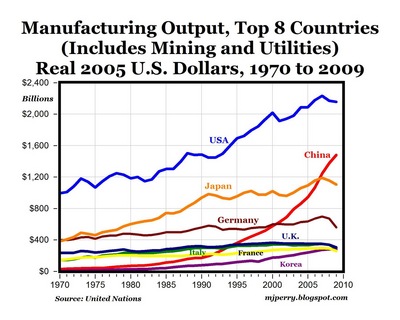
US Is World's Biggest Manufacturer
From "Made in the U.S.A." by Jeff Jacoby, The Boston Globe:
Americans make more "stuff" than any other nation on earth, and by a wide margin. According to the UN's comprehensive database of international economic data, America's manufacturing output in 2009 (expressed in constant 2005 dollars) was $2.15 trillion. That surpassed China's output of $1.48 trillion by nearly 46 percent. China's industries may be booming, but the United States still accounted for 20 percent of the world's manufacturing output in 2009 -- only a hair below its 1990 share of 21 percent.
Saturday, February 5, 2011
Odds Of Republicans Winning The US House In 2012 Dropping Quickly: Now 50-50
According to the Intrade price for the security "The Republicans to control the House of Representatives after 2012 Congressional Elections," the odds of the Republicans taking over the US House of Representative after the 2012 election has quickly dropped from about 80-20 to 50-50.
The Intrade odds still overwhelmingly favor the Republicans controlling the US Senate after the 2012 elections.
It is not clear what is so quickly changing the mood of the electorate to favor a Democratic majority in the House instead of a Republican majority.
Republicans to control the House after 2012 Elections
The Intrade odds still overwhelmingly favor the Republicans controlling the US Senate after the 2012 elections.
It is not clear what is so quickly changing the mood of the electorate to favor a Democratic majority in the House instead of a Republican majority.
 |
| Republicans to control the House of Representatives after 2012 Elections |
Thursday, February 3, 2011
Wednesday, February 2, 2011
Vegans Have Increased Heart Disease Risk
From "Vegans’ elevated heart risk requires omega-3s and B12" in ScienceBlog:
strict vegetarians who try to eat no meat or animal products of any kind — may increase their risk of developing blood clots and atherosclerosis or “hardening of the arteries,” which are conditions that can lead to heart attacks and stroke.*** vegans tend to have elevated blood levels of homocysteine and decreased levels of HDL, the “good” form of cholesterol. Both are risk factors for heart disease.
Subscribe to:
Posts (Atom)