About 12 to 18 months ago, a friend of mine bought some BP stock because he was in search of income and it had a high dividend yield. The dividend yield at the time was in the 8 to 10 percent range and because it was high I used the put call parity relationship to see if the market was expecting a dividend cut.
When prices of stocks and their associated put and call options are available, the prices can be used to compute the market's expectation of future dividends using the put-call parity relationship.
Put Call Parity states that the price of a stock less it expected dividends (discounted to current dollars) until the maturity of the stock options plus the price of a put option on the stock is equal to the price of a call option on the stock plus the value of a bond equal to the the discounted valued of the exercise price of the stock options.
When I computed the expected BP dividend 12-18 months ago using the then current BP prices at the time of its stock, its call option and its put option, the dividend adjustment expected by the market as represented in the put call parity relationship was about half of the then current dividend.
BP at the time had more than enough earnings and cashflow to pay its dividends. The stock and option markets were expecting some extraordinary event at least as far back as 12-18 months ago that would cause BP to reduce its dividend.
Was the market expecting an oil spill disaster by BP?
Friday, June 18, 2010

Thursday, June 17, 2010
BP Dividend Suspension Is A Hidden Tax On US Retirees
Thirty-nine percent of BP's shares are held in the United States by 133,300 individuals and institutions, according to BP's 2009 ownership statistics report. Since many single institutional holders have multiple beneficial owners, such as mutual funds, the total number of US individuals who directly or indirectly own BP exceeds the 133,300 number.
Obama's call for BP to suspend its dividend payments to pay for the Gulf Coast oil spill damage is a hidden tax on these US individuals. They have been asked by the President to give up their dividends to pay Gulf Coast residents and businesses.
Most shares in the US are owned directly or indirectly by older individuals in retirement accounts, according to 2007 US Survey of Consumer Finance Report published in February 2009.
Is it really fair to ask retirees and those saving for retirement to pay for the cleanup and damages in the Gulf Coast region? BP could have paid for the oil spill without suspending its dividend payments.
Obama's call for BP to suspend its dividend payments to pay for the Gulf Coast oil spill damage is a hidden tax on these US individuals. They have been asked by the President to give up their dividends to pay Gulf Coast residents and businesses.
Most shares in the US are owned directly or indirectly by older individuals in retirement accounts, according to 2007 US Survey of Consumer Finance Report published in February 2009.
Is it really fair to ask retirees and those saving for retirement to pay for the cleanup and damages in the Gulf Coast region? BP could have paid for the oil spill without suspending its dividend payments.
Atlanta Fed Podcast About Regional Economic Impact Of BP Deepwater Oil Spill
Michael Chriszt, assistant vice president in the Atlanta Fed's research department responsible for the Regional Economic Information Network, discusses (7 minutes) the oil spill in the Gulf of Mexico and its potential impact on regional economies.
Click here to download or listen to the 7 minute podcast about the economic impact of the BP oil spill on the Gulf Coast region.
Click here to download or listen to the 7 minute podcast about the economic impact of the BP oil spill on the Gulf Coast region.
Wednesday, June 16, 2010
Green Energy Technology Is Not Better Nor Safer Technology Than Oil Drilling
The lesson from the BP oil well catastrophe is not one about the harmful effects of oil spills. It is an example of the difficulty of managing large-scale energy production risks, whether it is carbon-based or green.
Green energy producing technologies for energy production are neither riskless technologies nor technologies without potential environmental harm. Green energy is low carbon output and energy efficiency. Green energy production might be better for global warming, but it is not risk free energy production.
Non-carbon based energy production is not necessarily less risky or more environmentally friendly than oil.
The US is 300,000,000 energy using people producing $16 trillion of goods and services each year that require a huge amount of yearly energy production.
The devastation from BP's Deepwater oil rig explosion and oil well leak is mostly from the scale of the operation and the vast amount of oil released.
The vast amount of harm from BP's disaster is due to its size and not to it being a carbon based energy form.
Any large-scale energy production facility or any large-scale energy component manufacturing facility, including green technologies, will have risks and the potential for a devastating and catastrophic event.
All large-scale production facilities have the potential for catastrophic harm.
Green energy is hydroelectric power plants requiring the building of many dams and the flooding of acres of major land areas, destroying and displacing many of the local fauna and flora.
Green energy is battery technology than requires large-scale mining operations, the substantial use of dangerous heavy and rare metals, such as indium, lithium, cadmium, etc. and manufacturing plants containing the dangerous elements. These metals are mined outside of the US.
Green energy is compact florescent lighting than uses and contains poisonous mercury.
Green energy is solar cell farms covering many square miles of land area with effects on the local environment.
Green energy is large-scale wind farms covering thousands of acres of land and ocean with potential weather disruption and environmental harm to birds and other animals and plants.
Green energy is multiple nuclear power plants.
Green energy still requires large transmission lines from electricity generating areas to users.
All large-scale energy production will have the potential for large-scale harm and catastrophe.
The BP tragedy does not lead to the conclusion that green energy is safer or more environmentally friendly than oil or other carbon based energy.
Green energy producing technologies for energy production are neither riskless technologies nor technologies without potential environmental harm. Green energy is low carbon output and energy efficiency. Green energy production might be better for global warming, but it is not risk free energy production.
Non-carbon based energy production is not necessarily less risky or more environmentally friendly than oil.
The US is 300,000,000 energy using people producing $16 trillion of goods and services each year that require a huge amount of yearly energy production.
The devastation from BP's Deepwater oil rig explosion and oil well leak is mostly from the scale of the operation and the vast amount of oil released.
The vast amount of harm from BP's disaster is due to its size and not to it being a carbon based energy form.
Any large-scale energy production facility or any large-scale energy component manufacturing facility, including green technologies, will have risks and the potential for a devastating and catastrophic event.
All large-scale production facilities have the potential for catastrophic harm.
Green energy is hydroelectric power plants requiring the building of many dams and the flooding of acres of major land areas, destroying and displacing many of the local fauna and flora.
Green energy is battery technology than requires large-scale mining operations, the substantial use of dangerous heavy and rare metals, such as indium, lithium, cadmium, etc. and manufacturing plants containing the dangerous elements. These metals are mined outside of the US.
Green energy is compact florescent lighting than uses and contains poisonous mercury.
Green energy is solar cell farms covering many square miles of land area with effects on the local environment.
Green energy is large-scale wind farms covering thousands of acres of land and ocean with potential weather disruption and environmental harm to birds and other animals and plants.
Green energy is multiple nuclear power plants.
Green energy still requires large transmission lines from electricity generating areas to users.
All large-scale energy production will have the potential for large-scale harm and catastrophe.
The BP tragedy does not lead to the conclusion that green energy is safer or more environmentally friendly than oil or other carbon based energy.
Saturday, June 12, 2010
The Offsetting Effects Of Regulations
In the current environment, where many want more regulation of financial institutions, more regulation of health care and health insurance, more regulation of oil company offshore drilling, and more regulation of energy use, it is worth remembering the Peltzman effect.
The Peltzman effect notes that behavior will modify to offset the beneficial effects of the intended regulatory benefits.
Following is a video (Peltzman's one hour talk plus 30 minutes of Q&A starts at 10 minute mark) and a transcript of Sam Peltzman's speech at the American Enterprise Institute about the offsetting effects to regulation (double click video for full screen):
Transcript of Peltzman's speech is available here.
(HT: Arnold Kling for mentioning Peltzman in his blog.)
The Peltzman effect notes that behavior will modify to offset the beneficial effects of the intended regulatory benefits.
Following is a video (Peltzman's one hour talk plus 30 minutes of Q&A starts at 10 minute mark) and a transcript of Sam Peltzman's speech at the American Enterprise Institute about the offsetting effects to regulation (double click video for full screen):
Transcript of Peltzman's speech is available here.
(HT: Arnold Kling for mentioning Peltzman in his blog.)
Friday, June 11, 2010
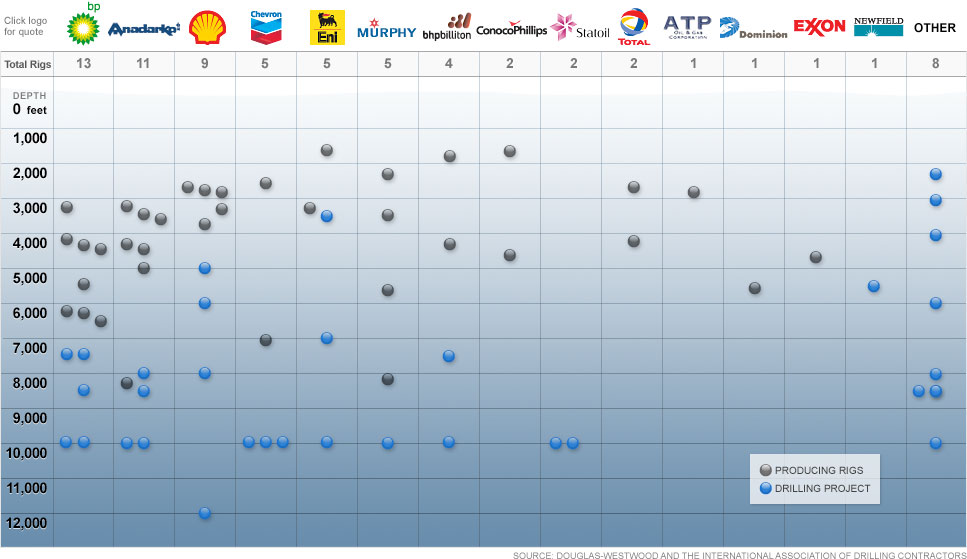
70 Oil Rigs And Oil Drilling Projects In Gulf Of Mexico
CNN reports that BP Deepwater Horizon oil well is only one of 70 oil rigs and drilling projects currently in the Gulf Of Mexico.
 Source CNN.
Thursday, June 10, 2010
Some Of The Gulf Oil Underwater Plumes Are Not BP's
From "BP oil isn’t the only source of gulf's deep roaming plumes: Some subsea plumes don't share the chemistry of BP's oil" by Janet Raloff, ScienceNews Web edition, Wednesday, June 9th, 2010:
During a June 8 briefing for reporters, Steven Murawski, chief science advisor for the National Oceanic and Atmospheric Association’s Fisheries Service, described deep strata of water tainted with oil. They were identified during a recent cruise in the Gulf of Mexico. A presumption had been that any clouds of oil hovering under the surface would be plumes spewed by the damaged BP well head. But the chemical fingerprinting of diffuse undersea oil clouds at one sampling site 142 nautical miles southeast of the Deepwater Horizon accident site was “not consistent with BP oil,” he pointed out.
Which begs the question: Where did this other oil come from — since Murawski noted that earlier research surveys of the area prior to the BP spill had turned up no subsea oil clouds.
Wednesday, June 2, 2010
Health Costs and the Federal Budget: CBO May 2010 Presentation: ObamaCare Did Not Fix The Problem
From the May 28, 2010, CBO Director's Blog:
The rising costs of health care will put tremendous pressure on the federal budget during the next few decades and beyond.
In CBO’s judgment, the health legislation enacted earlier this year does not substantially diminish that pressure. In fact, CBO estimated that the health legislation will increase the federal budgetary commitment to health care (which CBO defines as the sum of net federal outlays for health programs and tax preferences for health care) by nearly $400 billion during the 2010-2019 period.
CBO Health Costs and the Federal Budget Presentation 5-26-10 by Milton Recht on Scribd
GDP Potential Gap At $1 Trillion And Not Closing
Until the US economy makes up the $1 trillion potential GDP gap by growing faster than its long run 3 percent trend line growth rate, the US economy will not feel like its pre-recession levels. Unemployment will remain high and the economy will feel sluggish until the US closes its GDP potential gap.
(From KeithHennessey.com)

(From KeithHennessey.com)
Tuesday, June 1, 2010
Substitution Effect And Monopoly Pricing In Health Care
The comment I posted on "Where Are the Health Care Entrepreneurs?" by Andrew Samwick on capitalgainsandgames blog.
As you are aware, when goods are expensive, consumers switch to lower cost providers and also to substitute goods. From a researcher point of view, health care is only medical care (doctors, nurses, hospitals, etc) and pharmaceuticals.
From a consumer perspective, health care includes alternative medicine, such as vitamins, supplements, acupuncture, massages, etc. Plus, it includes lifestyle changes, such as eating less red meat, smoking less, exercising, drinking a glass of red wine, etc.
Additionally, health is affected by environmental and safety factors. The water and air are much cleaner and cause fewer ill health effects than decades ago. Likewise, the automobile, which is the primary cause of accidental deaths, is also much safer and auto deaths have declined.
Go to any major store that sells plastic bottles and you will see them advertise BPA free bottles, because of consumer concern about the health affects of BPA.
Tremendous innovation, entrepreneurship and efficiencies occur in health care, when the boundary of health care is broadened to match the views of the consumer.
Additionally, paying more is not necessarily better. Does a $15,000 Rolex watch tell time better than a $50 Seiko?
Doctors are a monopoly created by government licensing restrictions, and foreign-trained doctor restrictions and AMA restrictions on number of medical schools and number of graduating doctors. The number of graduating doctors has remained unchanged for decades despite population growth, while the number of applicants to medical schools has increased.
In monopolies, of course there are inefficiencies, high prices, lack of innovation and poor quality (poor health outcomes). Aren't insurance companies just capturing some of the economic rent that goes to doctors' monopoly pricing power? Aren't medical care consumers behaving similarly to other monopoly product consumers?
As the number of primary care doctors has declined as a percentage of the population, has it become somewhat like a luxury goods. Is there a status signaling effect as medical care costs increase? Is going to the doctor for a minor ailment a status signal, similar to owning a Lexus instead of a Camry?
Monopoly, luxury good effect, and failure to look at a broader consumer "health care" behavior can probably explain most of what we see happening in doctor provided medical care costs.
Saturday, May 29, 2010
Human Use Causes Much More Ocean Oil Than Drilling Accidents
From "Oil and Pollution in the Ocean" by the National Academy of Science, National Research Council:

accidental spills from platforms represent about 1 percent of petroleum discharged in North American waters and about 3 percent worldwide.Earlier in the report:
***
...surprising to many, is that oil from individual cars and boats, lawn mowers, jet skis, marine vessels, and airplanes contribute the most oil pollution to the ocean. This includes land runoff from oil slicks on urban roads and hydrocarbons deposited from the atmosphere. According to the report's estimates, use-related oil pollution dwarfs that from oil and gas production activities, accounting for about 87 percent of the oil from human activity in North American waters.
natural seeps are the largest single source of oil in the sea, accounting for about 60 percent of the total in North American waters and 45 percemt worldwide. Seeps form when crude oil oozes into the water from geologic formations beneath the seafloor. Oil and gas extraction activities are often concentrated in regions where seeps form.

What Is a Small Business?
There is a tendency to focus on small businesses. The media is fond of reporting that small businesses employ and create most of the jobs in the US. The media and the government are also concerned with the availability of bank loans and credit to small businesses. So, I thought I look up the definition of small business as defined by the Small Business Administration, a government lending program to small businesses.
Like all things government, the SBA has a 44 page booklet, "Table of Size Standards" for identifying small businesses.
Also available from here.
Surprisingly, a small business, depending on the industry, can have $35.5 million in annual receipts (gross profit plus cost of goods sold) or up to 1500 employees.
Small is relative and in comparison to the other companies in the industry.
A shop owner may think 1500 employees is big, but an auto manufacturer may not.
Like all things government, the SBA has a 44 page booklet, "Table of Size Standards" for identifying small businesses.
Also available from here.
Surprisingly, a small business, depending on the industry, can have $35.5 million in annual receipts (gross profit plus cost of goods sold) or up to 1500 employees.
Small is relative and in comparison to the other companies in the industry.
A shop owner may think 1500 employees is big, but an auto manufacturer may not.
Thursday, May 27, 2010
Federal Spending Crowds Out Local Private Investment And Lowers Employment
Specifically, we find statistically and economically significant evidence that firms respond to government spending...by: i.) reducing investments in new capital, ii.) reducing investments in R&D, and iii.) paying out more to shareholders in the face of this reduced investment opportunity set. Further, we find that when the spending...reverse..., most all of these behaviors reverse. Finally, we also find some evidence that firms scale back their employment, and experience a decline in sales growth.From "Do Powerful Politicians Cause Corporate Downsizing?" by Harvard Business School Professors Lauren Cohen, Joshua Coval and Christopher Malloy.
Also see Harvard Business School article, "Stimulus Surprise: Companies Retrench When Government Spends" on this research.
Tuesday, May 25, 2010
Costs Of Fed's Actions In Financial Crisis: CBO Study
The Federal Reserve System used its traditional policy tools to reduce shortterm interest rates and increase the availability of funds to banks, and it created a variety of nontraditional credit programs to help restore liquidity and confidence to the financial sector. In doing so, it more than doubled the size of its asset portfolio to over $2 trillion and assumed more risk of losses than it normally takes on.
***
In CBO’s estimation, the fairvalue subsidies conferred by the Federal Reserve System’s actions to stabilize the financial markets totaled about $21 billion.
The Budgetary Impact and Subsidy Costs of the Federal Reserve’s Actions During the Financial Crisis by Milton Recht
Friday, May 21, 2010
Goldman Sachs' Best Strategy Is Not To Settle SEC Charges
The best strategy for Goldman Sachs is not to settle the SEC fraud charges against it. Goldman can ask for a non-jury trial before a federal judge and avoid a public jury's dislike for the banking industry.
Federal rules of evidence would benefit Goldman since it will force the SEC to provide evidence, and not innuendo or popular opinion, of the fraud and the necessary intent to defraud. A mere description of the transaction, in of itself, would not show fraud.
Witnesses will be allowed to testify as to the exact meaning and context of emails and other communications. A judge would understand that typical company employee water cooler banter, which now is in the form of email exchanges, is not proof of Goldman Sachs' fraudulent intent or fraud.
The judge would hold the SEC to the existing law and not to what the law should be.
Penalties for this single instance of fraud are limited by securities law to an amount most likely substantially lower than any settlement amount Goldman would enter into with the SEC.
The judge will be unimpressed with the SEC's attempt to broaden the scope of the securities law to include transactions that maybe unethical but not fraudulent. The judge will also be unimpressed with any political pressure the SEC may feel to show it is a strong watchdog agency of the securities industry. In fact, the political climate and popular sentiment may appear to the judge that the SEC is over zealous in its prosecution of Goldman and find that the case does not have any merit.
Federal judges would be even tougher on the US Attorneys on proof of criminality.
Federal rules of evidence would benefit Goldman since it will force the SEC to provide evidence, and not innuendo or popular opinion, of the fraud and the necessary intent to defraud. A mere description of the transaction, in of itself, would not show fraud.
Witnesses will be allowed to testify as to the exact meaning and context of emails and other communications. A judge would understand that typical company employee water cooler banter, which now is in the form of email exchanges, is not proof of Goldman Sachs' fraudulent intent or fraud.
The judge would hold the SEC to the existing law and not to what the law should be.
Penalties for this single instance of fraud are limited by securities law to an amount most likely substantially lower than any settlement amount Goldman would enter into with the SEC.
The judge will be unimpressed with the SEC's attempt to broaden the scope of the securities law to include transactions that maybe unethical but not fraudulent. The judge will also be unimpressed with any political pressure the SEC may feel to show it is a strong watchdog agency of the securities industry. In fact, the political climate and popular sentiment may appear to the judge that the SEC is over zealous in its prosecution of Goldman and find that the case does not have any merit.
Federal judges would be even tougher on the US Attorneys on proof of criminality.
Passed Senate Financial Reform Legislation: S3739 Substituted For S3217
Embedded copy of Senate financial reform legislation, Senate Amendment S3739 substituted for S3217. S3739 was incoporated into House Bill HR4173 and passed by the Senate at 8:02 PM on Thursday, May 20, 2010. Incorporation into HR4173 allows bill to go to joint conference to reconcile differences. [Corrected May 21, Noon, by adding reference to HR4173].
Senate Amendment 3739
Senate Amendment 3739
Thursday, May 20, 2010
No Improvement In Electric Car Range In Last 100 Years

From "The status quo of electric cars: better batteries, same range" by Gail the Actuary (Gail E. Tverberg) on the Oil Drum Blog:
Electric motors and batteries have improved substantially over the past one hundred years, but today's much hyped electric cars have a range that is - at best - comparable to that of their predecessors at the beginning of the 20th century. Weight, comfort, speed and performance have eaten up any real progress. We don't need better batteries, we need better cars.
From about 1895 to the mid-1920s, and following the bicycle craze of the 1890s, electric cars shared the road with petrol and steam powered cars. EV's were comparatively slow, heavy, and had a smaller range than their alternatives. During the very early years, however, electric automobiles were the most popular option for a short time, mainly because of two reasons.
Firstly, they were easy to start, while a gasoline car had to be cranked up and a steam powered car required a long firing-up time (not unlike a wood gas car). Secondly, there were few paved roads outside the city at the turn of the 20th century, which made the limited range of EV's not that problematic. The production of electric vehicles peaked in 1912: during that time there were 30,000 EV's on the road in the United States, two-thirds of these were used as private passenger cars. Europe had around 4,000 electric vehicles.
Wednesday, May 19, 2010
CFTC/SEC Release Preliminary Findings on May 6 Unusual Market Events: Was NYSE The Cause?
The staffs of the Commodity Futures Trading Commission (CFTC) and Securities and Exchange Commission (SEC) released preliminary findings related to the unusual market events on May 6, 2010.
The report notes:
Additionally, there is anecdotal evidence that computerized traders withdrew their bids to buy shares (turned off their algorithms) because they expected many trades would be canceled because of the sharp decline in the price of the trades and they did not know beforehand the cutoff price for canceling trades.
One has to wonder if the NYSE Arca system and the lack of known SEC and NYSE price bounds for canceling trades was the cause of all the problems and not traders. Of course, since the SEC and NYSE are the ones looking for the causes of the decline, one wonders how much responsibility they will take for the stock market loss of liquidity and intra-day decline in the final report?
The 151 page report is available online from the CFTC, on Scribd and embedded below.
SEC-CFTC Preliminary Findings Regarding the Market Events of May 6, 2010
The report notes:
In addition, we are exploring the impact of “self-help” being invoked by NASDAQ and BATS against NYSE Arca. As NYSE Arca is the primary listing exchange for almost all ETFs, the loss of access to NYSE Arca’s liquidity pool may have had a disproportionate impact on market liquidity and trading for ETFs.Self help is declared against an exchange when that exchange is not responding in the proper time frame. Many of the ETFs are traded on NYSE Arca and many of the NYSE Arca ETFs trades were canceled because the prices of the ETFs were below, after the fact, acceptable levels.
Additionally, there is anecdotal evidence that computerized traders withdrew their bids to buy shares (turned off their algorithms) because they expected many trades would be canceled because of the sharp decline in the price of the trades and they did not know beforehand the cutoff price for canceling trades.
One has to wonder if the NYSE Arca system and the lack of known SEC and NYSE price bounds for canceling trades was the cause of all the problems and not traders. Of course, since the SEC and NYSE are the ones looking for the causes of the decline, one wonders how much responsibility they will take for the stock market loss of liquidity and intra-day decline in the final report?
The 151 page report is available online from the CFTC, on Scribd and embedded below.
SEC-CFTC Preliminary Findings Regarding the Market Events of May 6, 2010
Tuesday, May 18, 2010
SEC Proposes Circuit Breakers For Stocks In S&P 500
SEC to Publish for Public Comment Stock-by-Stock Circuit Breaker Rule Proposals
Washington, D.C., May 18, 2010 — The Securities and Exchange Commission announced that in response to the market disruption of May 6, the national securities exchanges and the Financial Industry Regulatory Authority (FINRA) are filing proposed rules today under which they would pause trading in certain individual stocks if the price moves 10 percent or more in a five-minute period.
The SEC is seeking comment on the proposed rules.
The markets are proposing these rules in consultation with FINRA and staff of the SEC to provide for uniform market-wide standards for individual securities in the S&P 500® Index that experience a rapid price movement.
These rules reflect a consensus that was achieved among the exchanges and FINRA after SEC Chairman Mary Schapiro convened a meeting of exchange leaders and FINRA at the SEC early last week. That meeting took place within days after the market dropped significantly and after approximately 30 S&P 500 Index stocks fell at least 10 percent in a five-minute period.
"We continue to believe that the market disruption of May 6 was exacerbated by disparate trading rules and conventions across the exchanges," said Chairman Schapiro. "As such, I believe it is important that all the exchanges quickly reached consensus on a set of uniform circuit breakers that would be triggered when needed. Today's filings reflect that consensus. I am pleased by the constructive cooperation of the exchanges and FINRA as evidenced by their rapid response."
Under the proposed rules, which are subject to Commission approval following the completion of the comment period, trading in a stock would pause across U.S. equity markets for a five-minute period in the event that the stock experiences a 10 percent change in price over the preceding five minutes. The pause would give the markets the opportunity to attract new trading interest in an affected stock, establish a reasonable market price, and resume trading in a fair and orderly fashion. Initially, these new rules would be in effect on a pilot basis through Dec. 10, 2010.
The markets will use the pilot period to make appropriate adjustments to the parameters or operation of the circuit breaker as warranted based on their experience, and to expand the scope to securities beyond the S&P 500 (including ETFs) as soon as practicable.
The proposed rules will be available on the SEC's website as well as the websites of each of the exchanges and FINRA. The Commission intends to promptly publish the proposed rules for a 10-day public comment period, and determine whether to approve them shortly thereafter.
"I believe that circuit breakers for individual securities across the exchanges would help to limit significant volatility. They would also increase market transparency, bolster investor protection, and bring uniformity to decisions regarding trading halts in individual securities," said Chairman Schapiro.
During the pilot period, Chairman Schapiro has asked the SEC staff to consider ways to address the risks of market orders and their potential to contribute to sudden price moves, as well as to consider steps to deter or prohibit the use by market makers of "stub" quotes, which are not intended to indicate actual trading interest. The staff will study the impact of other trading protocols at the exchanges, including the use of trading pauses and self-help rules. The SEC staff also will continue to work with the exchanges and FINRA to improve the process for breaking erroneous trades, by assuring speed and consistency across markets.
The SEC staff is working with the markets to consider recalibrating market-wide circuit breakers currently on the books — none of which were triggered on May 6. These circuit breakers apply across all equity trading venues and the futures markets.
* * *
The SEC also has sought public comment about a concept release on a wide range of topics concerning the equity markets to help facilitate the SEC's ongoing review of market structure issues.
# # #
http://www.sec.gov/news/press/2010/2010-80.htm
Washington, D.C., May 18, 2010 — The Securities and Exchange Commission announced that in response to the market disruption of May 6, the national securities exchanges and the Financial Industry Regulatory Authority (FINRA) are filing proposed rules today under which they would pause trading in certain individual stocks if the price moves 10 percent or more in a five-minute period.
The SEC is seeking comment on the proposed rules.
The markets are proposing these rules in consultation with FINRA and staff of the SEC to provide for uniform market-wide standards for individual securities in the S&P 500® Index that experience a rapid price movement.
These rules reflect a consensus that was achieved among the exchanges and FINRA after SEC Chairman Mary Schapiro convened a meeting of exchange leaders and FINRA at the SEC early last week. That meeting took place within days after the market dropped significantly and after approximately 30 S&P 500 Index stocks fell at least 10 percent in a five-minute period.
"We continue to believe that the market disruption of May 6 was exacerbated by disparate trading rules and conventions across the exchanges," said Chairman Schapiro. "As such, I believe it is important that all the exchanges quickly reached consensus on a set of uniform circuit breakers that would be triggered when needed. Today's filings reflect that consensus. I am pleased by the constructive cooperation of the exchanges and FINRA as evidenced by their rapid response."
Under the proposed rules, which are subject to Commission approval following the completion of the comment period, trading in a stock would pause across U.S. equity markets for a five-minute period in the event that the stock experiences a 10 percent change in price over the preceding five minutes. The pause would give the markets the opportunity to attract new trading interest in an affected stock, establish a reasonable market price, and resume trading in a fair and orderly fashion. Initially, these new rules would be in effect on a pilot basis through Dec. 10, 2010.
The markets will use the pilot period to make appropriate adjustments to the parameters or operation of the circuit breaker as warranted based on their experience, and to expand the scope to securities beyond the S&P 500 (including ETFs) as soon as practicable.
The proposed rules will be available on the SEC's website as well as the websites of each of the exchanges and FINRA. The Commission intends to promptly publish the proposed rules for a 10-day public comment period, and determine whether to approve them shortly thereafter.
"I believe that circuit breakers for individual securities across the exchanges would help to limit significant volatility. They would also increase market transparency, bolster investor protection, and bring uniformity to decisions regarding trading halts in individual securities," said Chairman Schapiro.
During the pilot period, Chairman Schapiro has asked the SEC staff to consider ways to address the risks of market orders and their potential to contribute to sudden price moves, as well as to consider steps to deter or prohibit the use by market makers of "stub" quotes, which are not intended to indicate actual trading interest. The staff will study the impact of other trading protocols at the exchanges, including the use of trading pauses and self-help rules. The SEC staff also will continue to work with the exchanges and FINRA to improve the process for breaking erroneous trades, by assuring speed and consistency across markets.
The SEC staff is working with the markets to consider recalibrating market-wide circuit breakers currently on the books — none of which were triggered on May 6. These circuit breakers apply across all equity trading venues and the futures markets.
* * *
The SEC also has sought public comment about a concept release on a wide range of topics concerning the equity markets to help facilitate the SEC's ongoing review of market structure issues.
# # #
http://www.sec.gov/news/press/2010/2010-80.htm
Why Isn't Obama Pushing Free Trade Agreements To Create Private Sector Jobs And Grow The Economy?
A comment I posted on Carpe Diem, "Inexcusable: Obama's Failure to Pass the FTAs" by Mark Perry.
To add to the idiocy of the administration's support of the anti-free trade, union position is that private sector union membership in manufacturing and construction is only 7.2 percent, a decline from the 35 percent peak in the 1950s.
State, local and federal government workers make up the majority, 52 percent, of union members. 43 percent of local government workers are union members.
So it is basically the teachers, the firemen, the policemen, the garbage man and other local community workers who live off everyone's tax dollars, have generous pensions, health benefits, vacation and sick days and who have not felt the effects of the recession and layoffs anywhere near the same extent as the private sector.
People who do not make anything, who do not compete in international markets, who need not worry about international trade and competition, and who do not have to worry about private sector job creation are the ones stopping the US economy from expanding, adding private sector jobs and from benefiting from free trade agreements.
Subscribe to:
Posts (Atom)