The United States' lawsuit to invalidate Arizona's enactment of an immigration law will cause more harm than good to immigrants in the US.
The judges, including appellate and likely also US Supreme Court, who will hear and decide this case, will write judicial opinions clarifying their reasoning for their decisions to uphold or overturn in whole or in part Arizona's immigration law.
The court decisions will define the boundaries of allowable immigration law by the states. All states, including inland states, do have certain rights to protect their borders and to seek out those who have committed crimes at the state and federal level, but clearly, their rights are not as encompassing as the federal rights.
The court will have to articulate a set of rules for allowing or disallowing a state to enforce rules about its borders and about seeking out persons within its borders who have committed crimes.
Once rules are established, state legislators can attempt to write legislation that complies with the rules and bans illegal immigrants. Some of these laws in whole or part will survive further lawsuits and become the blueprint for other states to follow.
Additionally, before a court considers a constitutional argument to a law, the court will consider whether there are other reasons, such as federal preemption, to invalidate the state law. Unconstitutionality is a last resort of a court.
If the courts overturn the Arizona law, more likely than a finding of a violation of the US constitution, the court will find that federal law preempts the Arizona law.
The court decision finding preemption will cite specific federal laws. There will be call by the states and by the majority of US citizens that support Arizona's law for the Congress to amend the cited federal laws to allow states to control illegal immigration within their borders.
The lawsuit will open a Pandora's Box. In the end, it will establish a blueprint for allowable state laws about immigration and more states will enact laws than if there were no lawsuit.
The lawsuit will also pressure Congress to modify any federal laws to allow states to enact their own illegal immigration enforcement laws.
In the end, either the Obama administration will lose the lawsuit outright or it will establish an outline for states legally to enact illegal immigration laws. It is a shortsighted move by Obama.
Tuesday, July 6, 2010

Blogger's Call To Buy BP Gas
From The Voice of Reason, " Buy BP! Gas, That Is!":
The reason is that I refuse to let the President and Democrats play their games with me, and I prefer to support the 80,200 BP employees and the 300,000 people who are dependent on BP for their incomes rather than the villification agenda of President Obama and his cronies.
Sunday, July 4, 2010
Erosion And Not Oil Leak Are Major Cause Of Louisiana Coastal Damage
From "Determining oil spill's environmental damage is difficult" by David A. Fahrenthold, Washington Post Staff Writer, Monday, July 5, 2010:
But Paul Kemp of the National Audubon Society said he flew over the same area and saw a different picture: The oil's damage was relatively small, at least in comparison with the marsh's existing problems.
"Here, we have a patient that's dying of cancer, you know, and now they have a sunburn, too," Kemp said. "What will kill coastal Louisiana is not this oil spill. What will kill coastal Louisiana is what was killing it before this oil spill," including erosion and river-control projects that have reduced the buildup of new land, he said.

Thursday, July 1, 2010
House Passed Version of Financial Reform, HR 4173
Copy of the final version of the Dodd-Frank financial reform bill, HR 4173, "Restoring American Financial Stability Act of 2010" as passed by the US House of Representatives on June 30, 2010, by a vote of 237-192.
Link to the HR4173 Conference Report (72MB, 1200 pages). Alternate download site for Conference Report.
HR4173: Restoring American Financial Stability Act of 2010
Link to the HR4173 Conference Report (72MB, 1200 pages). Alternate download site for Conference Report.
HR4173: Restoring American Financial Stability Act of 2010
Intrade Higgs Boson 2013 Discovery Contract Jumped 60+ Percent
The Intrade contract security closing price for discovery of the Higgs Boson particle before December 31, 2013, jumped over 60 percent yesterday. The contract closed at 49 and the previous close was 30.

The contract ID of this contract is: 700243, "Higgs Boson Particle to be observed on/before 31 Dec 2013."
The contract ID of this contract is: 700243, "Higgs Boson Particle to be observed on/before 31 Dec 2013."
Tuesday, June 29, 2010
Is It Time For Obama to Take Responsibility For Our Slow Economic Growth?
Read "Why Obamanomics Has Failed: Uncertainty about future taxes and regulations is enemy No. 1 of economic growth" by Allan H. Meltzer, professor of economics at Carnegie Mellon University, a visiting scholar at the American Enterprise Institute, and the author of "A History of the Federal Reserve" (University of Chicago Press, 2003 and 2010).
Two overarching reasons explain the failure of Obamanomics. First, administration economists and their outside supporters neglected the longer-term costs and consequences of their actions. Second, the administration and Congress have through their deeds and words heightened uncertainty about the economic future. High uncertainty is the enemy of investment and growth.
Better Science And Medical Reporting In Main Street News Media
One of the failings of main street news media science reporting is that the news often just repeats a press release. The media often fails to look at the underlying science to see if it is good science. Too often, the research does not support the broad conclusions in the press release, the sample size is too small and not statistically valid or the research did not follow accepted, valid scientific methods, such as randomized, blind trials, etc.
An article in today's Wall St. Journal by Jeremy Singer-Vine is a welcome exception to the above observation.
After each brief description of research, The Journal added a caveat section and included valid scientific reasons as to why upon further testing the conclusions may not be replicated and verified.
An article in today's Wall St. Journal by Jeremy Singer-Vine is a welcome exception to the above observation.
After each brief description of research, The Journal added a caveat section and included valid scientific reasons as to why upon further testing the conclusions may not be replicated and verified.
Monday, June 28, 2010
46 States Face $112 Billion Budget Deficit
From the Bloomberg article, "States of Crisis for 46 Governments Facing Greek-Style Deficits" by Edward Robinson:
Forty-six states face budget shortfalls that add up to $112 billion for the fiscal year ending next June, according to the Center on Budget and Policy Priorities, a Washington research institution. State spending is 12 percent of U.S. GDP.Read the entire article here.
Sunday, June 27, 2010
Kartik Athreya's Letter To Consumers Of The Economics Blogosphere: Economics Is Hard
[Links to paper are corrected and working as of June 29, 10:15 PM.]
From "Economics is Hard. Don’t Let Bloggers Tell You Otherwise" by Kartik Athreya, Research Department, Federal Reserve Bank of Richmond, June 17, 2010:
Thank you to Greg Mankiw for the link.
From "Economics is Hard. Don’t Let Bloggers Tell You Otherwise" by Kartik Athreya, Research Department, Federal Reserve Bank of Richmond, June 17, 2010:
The main problem is that economics, and certainly macroeconomics is not, by any reasonable measure, simple. Macroeconomics is most narrowly concerned with the tracing of individual actions into aggregate outcomes, and most fatally attractive to bloggers: vice versa. What makes macroeconomics very complicated is that economic actors... act. Firms think about how to make profits, households think about how to budget their resources. And both sets of actors forecast. They must. One has to take a view on one’s future income, health, and familial obligations to think about what to set aside for retirement, how much life insurance to buy, and so on. Of course, all parties may be terrible at forecasting, that’s certainly a possibility, but that’s not the issue. Even if one wanted to think of all economic actors as foolish and purposeless organisms making utterly random choices, one must accept that their decisions will still affect, and be affected by what others do. The finitude of resources ensures this “accounting” reality.Read the entire paper here.
Beyond this, some may recall that Economics 101 is usually insistent on reminding students of the Fallacy of Composition: what is true for some may not be true for all. Much of macroeconomics is dedicated precisely making sure that when we talk about the “economy”, we don’t fall afoul of this fallacy. It is therefore not surprising that the majority of the training of new PhDs in their macroeconomic coursework is giving them a way to come to grips with the feedback effects that are likely present. Some of this is nothing more than (valuable) exercises in book-keeping. So much of my 1st year homework involved writing down tedious definitions of internally consistent outcomes. Not analyzing them, just defining them, and so trying to convincing my instructors that I wasn’t inadvertently describing something nonsensical, where resources were being allowed to “fly in (or out) through a window.” In discussions of fiscal policy, such as those regarding deficits, for example, the discipline imposed by an insistence on doing the accounting correctly helps focus economists on the real issue (total spending, and the expected future path of spending), and also learn what might be peripheral (the deficit at any given moment).
The punchline to all this is that when a professional research economist thinks or talks about social insurance, unemployment, taxes, budget deficits, or sovereign debt, among other things, they almost always have a very precisely articulated model that has been vetted repeatedly for internal coherence.
Thank you to Greg Mankiw for the link.
How Absurd Environmental And Labor Rules Blocked The Oil Cleanup: Why Didn't Obama Suspend The Rules To Allow A Faster Oil Cleanup?
The absurd application of US clean water environmental rules block the efficient clean up of the BP Gulf oil leak. Equipment that can remove much, if not most, of the oil from the Gulf, such as European oil cleanup technology, cannot be used in the Gulf because the "cleaned water" cannot be returned into the Gulf and must be carted away in the ships.
US environmental regulators require the water to be at least 99.9985% pure, less than 15 parts per million of oil remaining in the water, for it to be returned to the Gulf of Mexico, even though the water is the same water from the Gulf and is much cleaner and has much less oil than when it was removed a short time before.
It is an absurd environmental requirement in the BP oil leak emergency where the removal of as much oil as possible as quickly and efficiently as possible is to everyone's benefit. Every drop of oil removed lessens the chances of damage to wildlife, the fisheries, sea animals, the coast, the marshes, etc.
Read the sad story of how US environmental and labor rules, and Obama's refusal to suspend these rules, turned a leak into a catastrophe in, "Avertible catastrophe: How U.S. labour and environmental rules blocked Dutch spill-cleanup technology" by Lawrence Solomon in the Financial Post.
US environmental regulators require the water to be at least 99.9985% pure, less than 15 parts per million of oil remaining in the water, for it to be returned to the Gulf of Mexico, even though the water is the same water from the Gulf and is much cleaner and has much less oil than when it was removed a short time before.
It is an absurd environmental requirement in the BP oil leak emergency where the removal of as much oil as possible as quickly and efficiently as possible is to everyone's benefit. Every drop of oil removed lessens the chances of damage to wildlife, the fisheries, sea animals, the coast, the marshes, etc.
Read the sad story of how US environmental and labor rules, and Obama's refusal to suspend these rules, turned a leak into a catastrophe in, "Avertible catastrophe: How U.S. labour and environmental rules blocked Dutch spill-cleanup technology" by Lawrence Solomon in the Financial Post.
Thursday, June 24, 2010
Faulty US Data Basis For BP Oil Spill Risk Planning
From the June 24, 2010 article in The Wall St. Journal, "BP Relied on Faulty U.S. Data" by Neil King Jr. And Keith Johnson:
BP PLC and other big oil companies based their plans for responding to a big oil spill in the Gulf of Mexico on U.S. government projections that gave very low odds of oil hitting shore, even in the case of a spill much larger than the current one.
The government models, which have not been updated since 2004, assumed that most of the oil would rapidly evaporate or get broken up by waves or weather. In the weeks since the Deepwater Horizon caught fire and sank, real life has proven these models wrong.
Oil has hit 171 miles of shoreline in southern Louisiana, Mississippi, Alabama and northern Florida. Further, government models don't address how oil released a mile below the surface would behave—despite years of concern among government scientists and oil companies about deep-water spills.
Wednesday, June 23, 2010
US Multinationals Contribute Disproportionately To US Economy’s Growth: McKinsey & Co Report
McKinsey & Company reports that US multinationals, which represent less than 1 percent of all US companies, contribute disproportionately to the US economy’s growth and health.
Read a McKinsey one page summary here.
Read the 11 page McKinsey executive summary here.
Read the 88 page McKinsey report here.
Listen to a 13 minute McKinsey audio discussion here.
In 2007, US multinationals accounted for 23 percent of US private-sector GDP (or value added). Since 1990, however, they have been responsible for 31 percent of the growth in real GDP and 41 percent of gains in US labor productivity. Their outsized contributions to productivity growth matter greatly because productivity increases have delivered nearly three-quarters of US real GDP growth since 2000, with the rest coming from employment gains—the reverse of the situation 30 years ago. Compared with other US companies, US multinationals are twice as concentrated in globally competitive sectors. Since many corporations confront similar pressures and choices, US multinationals may provide insights into how other companies—and the economy as a whole—can respond to increasingly intense global competition.Read the McKinsey Quarterly article here.
Read a McKinsey one page summary here.
Read the 11 page McKinsey executive summary here.
Read the 88 page McKinsey report here.
Listen to a 13 minute McKinsey audio discussion here.
Court Decision Lifting The Ban On Gulf Oil Drilling
Link (courtesy of The Wall St. Journal) to United States District Judge Martin L. C. Feldman's decision lifting the ban on oil drilling in the Gulf.
Judge Feldman wrote in his opinion:
Judge Feldman wrote in his opinion:
The Deepwater Horizon oil spill is an unprecedented, sad, ugly and inhuman disaster. What seems clear is that the federal government has been pressed by what happened on the Deepwater Horizon into an otherwise sweeping confirmation that all Gulf deepwater drilling activities put us all in a universal threat of irreparable harm. While the implementation of regulations and a new culture of safety are supportable by the Report and the documents presented, the blanket moratorium, with no parameters, seems to assume that because one rig failed and although no one yet fully knows why, all companies and rigs drilling new wells over 500 feet also universally present an imminent danger.
On the record now before the Court, the defendants have failed to cogently reflect the decision to issue a blanket, generic, indeed punitive, moratorium with the facts developed during the thirty-day review. The plaintiffs have established a likelihood of successfully showing that the Administration acted arbitrarily and capriciously in issuing the moratorium.
Tuesday, June 22, 2010
BP Spill Maybe Less Than Many Thought
Based on the available information and calculations, it is highly probable that the failed BP well is producing oil at a rate that is closer to 20,000 or 30,000 barrels of oil a day. If BP is currently collecting 25,000 barrels a day, then only some 5,000 barrels of oil are being spilled in the Gulf waters.From Bloomberg article, "BP Spill May Be Less Than Doomsayers Think" by Tadeusz W. Patzek, chairman of the petroleum and geosystems engineering department at the University of Texas- Austin.
Chinese Labor Costs Rising; Increase Automation In China Factories
From Bloomberg article, "Rising China Wages Prompt Nissan, Foxconn to Boost Automation" by By Mark Lee:
Companies have several ways to lower goods costs. Workers can become more efficient, i.e. produce more in the same time; companies can invest in machines and automation to produce more goods at a lower unit cost; or companies can outsource to lower labor cost countries. Employers will use all three methods and others to lower their cost per product made.
Preventing outsourcing only speeds up automation and the drive for more efficient workers. In all manufacturing, eventually, more will be produced with fewer workers at a lower unit cost.
New minimum wage laws, a looser yuan and worker strikes like those affecting Honda Motor Co. and Toyota Motor Corp. are raising costs at plants in China’s Pearl River Delta, leading to increased automation of assembly lines.The natural drive of all manufacturers, whether Chinese or American, is to reduce production costs. As labor costs rise, whether in the US or China, producers look for ways to lower their product costs.
Foxconn Technology Group, Nissan Motor Co.’s Chinese venture and VTech Holdings Ltd. said they are investing in factory equipment to reduce their reliance on labor.
Companies have several ways to lower goods costs. Workers can become more efficient, i.e. produce more in the same time; companies can invest in machines and automation to produce more goods at a lower unit cost; or companies can outsource to lower labor cost countries. Employers will use all three methods and others to lower their cost per product made.
Preventing outsourcing only speeds up automation and the drive for more efficient workers. In all manufacturing, eventually, more will be produced with fewer workers at a lower unit cost.
UK Abolishes FSA, Its SEC: Should The US Abolish Its SEC?
The UK is abolishing and replacing its current system of financial services regulation, including its less than a decade old Financial Services Authority, for failing to properly supervise and prevent the financial crisis.
The Bank of England (our Federal Reserve equivalent) will supervise and regulate the safety and soundness issues of all financial services entities, including insurance. A separate consumer protection agency will exist and an independent committee under the Bank of England will be formed with the responsibility for preventing and stopping threats to economic and financial stability.
From the June 16, 2010, speech by The Chancellor of the Exchequer, The Rt Hon George Osborne MP:
The Bank of England (our Federal Reserve equivalent) will supervise and regulate the safety and soundness issues of all financial services entities, including insurance. A separate consumer protection agency will exist and an independent committee under the Bank of England will be formed with the responsibility for preventing and stopping threats to economic and financial stability.
From the June 16, 2010, speech by The Chancellor of the Exchequer, The Rt Hon George Osborne MP:
What we are proposing is a new system of regulation that learns the lessons of the greatest banking crisis in our lifetime.
I can confirm that the Government will abolish the tripartite regime, and the Financial Services Authority will cease to exist in its current form.
We will create a new prudential regulator, which will operate as a subsidiary of the Bank of England.
It will carry out the prudential regulation of financial firms, including banks, investment banks, building societies and insurance companies.
We will create an independent Financial Policy Committee at the Bank, which will have the tools and the responsibility to look across the economy at the macro issues that may threaten economic and financial stability and take effective action in response.
We will also establish a powerful new Consumer Protection and Markets Authority.
It will regulate the conduct of every authorised financial firm providing services to consumers.
It will also be responsible for ensuring the good conduct of business in the UK’s retail and wholesale financial services, in order to preserve our reputation for transparency and efficiency as well as our position as one of the world’s leading global financial centres.
I can also confirm that we will fulfil the commitment in the coalition agreement to create a single agency to take on the work of tackling serious economic crime that is currently dispersed across a number of Government departments and agencies.
We take white collar crime as seriously as other crime and we are determined to simplify the confusing and overlapping responsibilities in this area in order to improve detection and enforcement.
I have thought longer and harder and spoken to more people about all these issues than almost any other issue to have crossed my desk.
We do not undertake these reforms lightly, and we do so only because we believe they are absolutely necessary.
We will handle the transition carefully, consult widely and get this right.
The process will be completed in 2012.
Friday, June 18, 2010
Did The Market Expect A BP Oil Spill Over A Year Ago?
About 12 to 18 months ago, a friend of mine bought some BP stock because he was in search of income and it had a high dividend yield. The dividend yield at the time was in the 8 to 10 percent range and because it was high I used the put call parity relationship to see if the market was expecting a dividend cut.
When prices of stocks and their associated put and call options are available, the prices can be used to compute the market's expectation of future dividends using the put-call parity relationship.
Put Call Parity states that the price of a stock less it expected dividends (discounted to current dollars) until the maturity of the stock options plus the price of a put option on the stock is equal to the price of a call option on the stock plus the value of a bond equal to the the discounted valued of the exercise price of the stock options.
When I computed the expected BP dividend 12-18 months ago using the then current BP prices at the time of its stock, its call option and its put option, the dividend adjustment expected by the market as represented in the put call parity relationship was about half of the then current dividend.
BP at the time had more than enough earnings and cashflow to pay its dividends. The stock and option markets were expecting some extraordinary event at least as far back as 12-18 months ago that would cause BP to reduce its dividend.
Was the market expecting an oil spill disaster by BP?
When prices of stocks and their associated put and call options are available, the prices can be used to compute the market's expectation of future dividends using the put-call parity relationship.
Put Call Parity states that the price of a stock less it expected dividends (discounted to current dollars) until the maturity of the stock options plus the price of a put option on the stock is equal to the price of a call option on the stock plus the value of a bond equal to the the discounted valued of the exercise price of the stock options.
When I computed the expected BP dividend 12-18 months ago using the then current BP prices at the time of its stock, its call option and its put option, the dividend adjustment expected by the market as represented in the put call parity relationship was about half of the then current dividend.
BP at the time had more than enough earnings and cashflow to pay its dividends. The stock and option markets were expecting some extraordinary event at least as far back as 12-18 months ago that would cause BP to reduce its dividend.
Was the market expecting an oil spill disaster by BP?
Thursday, June 17, 2010
BP Dividend Suspension Is A Hidden Tax On US Retirees
Thirty-nine percent of BP's shares are held in the United States by 133,300 individuals and institutions, according to BP's 2009 ownership statistics report. Since many single institutional holders have multiple beneficial owners, such as mutual funds, the total number of US individuals who directly or indirectly own BP exceeds the 133,300 number.
Obama's call for BP to suspend its dividend payments to pay for the Gulf Coast oil spill damage is a hidden tax on these US individuals. They have been asked by the President to give up their dividends to pay Gulf Coast residents and businesses.
Most shares in the US are owned directly or indirectly by older individuals in retirement accounts, according to 2007 US Survey of Consumer Finance Report published in February 2009.
Is it really fair to ask retirees and those saving for retirement to pay for the cleanup and damages in the Gulf Coast region? BP could have paid for the oil spill without suspending its dividend payments.
Obama's call for BP to suspend its dividend payments to pay for the Gulf Coast oil spill damage is a hidden tax on these US individuals. They have been asked by the President to give up their dividends to pay Gulf Coast residents and businesses.
Most shares in the US are owned directly or indirectly by older individuals in retirement accounts, according to 2007 US Survey of Consumer Finance Report published in February 2009.
Is it really fair to ask retirees and those saving for retirement to pay for the cleanup and damages in the Gulf Coast region? BP could have paid for the oil spill without suspending its dividend payments.
Atlanta Fed Podcast About Regional Economic Impact Of BP Deepwater Oil Spill
Michael Chriszt, assistant vice president in the Atlanta Fed's research department responsible for the Regional Economic Information Network, discusses (7 minutes) the oil spill in the Gulf of Mexico and its potential impact on regional economies.
Click here to download or listen to the 7 minute podcast about the economic impact of the BP oil spill on the Gulf Coast region.
Click here to download or listen to the 7 minute podcast about the economic impact of the BP oil spill on the Gulf Coast region.
Wednesday, June 16, 2010
Green Energy Technology Is Not Better Nor Safer Technology Than Oil Drilling
The lesson from the BP oil well catastrophe is not one about the harmful effects of oil spills. It is an example of the difficulty of managing large-scale energy production risks, whether it is carbon-based or green.
Green energy producing technologies for energy production are neither riskless technologies nor technologies without potential environmental harm. Green energy is low carbon output and energy efficiency. Green energy production might be better for global warming, but it is not risk free energy production.
Non-carbon based energy production is not necessarily less risky or more environmentally friendly than oil.
The US is 300,000,000 energy using people producing $16 trillion of goods and services each year that require a huge amount of yearly energy production.
The devastation from BP's Deepwater oil rig explosion and oil well leak is mostly from the scale of the operation and the vast amount of oil released.
The vast amount of harm from BP's disaster is due to its size and not to it being a carbon based energy form.
Any large-scale energy production facility or any large-scale energy component manufacturing facility, including green technologies, will have risks and the potential for a devastating and catastrophic event.
All large-scale production facilities have the potential for catastrophic harm.
Green energy is hydroelectric power plants requiring the building of many dams and the flooding of acres of major land areas, destroying and displacing many of the local fauna and flora.
Green energy is battery technology than requires large-scale mining operations, the substantial use of dangerous heavy and rare metals, such as indium, lithium, cadmium, etc. and manufacturing plants containing the dangerous elements. These metals are mined outside of the US.
Green energy is compact florescent lighting than uses and contains poisonous mercury.
Green energy is solar cell farms covering many square miles of land area with effects on the local environment.
Green energy is large-scale wind farms covering thousands of acres of land and ocean with potential weather disruption and environmental harm to birds and other animals and plants.
Green energy is multiple nuclear power plants.
Green energy still requires large transmission lines from electricity generating areas to users.
All large-scale energy production will have the potential for large-scale harm and catastrophe.
The BP tragedy does not lead to the conclusion that green energy is safer or more environmentally friendly than oil or other carbon based energy.
Green energy producing technologies for energy production are neither riskless technologies nor technologies without potential environmental harm. Green energy is low carbon output and energy efficiency. Green energy production might be better for global warming, but it is not risk free energy production.
Non-carbon based energy production is not necessarily less risky or more environmentally friendly than oil.
The US is 300,000,000 energy using people producing $16 trillion of goods and services each year that require a huge amount of yearly energy production.
The devastation from BP's Deepwater oil rig explosion and oil well leak is mostly from the scale of the operation and the vast amount of oil released.
The vast amount of harm from BP's disaster is due to its size and not to it being a carbon based energy form.
Any large-scale energy production facility or any large-scale energy component manufacturing facility, including green technologies, will have risks and the potential for a devastating and catastrophic event.
All large-scale production facilities have the potential for catastrophic harm.
Green energy is hydroelectric power plants requiring the building of many dams and the flooding of acres of major land areas, destroying and displacing many of the local fauna and flora.
Green energy is battery technology than requires large-scale mining operations, the substantial use of dangerous heavy and rare metals, such as indium, lithium, cadmium, etc. and manufacturing plants containing the dangerous elements. These metals are mined outside of the US.
Green energy is compact florescent lighting than uses and contains poisonous mercury.
Green energy is solar cell farms covering many square miles of land area with effects on the local environment.
Green energy is large-scale wind farms covering thousands of acres of land and ocean with potential weather disruption and environmental harm to birds and other animals and plants.
Green energy is multiple nuclear power plants.
Green energy still requires large transmission lines from electricity generating areas to users.
All large-scale energy production will have the potential for large-scale harm and catastrophe.
The BP tragedy does not lead to the conclusion that green energy is safer or more environmentally friendly than oil or other carbon based energy.
Saturday, June 12, 2010
The Offsetting Effects Of Regulations
In the current environment, where many want more regulation of financial institutions, more regulation of health care and health insurance, more regulation of oil company offshore drilling, and more regulation of energy use, it is worth remembering the Peltzman effect.
The Peltzman effect notes that behavior will modify to offset the beneficial effects of the intended regulatory benefits.
Following is a video (Peltzman's one hour talk plus 30 minutes of Q&A starts at 10 minute mark) and a transcript of Sam Peltzman's speech at the American Enterprise Institute about the offsetting effects to regulation (double click video for full screen):
Transcript of Peltzman's speech is available here.
(HT: Arnold Kling for mentioning Peltzman in his blog.)
The Peltzman effect notes that behavior will modify to offset the beneficial effects of the intended regulatory benefits.
Following is a video (Peltzman's one hour talk plus 30 minutes of Q&A starts at 10 minute mark) and a transcript of Sam Peltzman's speech at the American Enterprise Institute about the offsetting effects to regulation (double click video for full screen):
Transcript of Peltzman's speech is available here.
(HT: Arnold Kling for mentioning Peltzman in his blog.)
Friday, June 11, 2010
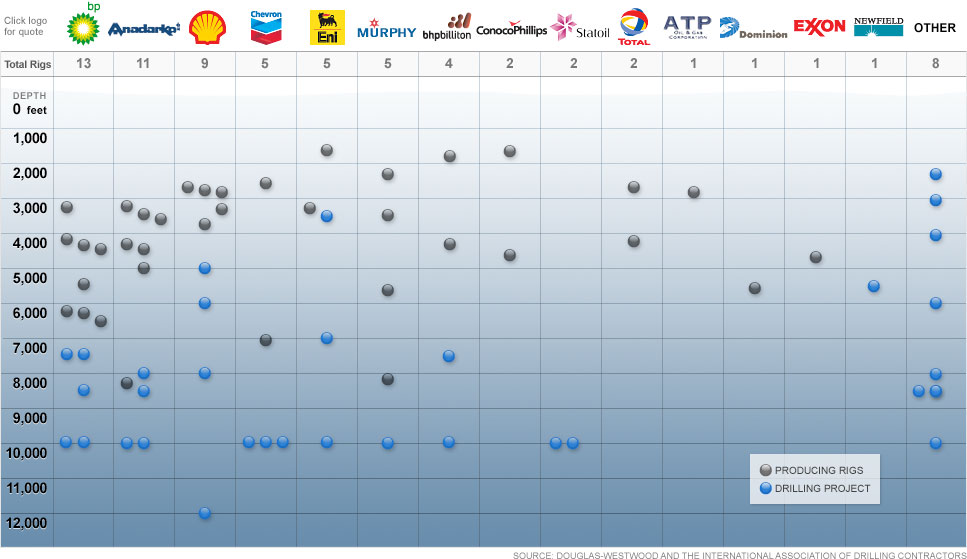
70 Oil Rigs And Oil Drilling Projects In Gulf Of Mexico
CNN reports that BP Deepwater Horizon oil well is only one of 70 oil rigs and drilling projects currently in the Gulf Of Mexico.
 Source CNN.
Thursday, June 10, 2010
Some Of The Gulf Oil Underwater Plumes Are Not BP's
From "BP oil isn’t the only source of gulf's deep roaming plumes: Some subsea plumes don't share the chemistry of BP's oil" by Janet Raloff, ScienceNews Web edition, Wednesday, June 9th, 2010:
During a June 8 briefing for reporters, Steven Murawski, chief science advisor for the National Oceanic and Atmospheric Association’s Fisheries Service, described deep strata of water tainted with oil. They were identified during a recent cruise in the Gulf of Mexico. A presumption had been that any clouds of oil hovering under the surface would be plumes spewed by the damaged BP well head. But the chemical fingerprinting of diffuse undersea oil clouds at one sampling site 142 nautical miles southeast of the Deepwater Horizon accident site was “not consistent with BP oil,” he pointed out.
Which begs the question: Where did this other oil come from — since Murawski noted that earlier research surveys of the area prior to the BP spill had turned up no subsea oil clouds.
Wednesday, June 2, 2010
Health Costs and the Federal Budget: CBO May 2010 Presentation: ObamaCare Did Not Fix The Problem
From the May 28, 2010, CBO Director's Blog:
The rising costs of health care will put tremendous pressure on the federal budget during the next few decades and beyond.
In CBO’s judgment, the health legislation enacted earlier this year does not substantially diminish that pressure. In fact, CBO estimated that the health legislation will increase the federal budgetary commitment to health care (which CBO defines as the sum of net federal outlays for health programs and tax preferences for health care) by nearly $400 billion during the 2010-2019 period.
CBO Health Costs and the Federal Budget Presentation 5-26-10 by Milton Recht on Scribd
GDP Potential Gap At $1 Trillion And Not Closing
Until the US economy makes up the $1 trillion potential GDP gap by growing faster than its long run 3 percent trend line growth rate, the US economy will not feel like its pre-recession levels. Unemployment will remain high and the economy will feel sluggish until the US closes its GDP potential gap.
(From KeithHennessey.com)

(From KeithHennessey.com)
Tuesday, June 1, 2010
Substitution Effect And Monopoly Pricing In Health Care
The comment I posted on "Where Are the Health Care Entrepreneurs?" by Andrew Samwick on capitalgainsandgames blog.
As you are aware, when goods are expensive, consumers switch to lower cost providers and also to substitute goods. From a researcher point of view, health care is only medical care (doctors, nurses, hospitals, etc) and pharmaceuticals.
From a consumer perspective, health care includes alternative medicine, such as vitamins, supplements, acupuncture, massages, etc. Plus, it includes lifestyle changes, such as eating less red meat, smoking less, exercising, drinking a glass of red wine, etc.
Additionally, health is affected by environmental and safety factors. The water and air are much cleaner and cause fewer ill health effects than decades ago. Likewise, the automobile, which is the primary cause of accidental deaths, is also much safer and auto deaths have declined.
Go to any major store that sells plastic bottles and you will see them advertise BPA free bottles, because of consumer concern about the health affects of BPA.
Tremendous innovation, entrepreneurship and efficiencies occur in health care, when the boundary of health care is broadened to match the views of the consumer.
Additionally, paying more is not necessarily better. Does a $15,000 Rolex watch tell time better than a $50 Seiko?
Doctors are a monopoly created by government licensing restrictions, and foreign-trained doctor restrictions and AMA restrictions on number of medical schools and number of graduating doctors. The number of graduating doctors has remained unchanged for decades despite population growth, while the number of applicants to medical schools has increased.
In monopolies, of course there are inefficiencies, high prices, lack of innovation and poor quality (poor health outcomes). Aren't insurance companies just capturing some of the economic rent that goes to doctors' monopoly pricing power? Aren't medical care consumers behaving similarly to other monopoly product consumers?
As the number of primary care doctors has declined as a percentage of the population, has it become somewhat like a luxury goods. Is there a status signaling effect as medical care costs increase? Is going to the doctor for a minor ailment a status signal, similar to owning a Lexus instead of a Camry?
Monopoly, luxury good effect, and failure to look at a broader consumer "health care" behavior can probably explain most of what we see happening in doctor provided medical care costs.
Saturday, May 29, 2010
Human Use Causes Much More Ocean Oil Than Drilling Accidents
From "Oil and Pollution in the Ocean" by the National Academy of Science, National Research Council:

accidental spills from platforms represent about 1 percent of petroleum discharged in North American waters and about 3 percent worldwide.Earlier in the report:
***
...surprising to many, is that oil from individual cars and boats, lawn mowers, jet skis, marine vessels, and airplanes contribute the most oil pollution to the ocean. This includes land runoff from oil slicks on urban roads and hydrocarbons deposited from the atmosphere. According to the report's estimates, use-related oil pollution dwarfs that from oil and gas production activities, accounting for about 87 percent of the oil from human activity in North American waters.
natural seeps are the largest single source of oil in the sea, accounting for about 60 percent of the total in North American waters and 45 percemt worldwide. Seeps form when crude oil oozes into the water from geologic formations beneath the seafloor. Oil and gas extraction activities are often concentrated in regions where seeps form.

What Is a Small Business?
There is a tendency to focus on small businesses. The media is fond of reporting that small businesses employ and create most of the jobs in the US. The media and the government are also concerned with the availability of bank loans and credit to small businesses. So, I thought I look up the definition of small business as defined by the Small Business Administration, a government lending program to small businesses.
Like all things government, the SBA has a 44 page booklet, "Table of Size Standards" for identifying small businesses.
Also available from here.
Surprisingly, a small business, depending on the industry, can have $35.5 million in annual receipts (gross profit plus cost of goods sold) or up to 1500 employees.
Small is relative and in comparison to the other companies in the industry.
A shop owner may think 1500 employees is big, but an auto manufacturer may not.
Like all things government, the SBA has a 44 page booklet, "Table of Size Standards" for identifying small businesses.
Also available from here.
Surprisingly, a small business, depending on the industry, can have $35.5 million in annual receipts (gross profit plus cost of goods sold) or up to 1500 employees.
Small is relative and in comparison to the other companies in the industry.
A shop owner may think 1500 employees is big, but an auto manufacturer may not.
Thursday, May 27, 2010
Federal Spending Crowds Out Local Private Investment And Lowers Employment
Specifically, we find statistically and economically significant evidence that firms respond to government spending...by: i.) reducing investments in new capital, ii.) reducing investments in R&D, and iii.) paying out more to shareholders in the face of this reduced investment opportunity set. Further, we find that when the spending...reverse..., most all of these behaviors reverse. Finally, we also find some evidence that firms scale back their employment, and experience a decline in sales growth.From "Do Powerful Politicians Cause Corporate Downsizing?" by Harvard Business School Professors Lauren Cohen, Joshua Coval and Christopher Malloy.
Also see Harvard Business School article, "Stimulus Surprise: Companies Retrench When Government Spends" on this research.
Tuesday, May 25, 2010
Costs Of Fed's Actions In Financial Crisis: CBO Study
The Federal Reserve System used its traditional policy tools to reduce shortterm interest rates and increase the availability of funds to banks, and it created a variety of nontraditional credit programs to help restore liquidity and confidence to the financial sector. In doing so, it more than doubled the size of its asset portfolio to over $2 trillion and assumed more risk of losses than it normally takes on.
***
In CBO’s estimation, the fairvalue subsidies conferred by the Federal Reserve System’s actions to stabilize the financial markets totaled about $21 billion.
The Budgetary Impact and Subsidy Costs of the Federal Reserve’s Actions During the Financial Crisis by Milton Recht
Friday, May 21, 2010
Goldman Sachs' Best Strategy Is Not To Settle SEC Charges
The best strategy for Goldman Sachs is not to settle the SEC fraud charges against it. Goldman can ask for a non-jury trial before a federal judge and avoid a public jury's dislike for the banking industry.
Federal rules of evidence would benefit Goldman since it will force the SEC to provide evidence, and not innuendo or popular opinion, of the fraud and the necessary intent to defraud. A mere description of the transaction, in of itself, would not show fraud.
Witnesses will be allowed to testify as to the exact meaning and context of emails and other communications. A judge would understand that typical company employee water cooler banter, which now is in the form of email exchanges, is not proof of Goldman Sachs' fraudulent intent or fraud.
The judge would hold the SEC to the existing law and not to what the law should be.
Penalties for this single instance of fraud are limited by securities law to an amount most likely substantially lower than any settlement amount Goldman would enter into with the SEC.
The judge will be unimpressed with the SEC's attempt to broaden the scope of the securities law to include transactions that maybe unethical but not fraudulent. The judge will also be unimpressed with any political pressure the SEC may feel to show it is a strong watchdog agency of the securities industry. In fact, the political climate and popular sentiment may appear to the judge that the SEC is over zealous in its prosecution of Goldman and find that the case does not have any merit.
Federal judges would be even tougher on the US Attorneys on proof of criminality.
Federal rules of evidence would benefit Goldman since it will force the SEC to provide evidence, and not innuendo or popular opinion, of the fraud and the necessary intent to defraud. A mere description of the transaction, in of itself, would not show fraud.
Witnesses will be allowed to testify as to the exact meaning and context of emails and other communications. A judge would understand that typical company employee water cooler banter, which now is in the form of email exchanges, is not proof of Goldman Sachs' fraudulent intent or fraud.
The judge would hold the SEC to the existing law and not to what the law should be.
Penalties for this single instance of fraud are limited by securities law to an amount most likely substantially lower than any settlement amount Goldman would enter into with the SEC.
The judge will be unimpressed with the SEC's attempt to broaden the scope of the securities law to include transactions that maybe unethical but not fraudulent. The judge will also be unimpressed with any political pressure the SEC may feel to show it is a strong watchdog agency of the securities industry. In fact, the political climate and popular sentiment may appear to the judge that the SEC is over zealous in its prosecution of Goldman and find that the case does not have any merit.
Federal judges would be even tougher on the US Attorneys on proof of criminality.
Passed Senate Financial Reform Legislation: S3739 Substituted For S3217
Embedded copy of Senate financial reform legislation, Senate Amendment S3739 substituted for S3217. S3739 was incoporated into House Bill HR4173 and passed by the Senate at 8:02 PM on Thursday, May 20, 2010. Incorporation into HR4173 allows bill to go to joint conference to reconcile differences. [Corrected May 21, Noon, by adding reference to HR4173].
Senate Amendment 3739
Senate Amendment 3739
Thursday, May 20, 2010
No Improvement In Electric Car Range In Last 100 Years

From "The status quo of electric cars: better batteries, same range" by Gail the Actuary (Gail E. Tverberg) on the Oil Drum Blog:
Electric motors and batteries have improved substantially over the past one hundred years, but today's much hyped electric cars have a range that is - at best - comparable to that of their predecessors at the beginning of the 20th century. Weight, comfort, speed and performance have eaten up any real progress. We don't need better batteries, we need better cars.
From about 1895 to the mid-1920s, and following the bicycle craze of the 1890s, electric cars shared the road with petrol and steam powered cars. EV's were comparatively slow, heavy, and had a smaller range than their alternatives. During the very early years, however, electric automobiles were the most popular option for a short time, mainly because of two reasons.
Firstly, they were easy to start, while a gasoline car had to be cranked up and a steam powered car required a long firing-up time (not unlike a wood gas car). Secondly, there were few paved roads outside the city at the turn of the 20th century, which made the limited range of EV's not that problematic. The production of electric vehicles peaked in 1912: during that time there were 30,000 EV's on the road in the United States, two-thirds of these were used as private passenger cars. Europe had around 4,000 electric vehicles.
Wednesday, May 19, 2010
CFTC/SEC Release Preliminary Findings on May 6 Unusual Market Events: Was NYSE The Cause?
The staffs of the Commodity Futures Trading Commission (CFTC) and Securities and Exchange Commission (SEC) released preliminary findings related to the unusual market events on May 6, 2010.
The report notes:
Additionally, there is anecdotal evidence that computerized traders withdrew their bids to buy shares (turned off their algorithms) because they expected many trades would be canceled because of the sharp decline in the price of the trades and they did not know beforehand the cutoff price for canceling trades.
One has to wonder if the NYSE Arca system and the lack of known SEC and NYSE price bounds for canceling trades was the cause of all the problems and not traders. Of course, since the SEC and NYSE are the ones looking for the causes of the decline, one wonders how much responsibility they will take for the stock market loss of liquidity and intra-day decline in the final report?
The 151 page report is available online from the CFTC, on Scribd and embedded below.
SEC-CFTC Preliminary Findings Regarding the Market Events of May 6, 2010
The report notes:
In addition, we are exploring the impact of “self-help” being invoked by NASDAQ and BATS against NYSE Arca. As NYSE Arca is the primary listing exchange for almost all ETFs, the loss of access to NYSE Arca’s liquidity pool may have had a disproportionate impact on market liquidity and trading for ETFs.Self help is declared against an exchange when that exchange is not responding in the proper time frame. Many of the ETFs are traded on NYSE Arca and many of the NYSE Arca ETFs trades were canceled because the prices of the ETFs were below, after the fact, acceptable levels.
Additionally, there is anecdotal evidence that computerized traders withdrew their bids to buy shares (turned off their algorithms) because they expected many trades would be canceled because of the sharp decline in the price of the trades and they did not know beforehand the cutoff price for canceling trades.
One has to wonder if the NYSE Arca system and the lack of known SEC and NYSE price bounds for canceling trades was the cause of all the problems and not traders. Of course, since the SEC and NYSE are the ones looking for the causes of the decline, one wonders how much responsibility they will take for the stock market loss of liquidity and intra-day decline in the final report?
The 151 page report is available online from the CFTC, on Scribd and embedded below.
SEC-CFTC Preliminary Findings Regarding the Market Events of May 6, 2010
Tuesday, May 18, 2010
SEC Proposes Circuit Breakers For Stocks In S&P 500
SEC to Publish for Public Comment Stock-by-Stock Circuit Breaker Rule Proposals
Washington, D.C., May 18, 2010 — The Securities and Exchange Commission announced that in response to the market disruption of May 6, the national securities exchanges and the Financial Industry Regulatory Authority (FINRA) are filing proposed rules today under which they would pause trading in certain individual stocks if the price moves 10 percent or more in a five-minute period.
The SEC is seeking comment on the proposed rules.
The markets are proposing these rules in consultation with FINRA and staff of the SEC to provide for uniform market-wide standards for individual securities in the S&P 500® Index that experience a rapid price movement.
These rules reflect a consensus that was achieved among the exchanges and FINRA after SEC Chairman Mary Schapiro convened a meeting of exchange leaders and FINRA at the SEC early last week. That meeting took place within days after the market dropped significantly and after approximately 30 S&P 500 Index stocks fell at least 10 percent in a five-minute period.
"We continue to believe that the market disruption of May 6 was exacerbated by disparate trading rules and conventions across the exchanges," said Chairman Schapiro. "As such, I believe it is important that all the exchanges quickly reached consensus on a set of uniform circuit breakers that would be triggered when needed. Today's filings reflect that consensus. I am pleased by the constructive cooperation of the exchanges and FINRA as evidenced by their rapid response."
Under the proposed rules, which are subject to Commission approval following the completion of the comment period, trading in a stock would pause across U.S. equity markets for a five-minute period in the event that the stock experiences a 10 percent change in price over the preceding five minutes. The pause would give the markets the opportunity to attract new trading interest in an affected stock, establish a reasonable market price, and resume trading in a fair and orderly fashion. Initially, these new rules would be in effect on a pilot basis through Dec. 10, 2010.
The markets will use the pilot period to make appropriate adjustments to the parameters or operation of the circuit breaker as warranted based on their experience, and to expand the scope to securities beyond the S&P 500 (including ETFs) as soon as practicable.
The proposed rules will be available on the SEC's website as well as the websites of each of the exchanges and FINRA. The Commission intends to promptly publish the proposed rules for a 10-day public comment period, and determine whether to approve them shortly thereafter.
"I believe that circuit breakers for individual securities across the exchanges would help to limit significant volatility. They would also increase market transparency, bolster investor protection, and bring uniformity to decisions regarding trading halts in individual securities," said Chairman Schapiro.
During the pilot period, Chairman Schapiro has asked the SEC staff to consider ways to address the risks of market orders and their potential to contribute to sudden price moves, as well as to consider steps to deter or prohibit the use by market makers of "stub" quotes, which are not intended to indicate actual trading interest. The staff will study the impact of other trading protocols at the exchanges, including the use of trading pauses and self-help rules. The SEC staff also will continue to work with the exchanges and FINRA to improve the process for breaking erroneous trades, by assuring speed and consistency across markets.
The SEC staff is working with the markets to consider recalibrating market-wide circuit breakers currently on the books — none of which were triggered on May 6. These circuit breakers apply across all equity trading venues and the futures markets.
* * *
The SEC also has sought public comment about a concept release on a wide range of topics concerning the equity markets to help facilitate the SEC's ongoing review of market structure issues.
# # #
http://www.sec.gov/news/press/2010/2010-80.htm
Washington, D.C., May 18, 2010 — The Securities and Exchange Commission announced that in response to the market disruption of May 6, the national securities exchanges and the Financial Industry Regulatory Authority (FINRA) are filing proposed rules today under which they would pause trading in certain individual stocks if the price moves 10 percent or more in a five-minute period.
The SEC is seeking comment on the proposed rules.
The markets are proposing these rules in consultation with FINRA and staff of the SEC to provide for uniform market-wide standards for individual securities in the S&P 500® Index that experience a rapid price movement.
These rules reflect a consensus that was achieved among the exchanges and FINRA after SEC Chairman Mary Schapiro convened a meeting of exchange leaders and FINRA at the SEC early last week. That meeting took place within days after the market dropped significantly and after approximately 30 S&P 500 Index stocks fell at least 10 percent in a five-minute period.
"We continue to believe that the market disruption of May 6 was exacerbated by disparate trading rules and conventions across the exchanges," said Chairman Schapiro. "As such, I believe it is important that all the exchanges quickly reached consensus on a set of uniform circuit breakers that would be triggered when needed. Today's filings reflect that consensus. I am pleased by the constructive cooperation of the exchanges and FINRA as evidenced by their rapid response."
Under the proposed rules, which are subject to Commission approval following the completion of the comment period, trading in a stock would pause across U.S. equity markets for a five-minute period in the event that the stock experiences a 10 percent change in price over the preceding five minutes. The pause would give the markets the opportunity to attract new trading interest in an affected stock, establish a reasonable market price, and resume trading in a fair and orderly fashion. Initially, these new rules would be in effect on a pilot basis through Dec. 10, 2010.
The markets will use the pilot period to make appropriate adjustments to the parameters or operation of the circuit breaker as warranted based on their experience, and to expand the scope to securities beyond the S&P 500 (including ETFs) as soon as practicable.
The proposed rules will be available on the SEC's website as well as the websites of each of the exchanges and FINRA. The Commission intends to promptly publish the proposed rules for a 10-day public comment period, and determine whether to approve them shortly thereafter.
"I believe that circuit breakers for individual securities across the exchanges would help to limit significant volatility. They would also increase market transparency, bolster investor protection, and bring uniformity to decisions regarding trading halts in individual securities," said Chairman Schapiro.
During the pilot period, Chairman Schapiro has asked the SEC staff to consider ways to address the risks of market orders and their potential to contribute to sudden price moves, as well as to consider steps to deter or prohibit the use by market makers of "stub" quotes, which are not intended to indicate actual trading interest. The staff will study the impact of other trading protocols at the exchanges, including the use of trading pauses and self-help rules. The SEC staff also will continue to work with the exchanges and FINRA to improve the process for breaking erroneous trades, by assuring speed and consistency across markets.
The SEC staff is working with the markets to consider recalibrating market-wide circuit breakers currently on the books — none of which were triggered on May 6. These circuit breakers apply across all equity trading venues and the futures markets.
* * *
The SEC also has sought public comment about a concept release on a wide range of topics concerning the equity markets to help facilitate the SEC's ongoing review of market structure issues.
# # #
http://www.sec.gov/news/press/2010/2010-80.htm
Why Isn't Obama Pushing Free Trade Agreements To Create Private Sector Jobs And Grow The Economy?
A comment I posted on Carpe Diem, "Inexcusable: Obama's Failure to Pass the FTAs" by Mark Perry.
To add to the idiocy of the administration's support of the anti-free trade, union position is that private sector union membership in manufacturing and construction is only 7.2 percent, a decline from the 35 percent peak in the 1950s.
State, local and federal government workers make up the majority, 52 percent, of union members. 43 percent of local government workers are union members.
So it is basically the teachers, the firemen, the policemen, the garbage man and other local community workers who live off everyone's tax dollars, have generous pensions, health benefits, vacation and sick days and who have not felt the effects of the recession and layoffs anywhere near the same extent as the private sector.
People who do not make anything, who do not compete in international markets, who need not worry about international trade and competition, and who do not have to worry about private sector job creation are the ones stopping the US economy from expanding, adding private sector jobs and from benefiting from free trade agreements.
Will A Value Added Tax (VAT) Help US Exports?
If you are interested in whether a Value Added Tax (VAT) will help increase US exports over imports, read Greg Mankiw's post, "Is a VAT good for exports?"
Basically, the foreign currency exchange rate will adjust to remove any hoped for price advantage created by an import export tax difference.
Basically, the foreign currency exchange rate will adjust to remove any hoped for price advantage created by an import export tax difference.
Monday, May 17, 2010
Video Of Rachel Maddow's Commencement Speech At Smith College
Rachel Maddow gave the commencement speech at Smith College's 132nd graduation ceremony on Sunday, May 16, 2010, in Northampton, MA. Following is a YouTube video and transcript of that speech. Her speech was very well received. Overall, it was less political and more cautionary than usual for Maddow.
Above video available on YouTube.
[Added May 19, 2010]
Transcript of Rachel Maddow's Smith 2010 Commencement Address on Sunday, May 16:
Above video available on YouTube.
[Added May 19, 2010]
Transcript of Rachel Maddow's Smith 2010 Commencement Address on Sunday, May 16:
This is very impressive -- all of you.
Thank you for asking me to be here today. I know by virtue of the achievement that earned you these seats down front today that you are too smart to take advice from anyone who hasn't earned it; let alone an erstwhile Northampton radio show D.J.
However, I do have a story to tell that I admit is a little woolly.
In June of 1900, a self righteous, by all accounts quite unpleasant woman in Kansas had a religious vision. Her name was Carry Nation. And years later when she wrote her autobiography in which she all but named herself a saint, she said that while she was praying in June 1900 and lamenting, weeping, trying to find a way to be a better Christian, she said that God spoke to her in a clear voice and directed her to go destroy saloons. God told her to leave Medicine Lodge, Kansas, and go and Kiowa, Kansas, and destroy any saloons she found there, and she did.
She stormed these turn-of-the-century bars, these saloons with their long mirrors, and she had a big rock and she used the rock to smash bottles of liquor -- she just laid waste to these barrooms.
Turns out Carry Nation had a hankering for this. She lustily enjoyed destroying property and terrifying people.
She soon made both a habit and a career of it. She traveled all over: Kansas first, and ultimately all over the country, destroying barrooms. She first used a rock and then a hatchet. She adopted the hatchet as her symbol. She called her saloon smashings "hatchetations," which is probably the one really cool thing about Carry Nation: "hatchetations."
Carry sold these tiny pewter hatchet pins and fundraising souvenirs. You can buy them on eBay. I have one. It looks like a labrys though. It's a nice idea but different.
Carry Nation's fundraising was actually for herself so she could market herself as essentially a sideshow act, as a “saloon smasher,” and she had a traveling sideshow manager promoting this traveling saloon-smashing road show she did around the country.
As a person who has become not a little obsessed with Carry Nation, I have come to think of her as mostly an American huckster, just promoting herself. But she was also promoting her cause: temperance, outlawing drinking, prohibition. And that campaign worked – she was one of the reigning symbols of the Prohibition movement from when she started smashing saloons in 1900 to when she died in 1911. By 1917, the combined effort of activists like her and the women's temperance union had actually succeeded in passing an anti-booze amendment to the United States Constitution -- as if we didn't have other things to do.
It passed overwhelmingly through both houses of Congress less than a year and a half later, ratified by two-thirds of the states; and, starting in 1920, the incredible stupid idea of Prohibition was the law of the land -- and it was a disaster.
Alcoholism went up. Dozens and then hundreds and thousands of illegal drinking establishments opened up. Bootleggers ran the black market to end all black markets. A whole new variety of organized criminal activity blossomed.
With the massive surge of profits flowing through that criminal underworld, this country reached whole new levels of government corruption that puts anything we've got today to shame -- except for maybe the Interior Department of the Bush administration.
It's not about the Bush administration -- remember they put the Abramoff guy as the Number Two guy in charge of the Department of Interior and there was that one office where they were snorting meth off the toaster oven and the people who worked in the office regulating the oil industry were actually having affairs with oil industry lobbyists? So the Bush administration Interior Department maybe can compete.
And actually, when you think about it, there was that morning last summer when 44 people got arrested all at once in New Jersey on corruption, and then there's Rod Blagojevich -- so alright maybe we can imagine what super corrupt criminal government looks like. But in Prohibition it was really bad.
In the Depression, the criminal economy that was a side effect of the Carry Nations of the world convincing us to ban booze -- that criminal economy was big enough that it crowded out a lot of the real economy. Trying to recover from the Great Depression meant, in part, finding a means of stimulus spending that wouldn't just disappear into the gangster economy, which was quantitatively an actual competitor to the legitimate economy.
Now granted, we do remember some cool things from that era -- flapper dresses, every drink you've ever had with orange juice because they needed something with a strong flavor to disguise the taste of the disgusting bathtub gin -- but basically it was a huge public policy failure.
I'll give you just one more concrete example of how barbaric and stupid this time was in American public policy. Consider industrial alcohol. There's alcohol for drinking and then there's alcohol for solvents -- rubbing alcohol. People were so desperate to drink that they would sometimes drink industrial alcohol, or people in the wildly profitable business of bootlegging would steal or rip off industrial alcohol and then redistill it to make it vaguely drinkable.
The government decided during Prohibition that that must be stopped, and their genius idea to stop it was to poison the industrial alcohol. Deborah Blum wrote about this for Slate.com recently. The government took industrial alcohol and they added things like kerosene, gasoline, benzene, mercury salts, nicotine, ether formaldehyde, acetone. They would add known poisons to these things that they knew people wanted to drink and then people would still drink them and they would die. It's been estimated that as many as 10,000 people may have been killed by government actions in this way during Prohibition when the government decided to discourage people from doing things that people already knew was bad for them but they wanted to do it anyway.
Prohibition was really stupid on a million different levels. Finally after 13 long, dumb years, it was repealed in 1933, and then we as a country promptly set about forgetting we had ever done it.
I think it's important to remember Prohibition because enacting it was a huge disaster for our nation, but it was a personal triumph for Carry Nation.
I would like to offer the hypothesis on this beautiful graduation day that personal triumphs are overrated.
If you think about it, when Jack Abramoff got the White House to install his on- the-take, corrupt, patsy as the Number Two job at the Department of Interior thus leading to the snorting-meth-off-the-toaster-oven, sleeping-with-the-oil-lobbyist vibe at the Department of the Interior, that was a personal triumph for Jack Abramoff.
Someone at Yum Brands this year achieved their personal triumph by getting KFC to remove the bun from a cheese and bacon sandwich and replace that bun with pieces of fried chicken -- the double-down sandwich-designer's personal triumph.
When the current president hit upon the strategy of co-opting his political opponent's wish list in order to get a climate bill passed this year, President Obama, adopting “Drill-Baby-Drill,” was lauded in the Beltway press as a political and personal triumph.
Someone invented the AMC Gremlin and got a car company to build it for nine years -- that was a personal triumph.
There's a Tennessee businessman who has mass-marketed a legal means of charging 400 percent interest on something called "payday loans" despite laws against usury and loan-sharking in this country. He made so much money off of ripping off Americans that way that he built himself a full-scale college football stadium with lights and seating and a field house and everything in his backyard for his personal use, and he hires college football teams to play there for his own enjoyment, he markets himself as a great American personal triumph.
Al Capone rose from humble beginnings in Brooklyn to build a huge crime empire that essentially owned Chicago during Prohibition -- a personal triumph.
All these people dream their dreams and work hard and achieve their dreams.
Some dreams are bad dreams.
[Stopped to recognize a cheer]
Will you do that again? Yah? The hooting -- that's very nice, thank you.
Everybody always says around occasions like this: life is short. It might be. If it is for you, I'm sorry. I wish that was not the case. But I would caution against believing life is short and to live everyday as if it is your last as if you're ever only going to be roughly the age you are now.
Frankly, if all goes well, life is long. So if you might take advice for me I would offer this, hopefully life is long. Do stuff you will enjoy thinking about and telling stories about for many years to come. Do stuff you will want to brag about.
No one brags to the grandkids that they were one of the geniuses behind poisoning all the industrial alcohol in the country. Nobody's going to brag to grand kids about "Who-needs-wetlands? Let's-have-a-subdivision-and-a-shipping-canal-instead" decisions that made New Orleans the tragedy and the distant hope that it is today -- and the 40 percent of our nation's wetlands that is Louisiana's beaten, bloodied coast.
Nobody's ultimately going to brag to their kids about having told the country that we ought to invade Iraq because, you know 9/11, and it ought to be easy. Imagine in the family history: "Yeah, then granddad went onto TV and said war in Iraq would take six weeks, max." Nobody wants to remember that about granddad.
So I would advise, if you have the choice, don't be the granddad, don't be the grandma whose temporal personal triumph is something you only hope is something that gets forgotten in history.
In the big picture, standing at the age 22-ish or 40-ish or 62-ish -- Ada Comstockers, right on -- standing at the age you are now at graduation, looking for your own deep-water horizon, consider the possibility that you might very well get old -- everybody hopes you do. Be part of good decisions because the stuff you do now you will want to be bragging about when you become 90.
How do you become part of good decisions in the absence of a crystal ball? The best way to guess what is going to work out in the future and to figure out what you'll be glad you played a role in is to get smart and get smart fast, to take the opportunities you've got very seriously, to continue your education not necessarily in a grad school way, but in a lifelong way, be intellectually and morally rigorous in your own decision-making and expect that the important people in your life do the same if they want to stay important to you.
Gunning not just for personal triumph for yourself, but for durable achievement to be proud of for life is the difference between winning things and leadership; it's the difference between nationalism and patriotism; it's the difference between running for office and devoting yourself to public service; it's agreeing that you're part of something; taking as your baseline that you will not seek to reach your own goals by stepping on your community; it means coming to terms that your country needs you, Smith Class of 2010.
There will come times in life and career ahead when you have to choose between integrity and more short-term temptations. You will be the press secretary who is asked to lie to the press; you will be the regulator asked to approve the drilling with the Mickey Mouse safety plan; you will be the artist commissioned to make what you suspect is propaganda; the engineer pressed to use the cheaper, unsafe welds; the job applicant asked to cross the picket line; the research scientist expected to round to the nearest publishable conclusion; the spouse tempted to cheat; the physician tempted to schill; the staff sergeant asked to keep quiet; the politician confronted with the focus group that proves how well appeals to racism poll in your district; the pundit offered the talking point; the procurement officer offered the kickback.
In the short term it's always crystal clear what advances you further, what makes you famous, what gets you your boss' job, what gets you elected, what gets you rich.
In the end, though, blood will out.
History has a way of not remembering that some of those Iraq War press secretaries had real talent in the White House press room; or that BP and Trans-Ocean had a real talent for drilling down to find oil deeper than anyone else.
When given the choice between fame and glory, take glory. Glory has a way of sneaking up on fame and stealing its lunch money later anyway.
Life might very well be long, keep your eye on the horizon and live in a way that you will be proud of. You will sleep more. You'll be a better partner. You'll be a better mom. You'll be a better friend. You'll be a better boss, and you will not have to remember any complicated lies to brag about at the old age home because you can brag about the truth of your well-lived life.
In conclusion, I'm not going to be egotistical enough to ask you to remember any of this advice. I might ask you, though, to remember Carry Nation. Carry Nation got what she wanted against the odds -- a product of her hard work -- it's not meant to be inspiring. It's meant to worry you. You are graduating from Smith College. You are well prepared. You are poised. You're well connected. You are wicked smart. You are already accomplished.
Do not for yourself today, but for yourself to be proud of at the end of your life. Do not for the fame, but for the glory – learn the difference. Do not just for your own life, but for the life of your nation, that is still, for all its challenges and its flaws, is in many ways the best hope on earth. A country that needs you and the best you have to offer and your best judgment.
Thank you for asking me to be here. Thank you for already having done the hard work that got you here, and please enjoy this moment. Be proud of yourself. We're all so very, very proud of you.
Sunday, May 16, 2010
Gulf Naturally Leaks 48 Million Gallons Of Oil Each Year, 5X To 25X BP Leak
In comparison to BP's leak in the Gulf of Mexico, the natural oil leaking in the Gulf from the ocean floor is 5 times to 25 times greater the amount of oil that BP's well is leaking into the Gulf.
[Also, see later post, "Human Use Causes Much More Ocean Oil Than Drilling Accidents"]
[Thomas] Shirley, the marine biologist [at Texas A&M University], notes that oil is not a foreign substance in the gulf: "What most people haven't considered is that there's 48 million gallons of oil that's leaked naturally in the gulf every year.From "Oil spill imperils an unseen world at the bottom of the gulf" by Joel Achenbach in the Washington Post.
Ian MacDonald, the Florida State University professor who has gained attention with his estimate, based on aerial images, that the leak is five times the official estimate of 5,000 barrels a day, said nature will ultimately have to fix the gulf mess. "BP is not going to clean up this spill," he said. "The Coast Guard is not going to clean up this spill. What's going to clean up this spill is the physical, chemical, biological process of the good ol', poor, downtrodden Gulf of Mexico."
[Also, see later post, "Human Use Causes Much More Ocean Oil Than Drilling Accidents"]
Friday, May 14, 2010
Remove Credit Rating Agencies From Financial Institution Regulatory Oversight Process
A comment I posted on "Find the Mistake" by Robert Waldmann on Angry Bear blog.
CDOs (including synthetics) and other combinations of mortgage securities and indices of mortgage securities used models to determine their pricing and expected returns. All models contain a finite set of explicit and implicit assumptions. No set of assumptions will reflect real world events under all future scenarios. CDOs in addition to normal market price risk of expected cashflows also have modeling risk. All pricing based on models will contain modeling risk. No pricing model will accurately predict outcomes under all circumstances..
Traded securities prices reflect investor cashflow expectations of those who think it is fair valued, over valued and under valued. Private placement underwritings, such as CDOs, do not have a trading market price. A potential investor who thinks a CDO underwriting is too risky or overpriced will walk away from the deal, not participate, and have little if any effect on valuation. In a trading scenario some overvalue investor will sell their holdings or find ways to short and will affect valuations.
In a trading market, there is a tension between investors who believe a security is over or under valued. In CDOs, the tension between over and under value investors did not exist and all pricing relied on a single valuation model. Investors, who believed they were overvalued or too risky, did not participate in the deals and did not influence the pricing of the deals.
It does not take a PhD in math or structured finance to understand that it is naïve to rely solely on models of future real world events. Investors in CDOs failed to account for modeling risk of the pricing and expected return.
One of the reasons that investors overlooked modeling risk was the desire to invest in highly credit rated securities. Regulators (Basel capital requirements among others) created the appetite for safe credit rated securities. The regulators embedded the credit ratings in their oversight criteria for capital, solvency and safety of financial institutions.
While many are blaming the credit rating agencies, the credit raters also will use models and under some set of scenarios, their models will fail.
The solution is not to blame the model of CDOs or that credit raters fail to accurately rate the securities. The solution is to remove credit raters from the regulatory process of overseeing financial institutions. Removal of the credit raters from the regulatory process would have reduced the appetite for these securities by financial institutions. A lower appetite would mean fewer CDOs, fewer loans with poor credit scores, and a reduced investor appetite in general for home mortgages
Thursday, May 13, 2010
2005 Bankruptcy Reform Increased Mortgage Defaults By 200,000 Per Year
The 2005 US bankruptcy reform increased the severity of the financial crisis and caused the number of mortgage defaults to increase by around 200,000 per year.
Ungated version is available here.
Abstract: [The] U.S. bankruptcy reform of 2005 played an important role in the mortgage crisis and the current recession. When debtors file for bankruptcy, credit card debt and other types of debt are discharged—thus loosening debtors’ budget constraints. Homeowners in financial distress can therefore use bankruptcy to avoid losing their homes, since filing allows them to shift funds from paying other debts to paying their mortgages. But a major reform of U.S. bankruptcy law in 2005 raised the cost of filing and reduced the amount of debt that is discharged. We argue that an unintended consequence of the reform was to cause mortgage default rates to rise. We estimate a hazard model to test whether the 2005 bankruptcy reform caused mortgage defaults to rise, using a large dataset of individual mortgages. Our major result is that prime and subprime mortgage default rates rose by 14% and 16%, respectively, after bankruptcy reform. We also use difference-in-difference to examine the effects of three provisions of bankruptcy reform that particularly harmed homeowners with high incomes and/or high assets and find that the default rates of affected homeowners rose even more. We find that bankruptcy reform caused the number of mortgage defaults to increase by around 200,000 per year even before the start of the financial crisis, suggesting that the reform increased the severity of the crisis when it came.From "Did Bankruptcy Reform Cause Mortgage Default to Rise?" May 2010, NBER Working Paper No. w15968, by Wenli Li, Federal Reserve Bank of Philadelphia, Michelle J. White, University of California, San Diego - Department of Economics; National Bureau of Economic Research (NBER) and Ning Zhu, University of California, Davis - Graduate School of Management; Yale School of Management; China Academy of Financial Research (CAFR).
Ungated version is available here.
Wednesday, May 12, 2010
Can't Bad Investments Just Be A Mistake Without Blame?
A comment I posted in response to Arnold Kling's blog, "Cognitive Failure or Moral Failure" on Econlog.
To call it a cognitive failure, doesn't one have to show that prices of trades in a liquid market substantially deviated from fundamental value? An underwriter's CDO price based on models and ratings is a guess at the value of a market based price. In the case of CDOs, the guess was off the mark.
The financial crisis began because CDO collateral value (a type of market price) declined, requiring more collateral to fund overnight borrowing, which created the liquidity and solvency crises at Bear Stearns and Lehman. No cognitive failure here.
As equity market participants recognized that the booked par value of CDOs was higher than the market value, bank stocks such as Citi, tumbled, reflecting the lower value of bank assets, the need for more capital and the potential of insolvency. No cognitive failure here.
Additionally, initial investors in CDOs chose these investments because they promised a higher yield than the equivalently rated US Treasury security. Investors switched from US debt to CDOs because of a promised higher yield. Higher yields mean higher risk and were required by investors to switch to CDOs. If investors truly believed the CDOs were AAA and not more risky than US debt, they would not have wanted a higher yield from CDOs. No cognitive failure here.
I have not seen any analysis that says that the ex ante promised yields of CDOs was not commensurate with the higher expected risk at the time of investment.
Analysis after known losses does not reflect the investment world before the losses. It is easy to recognize a poor investment after it loses money. It is not so easy to recognize one before the losses occur.
No one claiming they saw the coming housing crisis and bubble is claiming they sold their home(s) before the downturn, rented and then bought an equivalent home at a lower price and pocketed the profit.
Investors without cognitive failure make investment mistakes. Why can't all the housing market investment just be a mistake without resorting to all kinds of cognitive, modeling and analytical failings?
Is there really any surprise, that a bureaucratic, rigid regulatory scheme using the rating agencies did not reflect real world events? Doesn't that happen all the time with all regulatory agencies?
The future is always difficult to predict. Do we always need to blame someone or something for our inability to predict tomorrow's events?
Market Circuit Breakers Are Really Censorship
Market prices, price changes and price volatility of publicly traded shares and commodities convey important information about company valuation, relative sector valuation, the economy and geopolitical risks. Circuit breakers prevent trades, hide prices, and decrease apparent price changes and volatility.
Circuit breakers prevent prices from reflecting new information, whether based on speculation, rumor or fact. Algorithm computerized trading, while disparaged by many for the wild up and down US stock market price swings of last Thursday, use public information, such as last trade, relative prices, price changes, trade volume, etc. to determine if stocks should be sold, bought or held.
As computerized trades sold stocks on Thursday, as prices dropped to low levels, other computerized trades bought stocks. Sure, some stocks were sold at very low prices only to see the prices recover to near their old, higher levels very quickly. To the extent that the way trades are allocated among stock markets caused the price swing, that should be fixed to avoid a future occurrence. However, sharp price swings over short time periods in themselves are not a cause for reform or circuit breakers. Short term volatility captures the information uncertainty about risky political events and other risk at the time of the trades.
The European Finance Ministers, frightened by the price drop in global stock indices including the intra-day 1000-point drop on Thursday in the Dow Jones Industrial average, worked over the last weekend through Sunday night before Asian markets opened to put together an enhanced and bigger Greece bailout package to calm Monday morning financial markets.
On Monday in response to the EU's new, larger Greece bailout package, global stock markets surged.
With Greece facing default on its debt, with news coverage of Greeks rioting in the streets, and geopolitical uncertainty about the stability of Greece, other European countries, the EU and the Euro currency, it not not surprising that there was a large volume of shares traded last Thursday. It should also not be shocking that with so much geopolitical risk and uncertainty that there would be sharp price swings in share prices over very short time frames.
With geopolitical risk, there are no press releases as events unfold. Speculation and the merest hint of a rumor could cause trades and price swings. Information, speculation, rumors and political fear travels in microseconds across the globe among traders and investment managers these days. Without a press release or a defining moment, such as a declaration of war, or a military coup, market investigators will be hard pressed to discover any triggering event for the sharp price drop or price swing.
If markets had remained smooth and not reflected the markets' concerns about the first Greece bailout package through Thursday's price volatility and price drops, would the EU's finance ministers' work over the weekend to enhance the Greece bailout and finish before Asian markets opened Monday?
Circuit breakers do not change the underlying events that increase market and political risks. Circuit breakers are just makeup that hides blemishes without fixing the underlying condition. Short-term price volatility measures risks, rumors, speculation and other indicia of geopolitical and economic concerns of the market. Masking trades through circuit breakers, masks volatility and price drops and hides the riskiness of world events.
Political leaders, central banks, and finance ministers need to see markets unnerved. It motivates these government servants to action. Positive market responses, such as Monday's global market surge, visibility rewards and appreciates these government efforts.
Those that sell shares as their prices sharply drop only to see the prices quickly recover may feel they were unfairly treated by their brokers and the stock market. Market regulators and leaders can decide under what conditions these kind of trades can be voided.
Political leaders dealing with geopolitical and global economic risks need to see markets unnerved with increased short-term volatility. It motivates governments to act quickly and appropriately to the crisis. A positive market response through decreased volatility and increased prices acts as a positive indicator and a sign of an adequate response to these officials.
Market circuit breakers are really just government censorship of geopolitical risk and uncertainty expressed through price swings and drops.
Circuit breakers prevent prices from reflecting new information, whether based on speculation, rumor or fact. Algorithm computerized trading, while disparaged by many for the wild up and down US stock market price swings of last Thursday, use public information, such as last trade, relative prices, price changes, trade volume, etc. to determine if stocks should be sold, bought or held.
As computerized trades sold stocks on Thursday, as prices dropped to low levels, other computerized trades bought stocks. Sure, some stocks were sold at very low prices only to see the prices recover to near their old, higher levels very quickly. To the extent that the way trades are allocated among stock markets caused the price swing, that should be fixed to avoid a future occurrence. However, sharp price swings over short time periods in themselves are not a cause for reform or circuit breakers. Short term volatility captures the information uncertainty about risky political events and other risk at the time of the trades.
The European Finance Ministers, frightened by the price drop in global stock indices including the intra-day 1000-point drop on Thursday in the Dow Jones Industrial average, worked over the last weekend through Sunday night before Asian markets opened to put together an enhanced and bigger Greece bailout package to calm Monday morning financial markets.
On Monday in response to the EU's new, larger Greece bailout package, global stock markets surged.
With Greece facing default on its debt, with news coverage of Greeks rioting in the streets, and geopolitical uncertainty about the stability of Greece, other European countries, the EU and the Euro currency, it not not surprising that there was a large volume of shares traded last Thursday. It should also not be shocking that with so much geopolitical risk and uncertainty that there would be sharp price swings in share prices over very short time frames.
With geopolitical risk, there are no press releases as events unfold. Speculation and the merest hint of a rumor could cause trades and price swings. Information, speculation, rumors and political fear travels in microseconds across the globe among traders and investment managers these days. Without a press release or a defining moment, such as a declaration of war, or a military coup, market investigators will be hard pressed to discover any triggering event for the sharp price drop or price swing.
If markets had remained smooth and not reflected the markets' concerns about the first Greece bailout package through Thursday's price volatility and price drops, would the EU's finance ministers' work over the weekend to enhance the Greece bailout and finish before Asian markets opened Monday?
Circuit breakers do not change the underlying events that increase market and political risks. Circuit breakers are just makeup that hides blemishes without fixing the underlying condition. Short-term price volatility measures risks, rumors, speculation and other indicia of geopolitical and economic concerns of the market. Masking trades through circuit breakers, masks volatility and price drops and hides the riskiness of world events.
Political leaders, central banks, and finance ministers need to see markets unnerved. It motivates these government servants to action. Positive market responses, such as Monday's global market surge, visibility rewards and appreciates these government efforts.
Those that sell shares as their prices sharply drop only to see the prices quickly recover may feel they were unfairly treated by their brokers and the stock market. Market regulators and leaders can decide under what conditions these kind of trades can be voided.
Political leaders dealing with geopolitical and global economic risks need to see markets unnerved with increased short-term volatility. It motivates governments to act quickly and appropriately to the crisis. A positive market response through decreased volatility and increased prices acts as a positive indicator and a sign of an adequate response to these officials.
Market circuit breakers are really just government censorship of geopolitical risk and uncertainty expressed through price swings and drops.
Friday, May 7, 2010
Five Forces Reshaping The Global Economy: McKinsey & Co Survey
An ongoing shift in global economic activity from developed to developing economies, accompanied by growth in the number of consumers in emerging markets, are the global developments that executives around the world view as the most important for business and the most positive for their own companies’ profits over the next five years. Executives also identify two other critical positive aspects of globalization: technologies that enable a free flow of information worldwide and, increasingly, global labor markets.From "Five forces reshaping the global economy: McKinsey Global Survey results" in the May 2010 McKinsey Quarterly.
Tuesday, May 4, 2010
Using A Reproducible Evidenced Based Scientific Method In Economics
My thanks to Greg Mankiw for posting on his blog the following excellent video of a talk by Esther Duflo. She is one of the leading younger economists today. What distinguishes her from many other economists is that her economics is evidenced based, experimentally reproducible and not purely theoretical or model based.
Many other economists make policy recommendations based solely on theory and models. Esther is willing to use reproducible experimental results in real world settings to make her economic policy recommendations.
Congratulations to Esther Duflo for bringing the scientific method to real world economic problems.
Many other economists make policy recommendations based solely on theory and models. Esther is willing to use reproducible experimental results in real world settings to make her economic policy recommendations.
Congratulations to Esther Duflo for bringing the scientific method to real world economic problems.
Monday, May 3, 2010
The SEC's Dilemma
The SEC is in an unenviable situation. It will dishonor itself by either winning or losing its case against Goldman Sachs.
The SEC initiated civil charges and a Justice Department criminal inquiry against Goldman Sachs for fraud in the mortgage CDO and mortgage trading businesses.
A criminal fraud conviction of Goldman through a trial or through plea agreement will almost certainly put the firm out of business. Firms in the service and financial industries that primarily rely on theircredibly credibility and trustworthiness, as in market making, trading, money management and advisory services, cannot retain customer relationships with governments and top international corporations after a criminal conviction. Goldman will die from a criminal conviction as the public accounting firm Arthur Anderson died. Goldman likely will recover from a civil conviction without a criminal conviction, but it is will require luck and hard work from Goldman Sachs, and there is always the possibility Goldman could fail.
If Goldman goes out of business, without doubt given Goldman's international government connections, multinational corporation business and political relationships, there will be a strong backlash against the SEC and the Justice department. Goldman's punishment will be far worse than the crime, especially since the alleged criminality did not lead to subprime lending excesses, the housing bubble or to the recession. Additionally, Goldman's actions are not deliberate and blatant securities fraud.
Furthermore, it is extremely likely that what Goldman did was common practice on Wall St. and the SEC could make the same warning shot through prosecution of another firm or through a warning letter after one of its industry examinations of common practices in the mortgage CDO and trading areas. Moreover, the SEC will have to answer difficult questions as to why it targeted only Goldman.
If Goldman is found not guilty, the SEC's image of an ineffectual andbubbling bungling securities industry regulator will be reinforced.
The SEC must carefully thread a needle to avoid losing stature as a securities industry regulator as the case against Goldman Sachs proceeds. Goldman is fighting for its existence. The SEC needs to be strong, but not too strong, and the harm against Goldman has to be real but not too great to create a backlash against the regulator. The end has to be a win-win for both parties and it is difficult to see and execute endings that allow the double win.
Both a win and a loss can further damage the SEC's reputation, if it is not very careful. The backlash from a win will be much greater than the SEC has anticipated.
The SEC initiated civil charges and a Justice Department criminal inquiry against Goldman Sachs for fraud in the mortgage CDO and mortgage trading businesses.
A criminal fraud conviction of Goldman through a trial or through plea agreement will almost certainly put the firm out of business. Firms in the service and financial industries that primarily rely on their
If Goldman goes out of business, without doubt given Goldman's international government connections, multinational corporation business and political relationships, there will be a strong backlash against the SEC and the Justice department. Goldman's punishment will be far worse than the crime, especially since the alleged criminality did not lead to subprime lending excesses, the housing bubble or to the recession. Additionally, Goldman's actions are not deliberate and blatant securities fraud.
Furthermore, it is extremely likely that what Goldman did was common practice on Wall St. and the SEC could make the same warning shot through prosecution of another firm or through a warning letter after one of its industry examinations of common practices in the mortgage CDO and trading areas. Moreover, the SEC will have to answer difficult questions as to why it targeted only Goldman.
If Goldman is found not guilty, the SEC's image of an ineffectual and
The SEC must carefully thread a needle to avoid losing stature as a securities industry regulator as the case against Goldman Sachs proceeds. Goldman is fighting for its existence. The SEC needs to be strong, but not too strong, and the harm against Goldman has to be real but not too great to create a backlash against the regulator. The end has to be a win-win for both parties and it is difficult to see and execute endings that allow the double win.
Both a win and a loss can further damage the SEC's reputation, if it is not very careful. The backlash from a win will be much greater than the SEC has anticipated.
Friday, April 30, 2010
Is The SEC Unfairly Using Reputation Risk To Pressure Goldman To Settle?
News outlets, New York Times, Bloomberg, etc., are reporting that Goldman Sachs is under criminal investigation by the US Attorney for mortgage trading fraud. Goldman's shares dropped over 9 percent today on the news and about 25 percent since its peak about 6 months ago and prior to the SEC's announcement of its investigation into the ACA Paulson Abacus deal.
It is not at all surprising that the SEC referred the Goldman case for criminal review. The SEC often refers civil cases to the Justice Department for criminal review and it is not at all surprising that the SEC referred this high visibility case with populist appeal to the US Attorney for criminal review. It makes the SEC's case look stronger and criminal charges would make it easier to settle the case with Goldman.
Goldman's risk of losing to the government on the criminal or civil case is not high. Many SEC criminal referrals quietly disappear without charges against the firms. Goldman's greatest risks right now are its reputation and lost business.
My impression is that the price drop in its shares is not due to fact that Goldman is under criminal investigation. A criminal referral is expected. The share price dropped because the information is now in the public media.
The government does not announce criminal investigations and waits until an indictment to issue a press release. The government appears to have leaked the information about the investigation directly to the press or to parties with contacts with the press as a strategy to win this case.
Many entities will not do business with a firm under possible criminal indictment and the news stories will make many entities aware of the criminal investigations and make it harder for them to avoid acting upon the news and stop doing business with Goldman.
It appears the government is using reputation risk, lost business, and an Arthur Anderson scenario to pressure Goldman to settle with the SEC and admit guilt.
It is not at all surprising that the SEC referred the Goldman case for criminal review. The SEC often refers civil cases to the Justice Department for criminal review and it is not at all surprising that the SEC referred this high visibility case with populist appeal to the US Attorney for criminal review. It makes the SEC's case look stronger and criminal charges would make it easier to settle the case with Goldman.
Goldman's risk of losing to the government on the criminal or civil case is not high. Many SEC criminal referrals quietly disappear without charges against the firms. Goldman's greatest risks right now are its reputation and lost business.
My impression is that the price drop in its shares is not due to fact that Goldman is under criminal investigation. A criminal referral is expected. The share price dropped because the information is now in the public media.
The government does not announce criminal investigations and waits until an indictment to issue a press release. The government appears to have leaked the information about the investigation directly to the press or to parties with contacts with the press as a strategy to win this case.
Many entities will not do business with a firm under possible criminal indictment and the news stories will make many entities aware of the criminal investigations and make it harder for them to avoid acting upon the news and stop doing business with Goldman.
It appears the government is using reputation risk, lost business, and an Arthur Anderson scenario to pressure Goldman to settle with the SEC and admit guilt.
Thursday, April 29, 2010
Revised Bank Secrecy Act Anti-Money Laundering Examination Manual Released
Just a few years ago, during the height of the housing bubble, the major issue facing the banks and bank regulators was anti-money laundering. Large fines were levied against Riggs, AmSouth, Arab Bank, Union Bank of California and Wachovia. As usual, there were Congressional hearings and concerns about regulatory oversight.
Today, the Federal Financial Institutions Examination Council (FFIEC) released the revised Bank Secrecy Act/Anti-Money Laundering (BSA/AML) Examination Manual.
Now the hearings are about the financial crisis and, guess what else, regulatory oversight.
Today, the Federal Financial Institutions Examination Council (FFIEC) released the revised Bank Secrecy Act/Anti-Money Laundering (BSA/AML) Examination Manual.
Now the hearings are about the financial crisis and, guess what else, regulatory oversight.
Wednesday, April 28, 2010

Goldman's Senate Testimony Was Not Laughable Or Obscene
The following is a comment I posted on "Making markets" by Mark Crosby on Core Economics Blog:
Goldman's testimony about market making is neither obscene nor laughable. I do not see the import of Goldman's view of the product. On one side, a party asks Goldman for an investment product with a yield higher than US treasuries and with a good credit agency rating. On the other side, the party asks for a product that is inversely linked (shortable) to high-risk residential mortgages. In between the two parties is Abacus Synthetic CDO. Both parties at the time of investment got what they wanted. Yes, at times the market maker is approached by one side of a transaction and has to find and sell the other side to complete a deal. No one forced IKB, ACA and others to buy into the deal. A salesperson called investors likely to be interested, described the product as all salespersons describe products, and they took the long side. They invested. Market makers are not investment advisers. The investing firms have their own analytical ability. Goldman is an intermediary, a finder, a matchmaker.
There were only 90 mortgages in the synthetic CDO. Did any long investor ask for the credit scores or geographical locations of the homes? Did any investor analysts look at available data for residential mortgage default rates in the areas of the homes?
Suppose a restaurant customer asks the chef to heavily salt, overcook (extremely well done, crispy, burnt), and add lots of Tabasco sauce to hide the flavor of the chef's specialty fish dish. When served, the customer says it is exactly what he wanted. Is it important to know that the chef in the kitchen says the dish will be crap and he would not eat it? Suppose the chef thinks pasta is best al dente and lightly sauced but many customers complain and ask for over cooked pasta that is drowned in sauce, and the restaurant regularly serves the pasta heavily sauced and overcooked to attract customers and make money. Who cares if the chef would not eat it that way?
A market maker matches a long investor with a short investor. It is impossible for the market maker to agree with both parties' opposite investment outlooks. If the product is crap for one side, it is a great investment for the other side. Sometimes, the quantities on both sides do not match and the intermediary, the market maker, takes a position so the both sides of the transaction can be completed. Furthermore, the risk management part of the company might short the same instruments because it is aware that the firm tends to hold long positions as part of transactions.
Suppose Goldman instead of saying the deal was crap, say it was great for the long investors and it bought long positions for itself. Did Goldman then deceive Paulson for whom it created the synthetic CDO?
Either Goldman deceived Paulson or ACA and IKB by your point of view. Market makers are in the middle, match longs and shorts and do not deceive either party, no matter what the market maker's point of view of the transaction is.
Subscribe to:
Posts (Atom)